Why the Unexpectedly Cold Reaction?
Both the presidential office and Representative Yong Hye-in must be considerably taken aback. When the surprise cabinet reshuffle was announced last Sunday, many expected Justice Minister nominee Kim Seung-won to spark the most controversy. That expectation missed the mark. Instead of Kim, nominee for Minister of Gender Equality and Family Yong Hye-in has taken center stage in the controversy. Her stance of insisting on serving as minister while retaining her seat as a proportional representation lawmaker has triggered severe backlash. Fierce criticism from opposition parties like the People Power Party was predictable. Yet even within the ruling party, sentiment is far from warm. What cuts deeper is that the very demographics that justified her appointment—the youth, women, and minor parties—are responding with the coldest reactions. Far from generating favorable public sentiment among these groups, the appointment seems to have only stoked negative perceptions.
From Representative Yong's perspective, this might feel unfair. Local constituency lawmakers often return to the National Assembly without issue after serving as prime minister or cabinet minister, so why should only proportional representation lawmakers be required to step down? Why won't people understand the reality of a minor party with only a single lawmaker, where resigning immediately relegates the party outside parliament? (Representative Yong emphasizes this point above all else.) Having served on the National Assembly's Gender Equality and Family Committee during the 21st National Assembly and proposed numerous bills concerning women, families, and children closely related to the ministry's purview, she might ask whether she is not indeed a qualified and suitable candidate.
She is not embroiled in a major corruption scandal, nor has any newly revealed misconduct come to light. The current resentment is tied entirely to the political figure of Yong Hye-in herself. That is precisely why the situation may feel so bewildering. She might be asking herself: Why is everyone being so harsh on me?
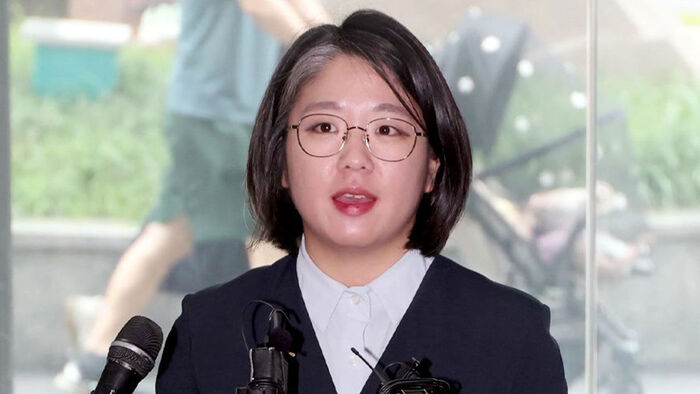
Why Do Proportional Representation Lawmakers Resign 100% of the Time?
Article 43 of the Constitution and Article 29 of the National Assembly Act state that "Members of the National Assembly may not hold any other post concurrently, except for the Prime Minister or a member of the State Council." In principle, lawmakers cannot hold public office concurrently. However, an explicit exception was made for the Prime Minister and State Council ministers. This is because South Korea's Constitution incorporates parliamentary cabinet system elements into its presidential structure. Conversely, under the same legal provisions, a lawmaker must resign if taking up a post in the presidential office. Legally, while lawmakers are permitted to concurrently hold ministerial posts, it remains an exception. Former Prime Minister Kim Min-seok and former Justice Minister Jeong Seong-hoon returned to their legislative duties without issue after stepping down from their executive posts.
However, convention dictates a completely different path for proportional representation lawmakers. Conventionally, 100% of proportional lawmakers appointed to cabinet positions have resigned their legislative seats. Constituency lawmakers strongly embody the role of "an individual directly chosen by local voters." If they resign, a direct vacuum occurs in representing their constituents. Until a by-election is held, that constituency loses its political representative and spokesperson. In contrast, proportional representation seats are allocated based on party vote share, policy focus, and professional expertise. When a proportional lawmaker moves to the executive branch, the next candidate on the party list succeeds the seat to maintain functional representation, leaving no legislative vacuum. For this reason, applying the concurrent holding exception to proportional lawmakers is widely considered unnecessary.
Demanding Privilege on Top of Privilege?
Public reaction has grown even sharper regarding her plea to accommodate the circumstances of the Basic Income Party, which holds just one parliamentary seat. Critics point out an original sin in Yong's political trajectory. They recall how, in both the 21st and 22nd general elections, she entered parliament by using the satellite proportional party platforms of major parties before returning to the Basic Income Party through nominal "expulsions." Critics note that while she rode the votes of major parties to secure a seat, she now rejects convention during cabinet nominations by citing "the sorrow of a minor party struggling to survive." Observers also point out that entering parliament through such unconventional methods is why her seat, upon resignation, would pass not to a member of her own party, but to the next candidate on the Democratic Party of Korea's recommended list. Having effectively received an extraordinary form of political privilege twice just to enter parliament, she is now facing sharp criticism for demanding yet another privilege upon being nominated as minister.
Expertise in Gender Equality and Family Affairs? Questionable
As a lawmaker, nominee Yong has sponsored or co-sponsored several bills related to the Ministry of Gender Equality and Family. A prime example is the Living Partnership Act. This bill proposes granting certain legal rights traditionally given to married couples to any two cohabiting adults who commit to mutual support and care, regardless of blood relation or marriage. In addition, she introduced legislation to ban "no-kids zones" and eliminate discrimination against children, sponsored a bill permitting children inside the National Assembly chamber, and actively participated in promoting comprehensive anti-discrimination legislation spanning gender, disability, and sexual orientation, as well as introducing non-consensual sexual intercourse clauses to broaden the scope of rape offenses. However, women's organizations argue that it is difficult to find clear legislative records or defined stances from her regarding the ministry's core traditional responsibilities, such as the gender wage gap, support for career-interrupted women, childcare and caregiving infrastructure development, and youth protection administration. They assess that her legislative track record in overseeing and advancing structural policies tied to large-scale administrative execution is relatively sparse.

Is Being a 30-Something Woman From a Minor Party Enough?
Nominee Yong embodies all the symbolic traits of youth, female representation, and minor-party politics. This was likely one of the central reasons the current administration took notice of her. However, analysis suggests that the critical reception from these very groups stems from structural fatigue caused by the "overrepresentation of identity" combined with a disconnect in her political trajectory.
She entered the National Assembly twice by taking advantage of election law loopholes. Even that process represented a deficiency in fairness. Yet rather than reflecting on this, she is seen as converting it into an entrenched privilege while seeking to add a ministerial post. What younger generations expect from youth politics is genuine reform that breaks with established norms. In contrast, the youth's verdict is that while Yong may be in her 30s in age, she has only provoked feelings of betrayal and fatigue by replicating the power-calculating playbooks of established politicians.
Women's advocacy circles are also skeptical about nominee Yong's "lack of expertise" and role as a "political subcontractor." This is the core reason several women's organizations, including the Korea Women's Political Network, pushed back immediately after her nomination, calling it "an unqualified, politically engineered reshuffle." They evaluate that her legislative activities have focused primarily on finance, taxation, and government-targeting clashes within the Public Administration and Security Committee, failing to demonstrate deep insight into gender equality, family welfare, caregiving, and labor disparities. The women's sector protests that she is merely being utilized as a symbolic trophy for a sensational cabinet reshuffle under the banner of a "working mother in her 30s."
The justification minor parties use to appeal to voters is clarity and independence against the collusion of the two dominant parties. However, Yong has faced criticism for securing her badge through proportional alliances with a major party and serving essentially as a front-line megaphone for the Democratic Party mainstream. This explains why the Justice Party, another minor party, has raised some of the sharpest voices against her.
What Kind of Narrative Truly Inspires the Youth?
Recently, a small-agency idol group named RESCENE has been enjoying sensational popularity. While various analyses have been offered, they all converge on one point: "Even when no one noticed, they quietly gave their absolute best." For nearly three years following their debut, there was neither widespread acclaim nor popularity. Even so, the members tirelessly produced content, explored diverse avenues to introduce themselves, and honed their skills—without shortcuts or backroom deals. Then, as the "Geoje Yaho" meme went viral, the spotlight finally shone on all their hard work, propelling them almost overnight into a nationally recognized idol group. This is precisely the kind of narrative that today's youth yearn for and find hope in. Nominee Yong must ask herself whether she can deliver that kind of genuine inspiration to the public, or at least to the nation's youth.
