SBS News
VANK: Spanish Textbooks Advance Japan's Colonial Rule of Korea by 15 Years
Published : Sep 2, 2026 11:36 AM

▲ The Vicens Vives history textbook, which claims that "Japanese forces occupied the Korean Peninsula from 1875 to 1895."
Some Spanish history and geography textbooks have been found to advance the timeline of Japan's colonial rule over the Korean Peninsula by at least 15 years, or to focus disproportionately on colonial domination and the Korean War when covering Korean history.
VANK, a cyber diplomatic mission, announced today (September 2) that it analyzed seven middle and high school textbooks published by five major Spanish textbook publishers, identified errors and biased descriptions regarding South Korea, and sent analysis reports and correction letters to the publishers.
The subjects of the analysis include history and geography textbooks from Santillana, Anaya, Vicens Vives, Akal, and Casals.
This marks the first time VANK has analyzed references to South Korea in Spanish-language textbooks.
World history textbooks for high schools published by Anaya and Vicens Vives state that "Japanese military forces occupied the entire Korean Peninsula from 1875 to 1895."
However, Japan stripped Korea of its diplomatic sovereignty through the Eulsa Treaty in 1905, and formal annexation took place in 1910.
VANK pointed out that according to these textbooks, the period during which the Korean Empire existed is erased, and the timing of Korea's loss of sovereignty is brought forward by at least 15 years.
The Akal textbook describes the 1895 Treaty of Shimonoseki as an agreement that solidified Japan's rule over Joseon.
However, VANK explained that this treaty actually made Qing China recognize Joseon's complete independence and autonomy, with no clauses recognizing Japanese dominance over Joseon.
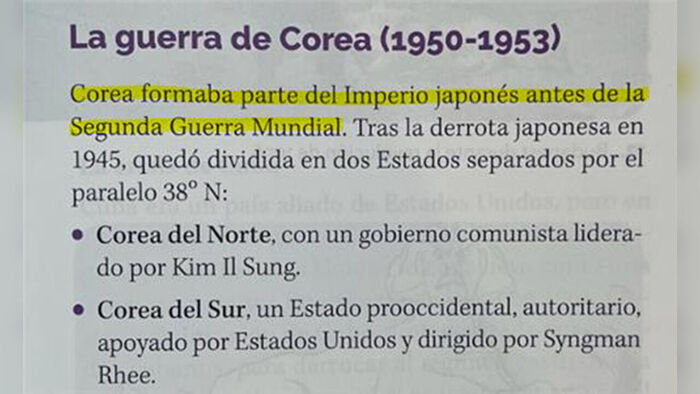 The Santillana textbook includes the expression, "Korea was part of the Japanese Empire before World War II."
VANK noted that this phrasing fails to properly reflect the coercive nature of the 1910 annexation and colonial rule, as well as Korean resistance such as the Righteous Army uprisings and the March First Movement.
The Korean War was also described primarily around the intervention of external actors such as the United States, the Soviet Union, China, and the United Nations, leaving insufficient coverage of the South Korean military's role and the suffering endured by Korean society.
Furthermore, the year 1948, when separate governments were established in South and North Korea, was largely omitted from the main texts concerning Korea.
That said, some textbooks accurately distinguished between the 1905 Eulsa Treaty and the 1910 annexation, and correctly specified 1948 as the year the South and North Korean governments were established.
Most maps adopted the concurrent use of the names Sea of Japan and East Sea.
VANK reported that Vicens Vives responded by stating that it had "shared the information with the editorial team and will review and consider incorporating it into future print runs."
Park Ki-tae, head of VANK, stated, "We will expand our analysis and correction efforts to ensure that Korean history is communicated accurately and in a balanced manner across more language spheres."
(Photo courtesy of VANK, Yonhap News)
※ Please note: This article was translated by AI and may contain errors.
Copyright Ⓒ SBS. All rights reserved. Unauthorized reproduction, redistribution, and use for AI training are prohibited.