SBS News
Push to Extend Lower-Grade Elementary School Dismissal to 3 PM Met With Backlash
Published : Sep 1, 2026 1:52 PM

▲ A first-grade classroom at an elementary school in Incheon
As the Presidential National Education Commission is reportedly considering extending school hours for lower-grade elementary students, teachers' unions are pushing back, arguing that the move shifts childcare responsibilities onto schools.
The commission is scheduled to gather opinions soon on a plan to expand educational hours, which would push the dismissal time for first and second graders from around 1 PM to 3 PM.
The expansion of school hours for young elementary students was previously pursued by the Presidential Committee on Aging Society and Population Policy in 2018, but fell through after sparking controversy.
The Elementary School Teachers' Union remarked today (Sept. 1) regarding the extension of lower-grade dismissal times, "Whether to expand educational hours should be carefully reviewed based on classes and breaks suited to the developmental stages of young children, rather than focusing on how long they should be kept at school."
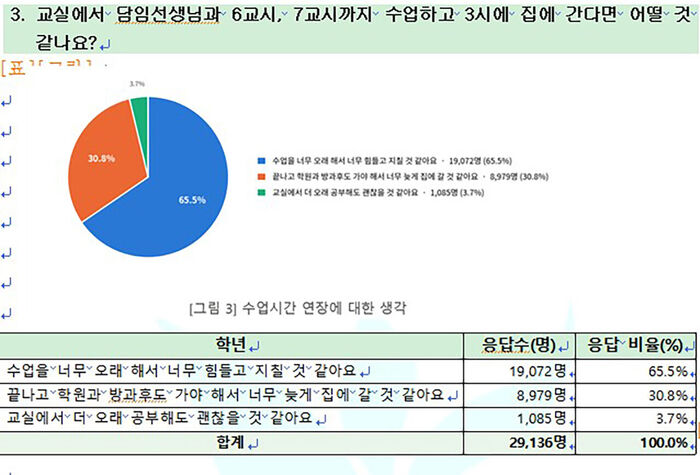
The union also released the results of a survey showing that a significant majority of lower-grade elementary students are negative about extending dismissal times.
On August 26 and 27, first and second-grade students across the country were asked, "How would you feel if you had classes with your homeroom teacher until the 6th or 7th period and went home at 3 PM?"
65.5% of responding students answered, "I think I would be too exhausted and tired because classes would be too long."
Only 3.7% responded that "it would be fine to study more in the classroom."
A total of 29,136 students participated in this survey, including 12,024 first graders and 17,112 second graders from 17 provincial and metropolitan regions nationwide.
Kang Seok-jo, President of the Elementary School Teachers' Union, said, "First and second-grade students want to play and spend time with their families after school ends," adding, "The National Education Commission must seriously weigh concerns regarding the developmental traits of young students and student fatigue in future discussion processes."
The Busan Teachers' Union also issued a statement yesterday (Aug. 31), criticizing that "keeping lower-grade elementary students tied to schools under the guise of an 'educational curriculum' is practically tantamount to state-level child abuse," and asserting, "This discussion was not initiated out of educational necessity for student growth, but merely out of administrative necessity to fill childcare gaps."
The union added, "The fundamental solution to childcare gaps is to create an environment where parents can directly raise their children," and noted, "Although businesses and society need to find common ground for this, the government is shifting the responsibility unilaterally onto schools while ignoring the core issue."
Within the education community, there are also deep concerns that extending dismissal times for first and second graders is unreasonable when school conditions, such as hiring additional teachers, are not properly established.
Jang Seung-hyok, a spokesperson for the Korean Federation of Teachers' Associations, pointed out, "Because the 3 PM dismissal system for lower elementary grades involves completely reorganizing the curriculum, it must be accompanied by large-scale teacher recruitment," and criticized, "While the government is introducing plans to cut local education finances, it has failed to present any blueprint on how it will create the conditions necessary for expanding regular school hours."
Last month, as the government decided to change the local education subsidy system from an automatic allocation method of 20.79% of domestic tax to a formula reflecting economic growth rates and changes in the school-age population, concerns were raised within the education community that investments in elementary, middle, and high schools could shrink.
(Photo provided by the Elementary School Teachers' Union, Yonhap News)
※ Please note: This article was translated by AI and may contain errors.
Copyright Ⓒ SBS. All rights reserved. Unauthorized reproduction, redistribution, and use for AI training are prohibited.