SBS News
BOK: Semiconductor Bonuses Drive Home Purchases in Dongtan and Purchases of Teslas
Published : Aug 31, 2026 12:35 PM

▲ Samsung Electronics / SK Hynix
The Bank of Korea (BOK) projected today (August 31) that increased consumption resulting from expanded performance bonuses at Samsung Electronics and SK Hynix could boost next year's real gross domestic product (GDP) growth rate by nearly 0.1 percentage points.
In a report released today titled "How Will Consumption Be Affected in Semiconductor Beneficiary Regions?", the BOK stated that the semiconductor industry boom is already having a meaningful positive impact on domestic consumption, and that the ripple effect through consumption channels will expand further as bonus payments increase in scale.
To determine whether consumption is actually increasing due to the semiconductor boom, the BOK analyzed card spending in so-called "semiconductor beneficiary regions," including Giheung-gu in Yongin, Hwaseong, and Pyeongtaek in Gyeonggi Province—where Samsung Electronics operates—as well as Icheon in Gyeonggi Province and Heungdeok-gu in Cheongju, North Chungcheong Province, home to SK Hynix.
As a result, monthly consumption in these regions following the payout of performance bonuses in January of last year is estimated to have been up to about 4% higher than in other areas.
The cumulative increase in consumption from last year through June of this year was approximately 1.1 trillion won, and if the current trend continues, it is expected to reach about 1.7 trillion won by the end of this year.
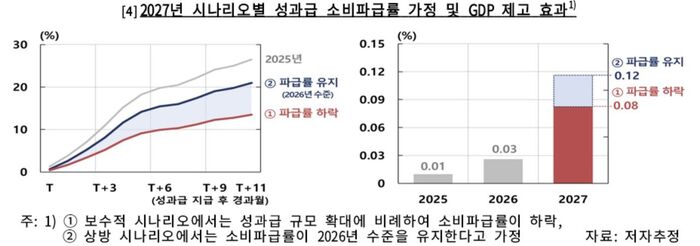
This increase in consumption was calculated to have raised GDP by 0.01% last year and 0.03% this year compared to what it would have been without the semiconductor boom.
Furthermore, considering that the scale of performance bonus payments at Samsung Electronics and SK Hynix is expected to expand significantly next year, the BOK analyzed that GDP will increase by 0.08% to 0.12%, which in turn will raise the GDP growth rate by an additional 0.06 to 0.09 percentage points.
The BOK reflected this analysis in its revised economic outlook released on the 27th, upgrading this year's and next year's growth rate projections to 3.3% and 2.9%, respectively.
The BOK explained that the magnitude of the consumption ripple effect from future semiconductor booms may vary depending on factors such as whether employment increases concurrently, the degree to which additional income flows into consumption rather than asset markets, and the extent to which consumer goods categories diversify.
In particular, the central bank noted that the effect of increased consumption was greater when a smaller proportion of performance bonuses was used to purchase housing.
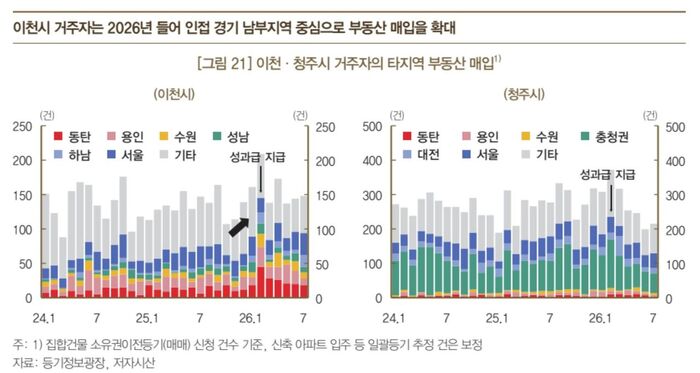
Comparing Icheon and Cheongju—where SK Hynix facilities are located—the increase in consumption following bonus payouts was more pronounced in Cheongju, where a higher proportion of additional income flowed into consumption rather than the housing market.
Existing residents of Icheon significantly increased their real estate purchases in areas such as Dongtan, Yongin, Suwon, Seongnam, and Hanam after receiving performance bonuses.
On the other hand, residents of Cheongju largely remained within the Daejeon and Chungcheong regions.
Lee Jae-ho, deputy director of the BOK's macroeconomic forecasting team, stated, "It is estimated that because Icheon is closer to the greater Seoul area than Cheongju and allows for commuting from the capital area, purchases of related housing were substantial."
He also emphasized, "Conditions must be fostered so that increased income can be smoothly channeled back into consumption and the real economy rather than asset markets."
Additionally, looking at past cases in industries such as shipbuilding, steel, automobiles, and chemicals, the ripple effect on consumption was shown to be greater when total wages increased through employment expansion rather than through rising wages per worker for existing employees.
To date, the increase in consumption in semiconductor beneficiary regions has been concentrated on high-priced discretionary goods such as automobiles and department store items.
For example, the average monthly growth rate of Tesla vehicle deliveries in these regions from January to June of this year reached 105.6% year-on-year, significantly outpacing the national average (77.2%).
However, the BOK's outlook suggests that if consumption diffuses with a time lag into services and other diverse categories, the virtuous cycle of "income leading to consumption, which in other words generates further income" can gradually strengthen.
(Photo: Bank of Korea, Yonhap News)
※ Please note: This article was translated by AI and may contain errors.
Copyright Ⓒ SBS. All rights reserved. Unauthorized reproduction, redistribution, and use for AI training are prohibited.