SBS News
Seoul Apartment Completions Drop by Nearly Half Through July This Year
Published : Aug 31, 2026 9:45 AM

However, housing construction starts in Seoul—a leading indicator of future housing supply—increased by 36%, signaling potential improvements in future supply conditions.
According to housing statistics for July released by the Ministry of Land, Infrastructure and Transport on the 31st, the number of completed housing units in Seoul totaled 20,916 from January to July this year, representing a 43.3% decrease from 36,904 units during the same period last year.
Among them, completed apartments stood at 17,603 units, down 48.7% from 34,339 units in the same period last year.
For the month of July alone, completed housing units in Seoul reached 5,756, up 8.9% from 5,286 units in the same month last year.
This marks a 180.9% increase compared to the previous month (2,049 units).
Completed apartments in Seoul also rose to 5,352 units, representing an 8.8% increase from 4,919 units in the same month last year and a 242.9% surge from 1,561 units the previous month.
Nationwide, the downward trend in cumulative completions continued.
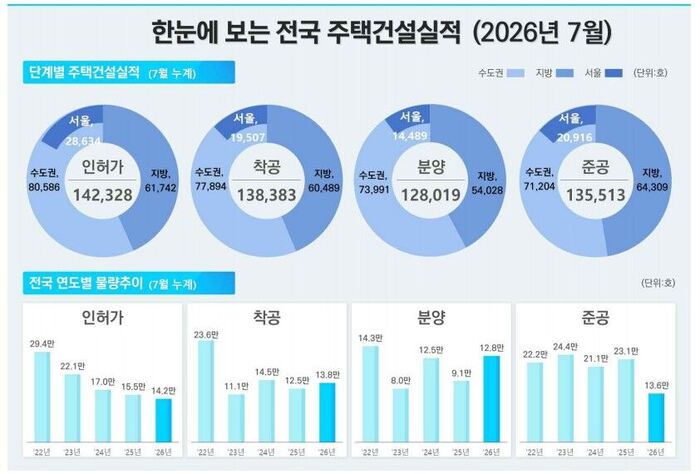
From January to July, nationwide housing completions totaled 135,513 units, down 41.4% from 231,172 units during the same period last year.
Completed apartments decreased by 44.2% to 119,682 units, while non-apartment completions fell by 5.9% to 15,831 units.
On the other hand, housing starts showed an upward trend.
Nationwide housing starts from January to July rose 11.1% to 138,383 units compared to 124,547 units in the same period last year.
Starts increased by 2.0% in the Seoul metropolitan area to 77,894 units and by 25.5% in regional areas to 60,489 units.
Housing starts in Seoul climbed 44.4% to 19,507 units.
Apartment starts in Seoul increased by 36.1% compared to the same period last year, reaching 14,995 units.
In particular, housing starts in Seoul for July alone surged 894.7% to 6,386 units from 642 units in the same month last year.
Apartment starts in Seoul skyrocketed to 5,574 units, roughly 20 times the 278 units recorded in July of last year.
Nationwide apartment sales (pre-sales) from January to July totaled 128,019 units, up 41.1% from 90,717 units during the same period last year.
Pre-sales in Seoul jumped 109.7% to 14,489 units.
However, nationwide pre-sales for July dropped 17.5% from the previous month (22,838 units) to 18,833 units, while pre-sales in Seoul plummeted 70.1% from the previous month (2,396 units) to 716 units.
Building permits saw a sharp increase in July, but the cumulative figures continued to decline.
Nationwide housing building permits in July stood at 25,717 units, up 43.5% from the previous month (17,917 units) and 59.6% from the same month last year (16,115 units).
Building permits in Seoul reached 7,979 units, representing a 95.1% increase from 4,089 units in the same month last year.
Consequently, cumulative building permits in Seoul from January to July rose 6.1% compared to the same period last year to 28,634 units.
Conversely, nationwide building permits over the same period fell 7.9% to 142,328 units.
Housing home sales transactions decreased.
The nationwide housing transaction volume in July was 63,185, down 8.2% from the previous month (68,819) and 1.6% from the same month last year (64,235).
Transactions in the Seoul metropolitan area decreased by 11.1% from the previous month to 34,749.
Apartment transaction volume in Seoul stood at 6,564, down 15.2% from the previous month (7,742) and 22.6% compared to the same month last year (8,485).
Nationwide jeonse and wolse (lease and monthly rent) transactions in July totaled 210,985, declining 3.5% from the previous month (218,618) and 13.5% from the same month last year (243,983).
Jeonse transactions decreased by 4.0% from the previous month and 22.3% from the same month last year to 68,462.
Wolse transactions fell 3.3% from the previous month and 8.6% from the same month last year to 142,523.
The cumulative proportion of wolse transactions from January to July reached 68.3%, up 6.5 percentage points from the same period last year.
In Seoul, the proportion of wolse transactions stood at 69.7%.
At the end of July, unsold housing units nationwide stood at 68,217, marking a 1.1% increase from the previous month.
Unsold housing in the Seoul metropolitan area rose 3.7% to 19,459 units, while regional unsold housing grew 0.1% to 48,758 units.
On the other hand, post-completion unsold housing, often referred to as " toxic unsold units," decreased by 2.1% from the previous month to 29,152 units.
Post-completion unsold units in the Seoul metropolitan area dropped 5.3% from the previous month to 4,444, while regional units fell 1.5% to 24,708.
Approximately 85% of all post-completion unsold properties are concentrated in regional areas.
By region, Daegu recorded the highest number at 3,481 units, followed by Busan (3,253), Gyeongnam (3,151), Gyeongbuk (2,970), Jeonnam and Gwangju (2,422), Jeju (2,364), and Chungnam (2,336).
While post-completion unsold housing decreased in most regions, it increased in Jeonnam and Gwangju by 149 units (6.6%) and in Jeju by 25 units (1.1%) from the previous month.
Seoul and Sejong maintained the same levels as the previous month.
(Photo: Yonhap News)
※ Please note: This article was translated by AI and may contain errors.
Copyright Ⓒ SBS. All rights reserved. Unauthorized reproduction, redistribution, and use for AI training are prohibited.