SBS News
The Neighborhood School Everyone Else Attends, But My Child Cannot Go
Published : Aug 22, 2026 4:40 PM
News Story 'Their Own Admissions War: Moving Three Times for Special Schools' Reporter's Notebook Part 2

A few years have passed, and Jun-seo, now preparing to enter elementary school next year, is knocking on the school's door once again. This elementary school has one special education class. The statutory class size limit for elementary special classes is six students per class. However, the current enrollment in this school's special class is seven students, meaning it is an overcrowded class exceeding the statutory limit. Even so, when submitting the application in June, Jun-seo's parents chose this school as their first choice. For working parents of a child with a disability, a "neighborhood school with a special class" was a hope they could not give up.
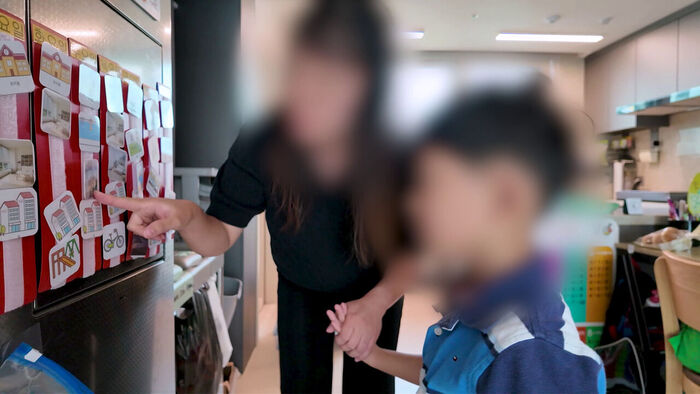
"A school right in front of home, whether it has a special class or regular class, is so great from a parent's perspective. If anything happens, you can run over right away. It also eases worries about commuting to school. Any parent would want to send their child to a nearby school. I knew (the neighborhood school) was at full capacity. But this school accommodates teaching assistants so they can even enter the classroom. Not every school does that, and many schools dislike it. Since that was such a huge advantage, I listed this school as our first choice, hoping for a miracle." (Jun-seo's mother)
However, a "miracle" is unlikely to happen. Aside from being an overcrowded class that already exceeds statutory limits, this school's special class has no sixth graders graduating this year. In other words, unless someone from another grade transfers out to create a vacancy or the school adds another special class, accepting a new special education student this year is practically impossible. Jun-seo's parents are well aware of this reality.
"For our second choice, we wrote down the school where his current kindergarten is located, but that requires a 20- to 30-minute drive. Right now, my husband is on parental leave and provides rides, but starting next year, that will be impossible. For us, the second, third, and fourth choices were virtually meaningless. We never imagined that sending our child to the school right across the street would be this difficult."
Are Special Classes in General Schools Better Off? What an Information Disclosure Request Revealed
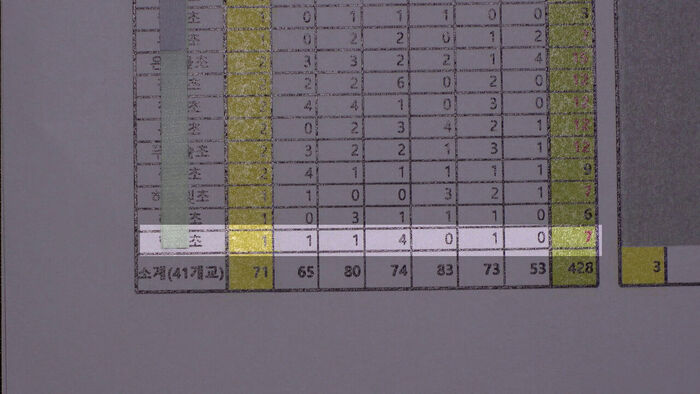
SBS filed an information disclosure request with 10 local education offices under the Seoul Metropolitan Office of Education regarding the status of elementary school special classes in their jurisdictions (as of July 1). There are 609 elementary schools in Seoul. Among them, 448 schools, or about 70%, have special classes installed. The total number of classes stands at 815, with 3,982 enrolled students. The average number of students per class is about 4.9, which falls below the statutory limit of six. Was the concern over overcrowded special classes an unnecessary worry?
"Averages" always hold a trap. Analyzing the data by district clearly reveals the reality. The district with the highest rate of overcrowded special classes in Seoul is the Seongdong-Gwangjin area. Out of 36 schools, special classes in 15 schools exceeded their capacity. The overcrowding rate exceeding capacity reached 41.7%. Elementary School A had 19 students across two special classes, far exceeding the quota of 12, and Elementary School B also had 10 students in one class (quota of 6). (For reference, there is only one special education school in the Seongdong-Gwangjin area.)
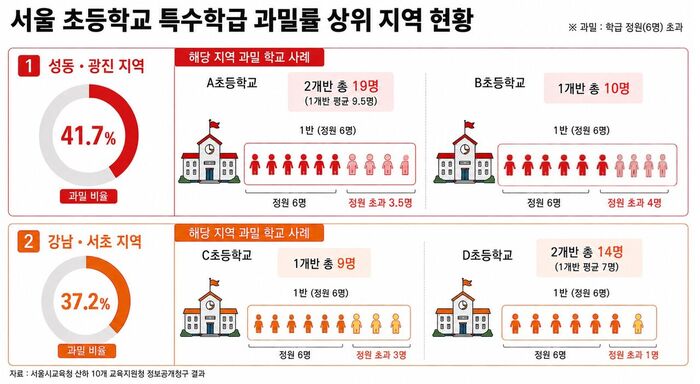
The next most congested area is the Gangnam-Seocho district. Out of 43 schools with special classes, 16 were overcrowded, representing a rate of 37.2%. Elementary School C had nine students in one class (quota of six), and Elementary School D had 14 students in two classes (quota of 12). In the case of Elementary School D, discussions have been ongoing for years regarding a merger with nearby Elementary School E due to declining student enrollment. An ironic situation is unfolding in the heart of Gangnam, where total student numbers are falling to the point of considering school closures, yet special classes remain overcrowded.
Parents note that special classes also gain reputation by word of mouth. One parent who sends a child to a special class at an elementary school in the Seocho area said they moved from Yangcheon District after learning that this school operated two separate special classes for lower and upper grades, unlike other neighboring schools. "Popular special classes draw even more applicants. I've even seen parents move to follow specific teachers who transferred elsewhere."
Is the Overcrowding Rate of Special Classes Decreasing? The 'Unassigned Rate' Must Be Considered
An official from an education office in Incheon said: "Currently, the total number of special education recipients is growing, but looking solely at elementary schools, it has begun to decrease slowly. We consider it to have entered an overall downward trend. In five to six years, it will likely decline substantially. As birth rates fall, the occurrence rate of children with disabilities drops as well. When elementary student numbers drop, middle schoolers will decrease down the road too, right? Overcrowding is prevalent right now, but we expect overcrowded spots to gradually decline." According to the Ministry of Education, the proportion of overcrowded special classes exceeding capacity fell from 10.1% (1,882 classes) in 2024 to 3.8% (742 classes) in 2025. As noted by education office officials, the decrease in overcrowded special classes stems partly from population decline and partly from special class availability gradually expanding. When opening additional classes is difficult, assigning two homeroom teachers to a single class is also used to relieve immediate overcrowding.
However, an important factor is being overlooked. Professor Kim Ki-ryong of Joongbu University, who attended a forum titled "Lost Special Education: Finding the Path on the Ground" hosted by the Special Education Teachers' Union at the National Assembly on August 11, pointed out that attention must be paid to the increasing "unassigned rate." According to Professor Kim, while special education applicants grew from 40,203 in 2021 to 51,896 in 2025, the placement rate of students assigned to their requested schools dropped from 93.8% to 87.5% over the past five years. Elementary schools recorded the lowest placement rate at 84%. Even in 2025, when overcrowding dropped significantly, 6,605 students could not attend their desired schools.
"This does not mean these students received no special education at all, but rather that they had to accept placements away from where they lived or away from their preferred schools. From the perspective that inclusive education should take place within local communities, this represents a distinct failure. (Omitted) Just because overcrowding metrics have improved does not mean conditions have gotten better by the same degree. Overcrowding indicators from education authorities merely show how concentrated students are; they do not measure how much work teachers shoulder or whether students are being educated where they want." (Kim Ki-ryong, Professor at Joongbu University)
At the forum, Professor Kim also proposed that the law mandate education authorities to publicly disclose not only student-to-class ratios, but also application-to-placement rates and the student-to-teacher ratio per instructor.
Is There Any Other Admissions Process as Opaque as This?
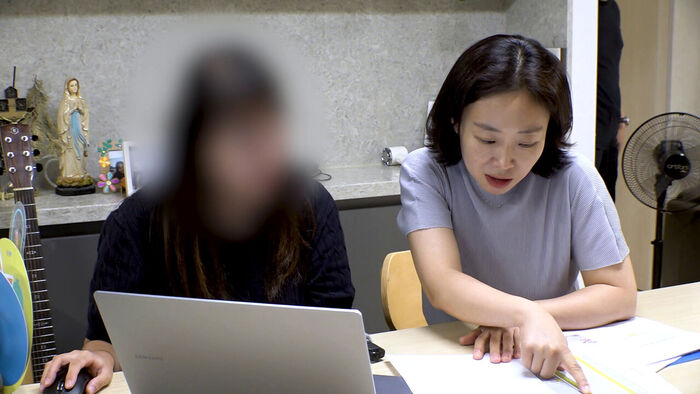
The selection of special education recipients and their assignment to special schools and special classes are decided up to middle school through reviews by Special Education Steering Committees under local Special Education Support Centers (high school assignments are handled by respective provincial or metropolitan offices of education). However, significant regional disparities in operation methods and screening criteria have long been flagged as an issue. Parents argued it is unreasonable that children with identical levels of disability are accepted or rejected depending on where they live or when they apply.
During reporting, it was confirmed that the National Institute of Special Education recognized these problems, conducted a research study last year, created a manual for selecting and placing special education recipients, distributed it to Special Education Support Centers nationwide, and conducted training for related personnel. It was also found that parts of this manual are publicly available on the National Institute of Special Education website. The reporter obtained and reviewed the entire 110-page manual. How binding is this manual? An official from the National Institute of Special Education stated, "Although we distributed the manual, each region faces different circumstances, so it is difficult to demand unconditional compliance. Ultimately, decisions rest with each local office of education."
Will Jun-seo Be Able to Attend the Neighborhood School Next Year?
Watching Jun-seo's parents try their best to smile left an aching pain in the heart.
References: Ministry of Education Special Education Statistics (2025)
Discussion Forum Sourcebook: 'Lost Special Education: Finding the Path on the Ground' (August 11, 2026)
▶ Related Article: [News Story] Their Own Admissions War: 'Moving Three Times for Special Schools'
▶ Related Article: [Reporter's Notebook] From Fake Residency to Sham Divorces... The 'Cruel Reality' Behind the 'Special School Admissions War'
※ Please note: This article was translated by AI and may contain errors.
Copyright Ⓒ SBS. All rights reserved. Unauthorized reproduction, redistribution, and use for AI training are prohibited.