SBS News
Jeonse Contracts Without Risk of Deposit Loss Coming... 'Safe Trust' to Be Introduced
Published : Aug 20, 2026 11:20 AM

▲ Choi In-ho, president of the Korea Housing & Urban Guarantee Corporation (HUG), explains details during a press conference on the 'Jeonse and Monthly Rent Safe Trust' held via the HUG Jeonse and Monthly Rent Stabilization Organization at HUG's Seoul Western Branch in Yeouido, Seoul, on the 20th.
A new type of Jeonse (lump-sum deposit-based lease) contract is being introduced, lowering the risk of unreturned deposits by allowing tenants to deposit their Jeonse security deposits with a public institution instead of handing them directly to landlords.
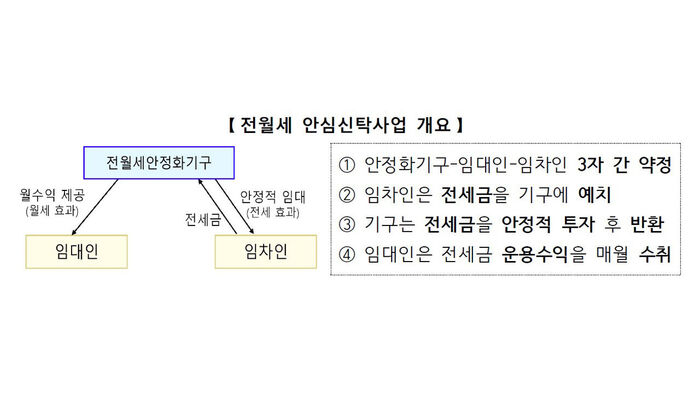
Instead of receiving the deposit directly, landlords will receive monthly returns generated by the public institution's management of the funds, much like monthly rent.
The Ministry of Land, Infrastructure and Transport announced today (the 20th) that, as a follow-up measure to the "Housing Rapid Supply Plan" announced on the 13th, the Korea Housing & Urban Guarantee Corporation (HUG) will pursue the "Jeonse and Monthly Rent Safe Trust" project, which handles the deposit custody, management, and return.
Under the Safe Trust system, HUG, the landlord, and the tenant enter into a three-way contract, with the tenant depositing the Jeonse money into HUG.
HUG manages the Jeonse deposit to pay the landlord a return equivalent to monthly rent, and directly returns the deposit to the tenant upon the expiration of the lease agreement.
Unlike conventional Jeonse contracts where landlords hold the deposit, tenants can avoid the risk of not getting their deposits back due to the landlord's financial circumstances.
The burden of guarantee fees is also reduced as there is no need to subscribe to separate Jeonse deposit return guarantees and Jeonse loan guarantees.
 The initiative also aims to lower tenants' housing costs by converting monthly rent properties into Jeonse.
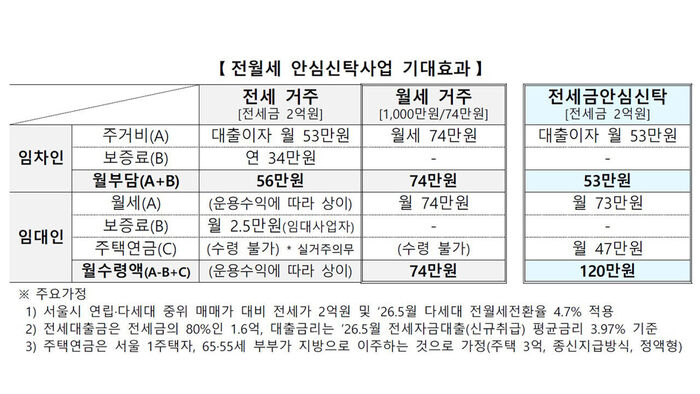
Citing the example of a Seoul row or multi-family house with a market value of 300 million won and a Jeonse deposit of 200 million won, the government estimated that if a tenant who previously paid a 10 million won deposit and 740,000 won in monthly rent uses the Safe Trust to live under a Jeonse arrangement instead of monthly rent, their monthly housing costs will drop to around 530,000 won, a reduction of about 200,000 won.
This is based on the assumption that 160 million won, which is 80% of the Jeonse deposit, is borrowed at an annual interest rate of 3.97%.
In addition, about 340,000 won in annual guarantee fees can be saved.
Landlords can receive steady returns without the risk of rent arrears or vacancies.
HUG plans to create a housing supply activation fund based on the deposited Jeonse funds, invest in HUG-guaranteed project financing (PF) loans, and generate annual interest returns in the 4% range to pay landlords every month.
Even if investment losses occur, the tenant's Jeonse deposit will be fully guaranteed, and the agreed monthly returns will be paid normally to the landlord.
If registered rental businesses participate in the project, the obligation to subscribe to rental deposit return guarantees will be exempted, easing the burden of guarantee fees.
To encourage landlord participation, the government is also pushing for tax support on income earned through the Safe Trust.
In particular, the government plans to allow participating landlords who move from regulated areas such as Seoul to regional areas to receive housing pensions.
In addition to the monthly rental income in the 4% annual range through the Safe Trust, they can additionally receive a housing pension at an annual level of 1% to 3%.
Through this, the government aims to convert housing owned by the elderly population in the capital area into Jeonse supplies while encouraging regional relocation and securing retirement income.
 The project will operate on a voluntary application basis for landlords and tenants who wish to participate, without income or asset restrictions.
While there are no specific restrictions on housing types and regions, the project will be preferentially implemented for homes with a market price of 2 billion won or less.
Checks will be conducted in advance on whether a building is unauthorized or if the Jeonse deposit is excessive relative to market value.
Participation in the project requires depositing the full amount of the security deposit with HUG.
Consequently, the government believes that the incentive for landlords to use Jeonse deposits for purchasing houses, known as "gap investment," or to invest in high-yield risky assets will not be significant.
The government plans to issue a project public notice at the end of September, accept applications starting in October, conclude three-way contracts from November, and sequentially support move-ins starting at the end of the year.
This year, 500 households of LH purchased rental housing will also be supplied on a pilot basis via the Safe Trust method.
Kim I-tak, 1st Vice Minister of Land, Infrastructure and Transport, said, "Going forward, through the Jeonse and monthly rent stabilization organization, tenants will be able to shed the risk of deposit returns and landlords the burden of rent arrears, allowing them to safely conclude lease contracts."
(Photo provided by Ministry of Land, Infrastructure and Transport, Yonhap News)
※ Please note: This article was translated by AI and may contain errors.
Copyright Ⓒ SBS. All rights reserved. Unauthorized reproduction, redistribution, and use for AI training are prohibited.