SBS News
Indian Gen Z Women Face Online Harassment and Slurs After Joining 'Cockroach Party' Protests
Published : Aug 19, 2026 2:09 PM
"They're trying to demonize me," says actor targeted online for her posture during protests against medical exam leaks.

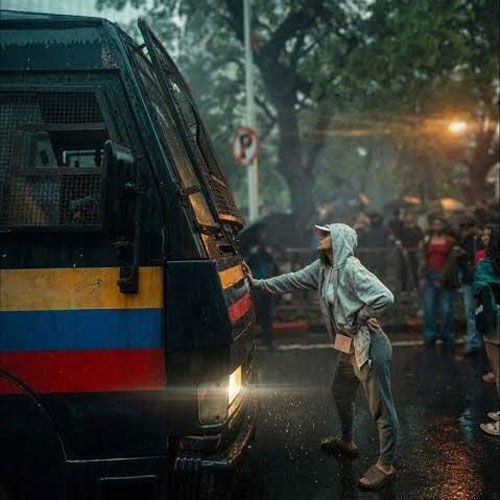
▲ Riya Ahir blocking a police bus carrying detained protesters with one hand (Photo: X)
Young Indian women participating in large-scale protests organized by Gen Z (born 1995–2007) online groups against unfairness, recently triggered by a medical school entrance exam question leak scandal, are facing cyberbullying and sexual harassment online.
According to the U.S. daily The New York Times (NYT) on the 19th (local time), Riya Ahir, a 27-year-old model and actor based in Mumbai, western India, drew widespread attention after joining a massive protest last month held by the Cockroach People's Party (CJP), a Gen Z political movement group.
Her photo went viral online showing her defiantly blocking a police bus carrying detained protesters with a single hand.
However, Ahir was subsequently criticized online for her outfit and posture at the time, with trolls accusing her of "flaunting her body" because her hips were pushed slightly backward.
False rumors were also spread claiming she sold adult content on the social media platform Instagram for 149 rupees (approximately 2,200 won).
The NYT reported that these acts were carried out by anonymous accounts promoting Hindu nationalist ideologies.
Ahir told the NYT, "Shortly after receiving unexpected attention, the hatred started pouring in," pointing out that "they are trying to demonize me and undermine the credibility of the women who participated in the protests."
Not only the Indian women participating in the protests, but even their families have faced intimidation from local police officers.
Indian police officers visited the home of Danish Ali’s relatives—a student activist attending graduate school in Delhi—to say they were "investigating," and called his father to intimidate him by saying his daughter "should focus on her studies."
Recently, Kangana Ranaut, a lawmaker belonging to the Hindu nationalist Bharatiya Janata Party (BJP) led by Indian Prime Minister Narendra Modi, also joined in criticizing so-called Westernized young Indian women.
She labeled young Indian women as a "gutter generation," criticizing that they "have nothing to contribute to society and are unfit to even become housewives."
Previously, Prime Minister Modi also mentioned the profanities used by female protesters, stating, "How can the daughters of this country use such language?" and calling it a "cultural shock," while remaining silent about the young men who chanted slogans alongside them.
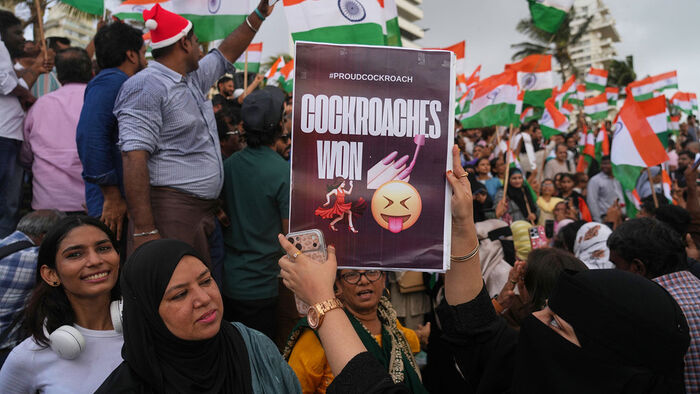
Critics point out that the reason attacks are specifically targeting female Gen Z protesters stems from deeply rooted misogyny in Indian society.
The NYT noted that this represents an additional risk that women striving to uphold their convictions must endure in a patriarchal Indian society.
Ahir asked rhetorically, "Do I need to be afraid of someone who says, 'I will tear you to pieces if I see you'?" adding, "If I want to raise my voice for my country, do I really have to wear a sari?"
The CJP was formed following controversial remarks made last May by Indian Supreme Court Justice Surya Kant, who compared unemployed youths to cockroaches.
Amid suspicions of a question leak surrounding the National Eligibility cum Entrance Test (NEET) for undergraduate medical courses, the CJP led protests in the capital of New Delhi for nearly two months, eventually forcing Education Minister Dharmendra Pradhan to resign.
Meanwhile, the BJP replaced the head of its social media strategy, a position held for over a decade since 2015.
This marks the first organizational reshuffle by 45-year-old BJP President Nitin Nabin, who took office as the youngest ever last January, and is interpreted as an effort to strengthen online communication with Gen Z voters ahead of the 2029 general election.
While the CJP's Instagram account has surpassed 20 million followers, the BJP—which claims to be the world's largest political party—has fewer than half that number with 9.7 million followers.
(Photo: X, AP, Yonhap News)
※ Please note: This article was translated by AI and may contain errors.
Copyright Ⓒ SBS. All rights reserved. Unauthorized reproduction, redistribution, and use for AI training are prohibited.