SBS News
"Couldn't Last 5 Minutes Without a Mask… Couldn't Open Eyes": Devastating Scene of Warehouse Fire
Published : Aug 13, 2026 3:25 PM

▲ Fire scene at the hazardous materials warehouse in Pyeongtaek
"The burning smell is so strong that I can't even open my eyes. All the factory windows have melted."
At 9:00 a.m. today (August 13), at the PJK Pyeongtaek Center 1, a special logistics center in Tojin-ri, Cheongbuk-eup, Pyeongtaek, Gyeonggi Province.
The site of the massive fire, which prompted the issuance of a national firefighting mobilization order in the early hours of the 11th, was left looking like it had been hit by a bomb, with only black ash remaining.
Inside and outside the building, which was burned down beyond recognition, twisted H-beams resembling taffy and fixtures that once held chemical substances were scattered about.
Although the fire authorities mobilized heavy equipment to clear the debris, the scene still bore a striking resemblance to a battlefield.
Even 36 hours after the flames were completely extinguished, a pungent odor pierced the nose.
Approaching within dozens of meters of the site, a sharp and bitter smell filled the air, making it difficult to last even five minutes without a mask.
Nearby factory officials and residents sighed as they watched the devastating scene.
Mr. Jang, the representative of an auto parts factory located just tens of meters away from the fire site, visited the factory this morning to explain the damage—such as windows melted by the heat at the time of the fire—to fire insurance officials.
Mr. Jang lamented, "The immense heat during the fire melted all the facilities, and the smell is still so severe that normal work is virtually impossible."
He added, "I heard that other warehouses also store hazardous materials. The exact cause of the fire must be revealed so that people working around here can feel at ease."
In fact, the PJK Pyeongtaek Center 1 where the fire broke out is a large-scale special logistics facility with an authorized storage capacity for hazardous materials totaling 12.55 million liters.
The single-story warehouse building where the fire first started was also authorized to store 1.91 million liters, including about 100 types of Class 4 hazardous flammable liquids and other general chemical substances.
The fire that started here at 12:03 a.m. on the 11th spread fiercely along the hazardous materials, eventually swallowing up the adjacent warehouse buildings as well.
Concerned about the possibility of the fire spreading due to chemical substances, the fire authorities successively raised the response level and even issued a national firefighting mobilization order.
The fire was completely extinguished at 9:17 p.m. on the same day, about 21 hours after it started.
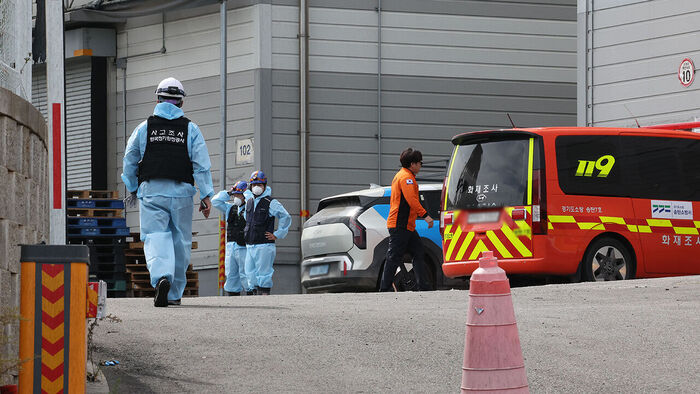
At around 9:40 a.m. today, vehicles from relevant agencies, including forensic investigation vehicles, began entering the previously quiet fire scene one by one.
By 10:00 a.m., about 20 officials from five agencies—including the Gyeonggi Provincial Fire and Disaster Headquarters, the Gyeonggi Southern Provincial Police Agency, the National Forensic Service, Korea Gas Corporation, and Korea Electrical Safety Corporation—began a joint inspection.
The joint inspection team, wearing white inspection outfits and vests bearing the words "Accident Investigation," carefully examined various parts of the site to search for the starting point of the fire.
They moved cautiously to avoid debris and gathered at specific locations within the site, meticulously examining the area.
The police and fire authorities plan to determine where and how the fire that swallowed the large hazardous materials warehouse started, based on the results of the joint inspection, CCTV analysis, and interviews with company officials.
(Photo: Yonhap News)
※ Please note: This article was translated by AI and may contain errors.
Copyright Ⓒ SBS. All rights reserved. Unauthorized reproduction, redistribution, and use for AI training are prohibited.