SBS News
8 Times Yeouido's Area Dries Up... 'Severe' Drought Hits 5 Regions
Published : Aug 13, 2026 11:09 AM

▲ Drought-parched land
While 200 fire water tank trucks from across the country are providing emergency water supplies to rice paddies and fields in South Gyeongsang Province under a national firefighting mobilization order, agricultural reservoirs in the province are increasingly drying up.
As of the 13th, all 18 cities and counties in South Gyeongsang Province have entered agricultural drought zones, with two more municipalities entering the highest drought stage, bringing the total to five.
The agricultural drought stages are divided into four levels: Attention, which indicates a mild drought when the reservoir storage rate falls to 70 percent or below compared to the 30-year average; Caution, a moderate drought at 60 percent or below; Alert, a severe drought at 50 percent or below; and Severe, an extreme drought at 40 percent or below.
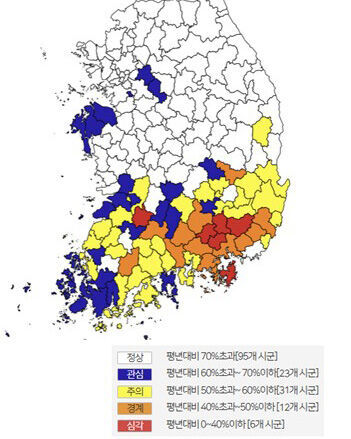 According to the Agricultural Drought Management System, Hamyang County—which was the only municipality among the 18 cities and counties in South Gyeongsang Province not classified as an agricultural drought zone today—has also entered the Attention stage.
Uiryeong County and Changnyeong County, which were previously under the Alert stage, have been upgraded to the Severe stage.
The average reservoir storage rate across the 18 cities and counties in South Gyeongsang Province stands at 32.8 percent, plummeting to 46.3 percent of the normal average of 70.8 percent.
Currently, five regions are under the Severe stage: Miryang, Geoje, Haman, Uiryeong, and Changnyeong.
Nine regions are under the Alert stage, including Changwon, Jinju, Tongyeong, Gimhae, Yangsan, Goseong, Hadong, Sancheong, and Hapcheon; three regions are under Caution, including Sacheon, Namhae, and Geochang; and Hamyang is at the Attention stage.
Although 200 national fire water tank trucks have been deployed to provide agricultural water to South Gyeongsang Province, reservoir storage rates continue to drop because they are supplying water directly to rice paddies and fields rather than the reservoirs.
Based on figures from yesterday, the provincial government has found that drought damage—such as withered crops, leaf scorching, and fruit splitting—has affected 2,400 hectares of farmland, mainly targeting rice, fruit trees like sweet persimmons, pears, and apples, and field crops such as soybeans, sesame seeds, and chili peppers.
The damaged area has increased by 279 hectares compared to yesterday's tally.
Along with the National Fire Agency, the Korea Forest Service, the 39th Infantry Division, the 3rd Air Force Training Wing, the Air Force Education and Training Command, and the Navy Jinhae Naval Base Command will also provide water supply support today.
The Korea Meteorological Administration has forecasted 5 to 30 millimeters of showers for the southern coast and eastern inland areas of South Gyeongsang Province from the afternoon of the 13th through the 14th.
If rain actually falls, it is expected to provide some relief from the drought.
(Photo: Capture from Agricultural Drought Management System, Yonhap News)
※ Please note: This article was translated by AI and may contain errors.
Copyright Ⓒ SBS. All rights reserved. Unauthorized reproduction, redistribution, and use for AI training are prohibited.