SBS News
SK Hynix Ranks in Top 3% for Employee Happiness; Samsung Electronics at Bottom 40%
Published : Aug 12, 2026 11:28 AM

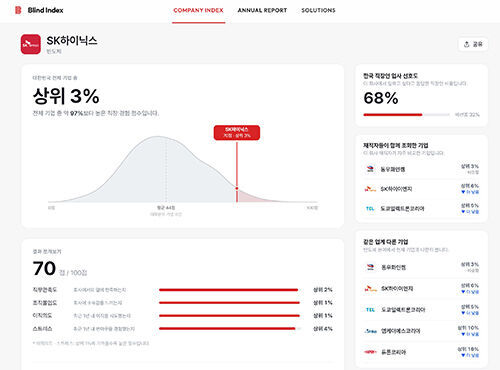
▲ Employee Happiness
While the overall happiness of South Korean workers has declined, the proportion of employees attempting to change jobs has decreased, according to findings.
In industries such as semiconductors and platforms, significant gaps in employee happiness were observed depending on the specific company, even within the same sector.
Blind, a workplace social platform, released the results of its Blind Index today (August 12), which was conducted based on an index co-developed with the Korea Labor Institute.
The survey was conducted among 34,372 South Korean workers from July to December of last year.
According to the survey results, the proportion of companies receiving a happiness score of 50 or higher dropped 14 percentage points from 47% the previous year to 33% this year.
Only about 100 companies saw their index rise, while more than 370 companies experienced a decline.
By company, Korea Gas Corporation claimed the top spot with 85 points, followed by SAP Korea and Korea South-East Power at 82 points, Google Korea at 80 points, and Korea Housing Finance Corporation at 79 points.
Disparities among major corporations were also pronounced.
In the semiconductor industry, SK Hynix placed in the top 3%, whereas Samsung Electronics lagged in the top 60%.
In the platform industry, Naver recorded the top 2%, while Kakao plummeted from the top 46% last year to the top 93% this year.
By job category, professionals such as lawyers (54 points), medical personnel (51 points), and doctors (50 points) maintained the highest ranks, while hardware engineers handling semiconductor and circuit design (49 points) entered the top tier for the first time.
The job categories with the lowest indices were planners (36 points), career soldiers (37 points), and customer service workers (40 points), in that order.
The most notable change is that despite the drop in happiness, the proportion of workers who attempted to switch jobs within the past year decreased.
Normally, a decrease in happiness leads to an increase in job-seeking attempts, but this year saw a decrease in the proportion of workers trying to change jobs over the past year compared to the previous year, despite the falling happiness levels.
As a result of Blind analyzing 218,000 posts by employees from top- and bottom-tier companies using AI, top-tier companies showed 1.8 times more conversations or questions aimed at improvement rather than organizational departure, compared to bottom-tier companies.
(Photo provided by Blind, Yonhap News)
※ Please note: This article was translated by AI and may contain errors.
Copyright Ⓒ SBS. All rights reserved. Unauthorized reproduction, redistribution, and use for AI training are prohibited.