SBS News
"What Is That?" Stepped On, but... The 'Bomb Drone' That Nearly Blew Up an Airport
Published : Aug 11, 2026 9:30 AM
⚡ Key Points
Explosive-Laden Drone Discovered: On the night of August 4, 2026, a drone equipped with high-performance military explosives was discovered near a Ukrainian cargo plane in the freight area near the runway of Leipzig/Halle Airport in Germany. An explosion was averted due to a detonator malfunction.
A New Stage of Hybrid Attack: Germany's Federal Minister of the Interior defined the incident as a "threat of a new dimension" and a "hybrid attack scenario." On the same night, another flying object collided in mid-air with a cargo plane.
144 Drone Infiltrations in Two Years: According to the International Institute for Strategic Studies (IISS) in London, at least 144 suspicious drone incidents occurred across 13 European countries between August 2024 and February 2026, raising concerns of a Kremlin-led UAV campaign.
1. A 'Time Bomb' Discovered Overnight in the Cargo Area
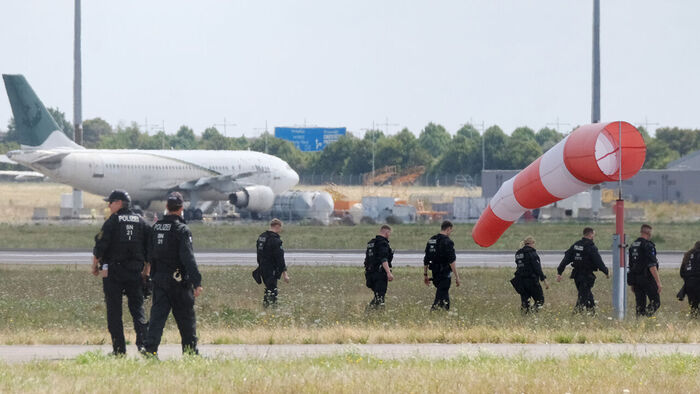
At around 7:30 p.m. on August 4, 2026, an explosive-laden drone landed at Stand 213 of Leipzig/Halle Airport in Germany, right next to a Ukrainian Antonov cargo aircraft. For more than four hours, it remained completely undetected.
Its discovery was purely accidental. An employee working as an airport shuttle bus driver spotted a low-flying object at around 11:42 p.m., kicked it to the ground without any special equipment, and stepped on it to hold it in place. The driver reportedly held it down in that position until security officers arrived. Saxony State Police and prosecutors in Germany stated in a joint press release that "an airport employee discovered a drone carrying an unidentified explosive device," adding that the Federal Police's explosive ordnance disposal unit deployed a robot to remove the detonator.
According to German media reports, the drone was loaded with up to 800 grams of high-performance military explosives, PETN and Semtex. The explosives were confirmed to have been hidden inside an empty tin can. Semtex is the very explosive used in the 1988 Pan Am Flight 103 Lockerbie bombing. Trevor Lawrence, an explosives expert at Cranfield University in the UK, explained, "An aircraft fuselage is usually just 3 millimeters of aluminum," adding, "This amount of explosive is enough to cause significant damage."
It was also revealed that the drone was fitted with a 5G communication antenna. This meant the operator could control it remotely from a café in downtown Leipzig or even from abroad, provided they had an internet line with an activated SIM card. German drone expert Christian Kaiser explained, "Even with a frequency scanner, it is indistinguishable from an ordinary mobile phone, making it a worst-case scenario for detection."
Fortunately, the detonator malfunctioned and failed to explode. However, had it detonated, it would likely have resulted in a major disaster at the cargo terminal operating overnight and for passenger flights scheduled into the early morning. According to German media outlets such as Bild and Der Spiegel, the incident is analyzed as an attempted physical strike against critical infrastructure in Germany.
On the evening of August 6, two days after the incident, the Federal Public Prosecutor's Office in Karlsruhe took over the investigation from the Dresden Public Prosecutor's Office due to the severity of the matter. The Federal Public Prosecutor's Office defined the incident as a "serious attack on Germany's transport and logistics infrastructure" and a "matter that could undermine the internal and external security of the Federal Republic."
Coincidentally, on the same night as the incident, a DHL cargo plane aborted its landing attempt and climbed again after being notified of the airport's closure. During this maneuver, it collided with an unidentified object at an altitude of 400 meters, approximately 6 kilometers from the airport, and made an emergency landing at Hanover Airport with damage to its airframe. Whether this object was a drone has not yet been confirmed.
2. Allegations of Targeting Ukraine-Related Hubs
Leipzig/Halle Airport is no mere regional airport. It is Europe's fourth-largest cargo hub, a major base for DHL, and a transport hub for military supplies for the German armed forces and NATO allies. Particularly following Russia's full-scale invasion of Ukraine in 2022, it became the European operational base for Ukraine's Antonov Airlines.
At the scene was an Antonov cargo plane painted in yellow and blue, the colors of the Ukrainian national flag. On the side of the fuselage, the English phrase "Be Brave Like Kherson" was written—a message of support for the Kherson region in Ukraine, which was devastated by Russian airstrikes. According to German media reports, the drone was discovered right near this aircraft, which was carrying military ammunition that had just arrived from France and was scheduled for onward transport to Ukraine.
In an interview with German broadcaster Welt TV, Oleksii Makeiev, Ukraine's ambassador to Germany, immediately pointed the finger at Moscow, saying, "Who else could it be besides Russia?" While German authorities have not yet issued an official position, Federal Minister of the Interior Alexander Dobrindt cut his vacation short and rushed to the scene, describing the incident as a "threat of a new dimension" and a "hybrid attack scenario."
On the other hand, Russia strongly denied involvement. The Russian Embassy in Germany issued a statement on August 7, expressing concern over what it called a "new wave of anti-Russian hysteria in Germany." The embassy mocked the sequence of events in which the drone was "coincidentally" discovered, subdued "by a bus driver," and failed to detonate "also coincidentally," scoffing at the narrative that "a series of lucky coincidences prevented damage." It claimed the incident was a "hastily cooked-up provocation that serves only the interests of Kyiv and hardliners in European political circles."
Foreign news outlets, including Reuters and Bloomberg, reported that the incident strongly aims to exert political and military pressure by threatening the overall supply chain of military aid to Ukraine. This underscores that global supply chains, including South Korea's, could also be exposed to similar drone- or package-based terrorism.
3. The Link to the 2024 DHL Self-Igniting Package Incident
To understand this incident, one must go back to July 2024. At this very Leipzig airport, a DHL package caught fire just before being loaded onto an aircraft. A similar package ignited in a warehouse in Birmingham, UK, and related incidents occurred in Poland as well. In a March 2026 announcement, Eurojust, the European Union Agency for Criminal Justice Cooperation, revealed the findings of its investigation into those behind the incidents.
Eurojust identified 22 suspects in Lithuania and Poland, stating that they were suspected of operating for Russian military intelligence. Recruitment and instructions were handled via online messaging services, with compensation paid in cryptocurrency. Roles were compartmentalized, and perpetrators acted without knowing the full outline of the operation. It was a classic hybrid tactic: rather than acting directly, state actors cheaply mobilized socioeconomically vulnerable proxies.
In a February 2026 report, the International Centre for Counter-Terrorism (ICCT) in The Hague, Netherlands, analyzed that suspected Russian-linked incidents in Europe reached 151 between February 2022 and February 2026, with target distribution strongly tied to the level of support for Ukraine. In particular, countries offering strong support to Ukraine, such as Poland, France, Germany, and the UK, accounted for a majority of the cases. If the 2024 package incidents represented "infiltration of the postal and logistics chain," the 2026 Leipzig incident constitutes "direct aerial infiltration into airport perimeter zones." Though the means differ, the shared goal is undermining trust in cargo and transport systems.
4. The Shadow of 144 Drone Incidents Blanketing Europe
In a report released in July 2026, the International Institute for Strategic Studies (IISS) in London presented a broader picture. It stated that between August 2024 and February 2026, at least 144 suspicious drone-related incidents occurred across 13 European countries and Ireland. Suspicious drones were observed over military bases, civilian airports, ports, and energy facilities. The IISS assessed that this is highly likely part of a broad, Kremlin-led unmanned aerial vehicle (UAV) campaign.
In Germany alone, the situation is grave. According to figures compiled by the German news agency dpa, unauthorized drones were spotted 166 times across 15 international airports in Germany in the first half of 2026 alone.
The core hypothesis of the IISS report is the use of a "shadow fleet." It raised the possibility that Russian-linked vessels in international waters served as launch, recovery, or relay nodes for drones. This paints a far more complex picture than the traditional notion of "drones flying across borders," pointing to an operational concept that blends maritime, aerial, and intelligence warfare. According to the IISS analysis, European nations failed to detect, recover, or publicly attribute drones in a significant number of incidents. The larger issue was the lack of clarity regarding who launched them, where they originated, and what system should be used to respond.
While past incidents leaned primarily toward reconnaissance, disruption, or testing response readiness, the Leipzig incident appears—at least based on public reports—to have crossed into the stage of carrying explosives. The Center for Strategic and International Studies (CSIS), a US think tank, analyzed that Russia is employing a long-term pressure strategy to systematically expose vulnerabilities in Europe below the threshold of open warfare. The Leipzig incident is interpreted as an upgrade to that strategy.
5. Gaps in European Aviation Security and the Failure of an Integrated Response
As early as 2021, the European Union Aviation Safety Agency (EASA) issued dedicated guidance on unauthorized drones around airports, noting that while such incidents may result from reckless piloting, they could also stem from intentional disruption, criminal intent, or, in extreme cases, terrorist motives. The International Civil Aviation Organization (ICAO) similarly stated that the misuse of unmanned aircraft through unauthorized intrusions into controlled airspace and airport vicinities poses a growing threat, advising nations to put in place prevention, response, and mitigation measures to protect civil aviation infrastructure.
However, the issue lies in the fragmentation of response systems. Unless airport operators, air traffic control, police, intelligence agencies, the military, prosecutors, border and customs authorities, and sanctions enforcement bodies share the same threat picture in real time, low-cost drones will continue to yield high efficiency. EASA's manual on airport drone incidents explains that detection systems should be deployed using a risk-based approach—meaning airports like Leipzig, where civilian, military, and strategic logistics functions overlap, justify a higher level of protection.
The European Union (EU) introduced a sanctions framework in October 2024 targeting Russian hybrid threats and destabilization activities, and expanded its scope in May 2025 to include physical components of ships, aircraft, real estate, telecommunications networks, and financial transactions. Yet even with sanctions in place, Russian-linked sabotage remains effective due to plausible deniability, the use of proxies, multi-domain dispersion, and cost asymmetry. What matters more than the success of an actual explosion is creating the perception that "European airports and logistics hubs can be breached at any time." Flight disruptions, runway closures, site cordons, media fallout, and soaring insurance and security costs are themselves the intended effects of hybrid attacks.
Deep Dive Q&A
Q1. Was this incident really Russia's doing?
A1. German authorities have not yet released an official statement. However, multiple circumstances strongly point to possible Russian involvement. These include the fact that the drone was found near a hub handling Ukrainian military supplies, that 22 suspects linked to Russian military intelligence were identified in the 2024 DHL package incidents, and that the IISS assessed 144 drone incidents across Europe as likely part of a Kremlin-led campaign. Ukraine's ambassador to Germany pointing directly to Moscow can also be understood in this context. In an August 7 statement, the Russian government strongly denied the allegations, calling them "anti-Russian hysteria."
Q2. Why Leipzig Airport of all places?
A2. Leipzig/Halle Airport is Europe's fourth-largest cargo hub and a primary base for DHL. At the same time, it serves as a logistics transport hub for the German military and NATO, and has been the European operational base for Ukraine's Antonov Airlines since 2022. In short, it is a strategic node where civilian logistics, military logistics, and Ukraine support lines overlap. If the attackers are indeed linked to Russian state entities or their proxy networks, their aim is likely not merely physical destruction, but spreading the perception that Europe's support network for Ukraine is unsafe, raising costs, and paralyzing response procedures.
Q3. Why are Europe's airport defense systems so vulnerable?
A3. The issue stems less from technological limits than from fragmentation among agencies. If airport operators, air traffic control, police, intelligence services, the military, and prosecutors fail to share a real-time threat picture, even cheap drones can achieve high efficiency. The fact that the Leipzig drone was equipped with a 5G communication module symbolically highlights this issue: when controlled in a way that is indistinguishable from ordinary cell phone signals, existing frequency detection equipment virtually cannot filter it out. While EASA and ICAO recommended years ago that unauthorized drones around airports be treated as a complex safety and security issue, most countries have not institutionalized routine systems for detection, identification, on-site command, and legal authority. According to the IISS report, European nations failed to detect, recover, or publicly attribute drones in a significant number of incidents, demonstrating that response systems are failing to keep pace with the speed of the threat.
※ Please note: This article was translated by AI and may contain errors.
Copyright Ⓒ SBS. All rights reserved. Unauthorized reproduction, redistribution, and use for AI training are prohibited.