SBS News
Jeju Air's China Route Passengers Up 37% This Year Amid Rising Short-Haul Travel Demand
Published : Aug 10, 2026 10:38 AM

▲ Jeju Air counter
The number of passengers utilizing Jeju Air's Korea-China routes has increased by nearly 40% so far this year.
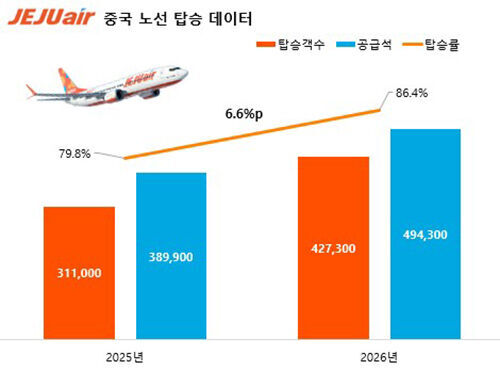
Jeju Air announced on August 10 that it supplied 494,300 seats on its routes between South Korea and China from January to July, marking a 26.8% increase compared to 389,900 seats during the same period last year.
The number of boarding passengers increased by 37.4% to 427,300, and the load factor rose by 6.6 percentage points to 86.4%.
In particular, the passenger growth rate outpaced the seat supply growth rate by 10.6 percentage points.
Jeju Air analyzed that the growth was driven by increased travel demand following the two countries' visa-free policies and a preference for short-haul overseas travel.
By age group, passengers in their 20s and 30s numbered 158,500, accounting for 37.1% of the total and representing the largest share.
Load factors also rose on key routes with high usage by travelers in their 20s and 30s.
The load factor for the Busan-Shanghai (Pudong) route stood at 89.0%, up 2.1 percentage points from last year.
Jeju-Beijing (Daxing) recorded 89.7%, up 13.7 percentage points, and Incheon-Qingdao recorded 93.5%, up 10.8 percentage points.
Jeju Air believes that as Chinese travel shifts from traditional group tours to individual and small-scale trips, independent travelers looking to enjoy gourmet food, sightseeing, and night views have increased.
As of August, Jeju Air operates 11 routes to China, including Incheon-Qingdao, Weihai, Yanji, Harbin, Jiamusi, and Shijiazhuang; Busan-Shanghai (Pudong), Shijiazhuang, and Zhangjiajie; and Jeju-Beijing (Capital) and Beijing (Daxing).
The airline is also reviewing the expansion and operation within the year of the Busan-Guilin, Busan-Shanghai, Daegu-Shanghai, Jeju-Chengdu, and Jeju-Chongqing routes, for which traffic rights were distributed by the Ministry of Land, Infrastructure and Transport last April.
(Photo: Yonhap News)
※ Please note: This article was translated by AI and may contain errors.
Copyright Ⓒ SBS. All rights reserved. Unauthorized reproduction, redistribution, and use for AI training are prohibited.