SBS News
Debating Government or Fragmented Government? 'One Voice' is Also Competence
Published : Aug 7, 2026 3:19 PM
Discord Beyond Policy Route Competition... Dealing a Blow to Policy Trust
 During a briefing following the conclusion of the work reports, Foreign Minister Cho Hyun evaluated the "Korean Peninsula Peace and Co-prosperity Initiative" pursued by Unification Minister Chung Dong-young as "idealistic." Regarding the Unification Ministry's announcement that it would secure momentum for four-way talks involving the two Koreas, the United States, and China, he even went so far as to say it should be taken with a "discount." On his way to work the next day, Minister Chung met with reporters and pointed out that "reality can only be changed when there is an ideal." When asked about concerns regarding the exposure of disagreements, a Unification Ministry official retorted, "Did we expose the disagreements?" It is true that the Unification Ministry's work report was indeed "idealistic," but it was unusual for the Foreign Ministry, which typically employs diplomatic language, to respond with exceptionally undiplomatic remarks. The series of events—where the head of the Foreign Ministry seemingly disparaged the remarks of the Unification Ministry chief, and the Unification Ministry chief immediately expressed discomfort—gave the impression that raw emotions were laid bare. While there are cases in a single government where roles are divided and situations are manipulated to one's advantage through "staged coordination," it can be said with certainty that this was not such a situation.
The Double-Edged Sword of 'Transparent Disclosure'... Accumulating Fatigue
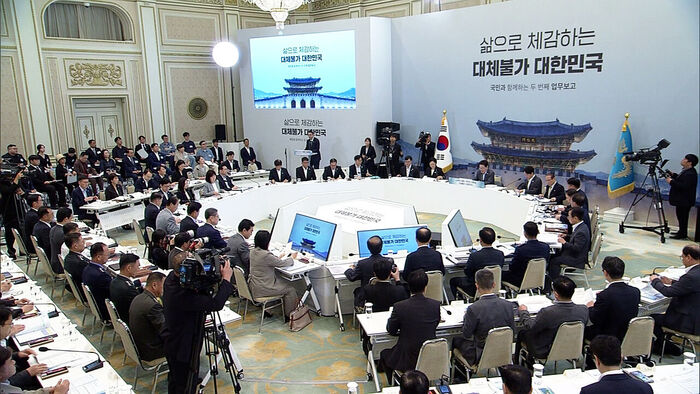
 The fact that disagreements between ministries or cabinet ministers are relatively visible is not unrelated to the Lee Jae-myung administration's proactive governance stance of disclosing information. With Cabinet meetings broadcast live and work reports also fully televised, the government's "inner workings," which were previously difficult to know, may be easily exposed. Unlike previous administrations that typically rushed to control and conceal information, this pattern was initially sufficient to receive positive evaluations in terms of honestly demonstrating the process of state administration. However, as even the unrefined aspects of policy planning stages and uncoordinated differences of opinion are exposed, fatigue among observers seems to be piling up.
How Long is the Shelf Life of 'Raw' Governance? Time to Show 'Coordination and Arrangement Capabilities'
 Laying the groundwork for a hundred schools of thought to contend by inducing debate without unilaterally favoring a specific faction or ministry can contribute to boosting vitality in the early stages of governance. However, after fierce competition among various voices, they must eventually converge and be organized into a single, refined direction. The "ability to coordinate and organize," which maintains the center of gravity and makes decisive judgments amidst numerous differing opinions, is the true competence of state administration. The shelf life of the freshness provided by "raw governance" does not last forever. I would like to ask if it is now time to prove competence beyond the "disclosure of process" with "refined outcomes and decisiveness." Just as debate is a competency, speaking with "one voice" must also be a competency.
※ Please note: This article was translated by AI and may contain errors.
Copyright Ⓒ SBS. All rights reserved. Unauthorized reproduction, redistribution, and use for AI training are prohibited.