SBS News
'The Odyssey': Nolan's Reinterpretation of a Classic Focuses on the Human, Not the Hero
Published : Aug 5, 2026 3:58 PM
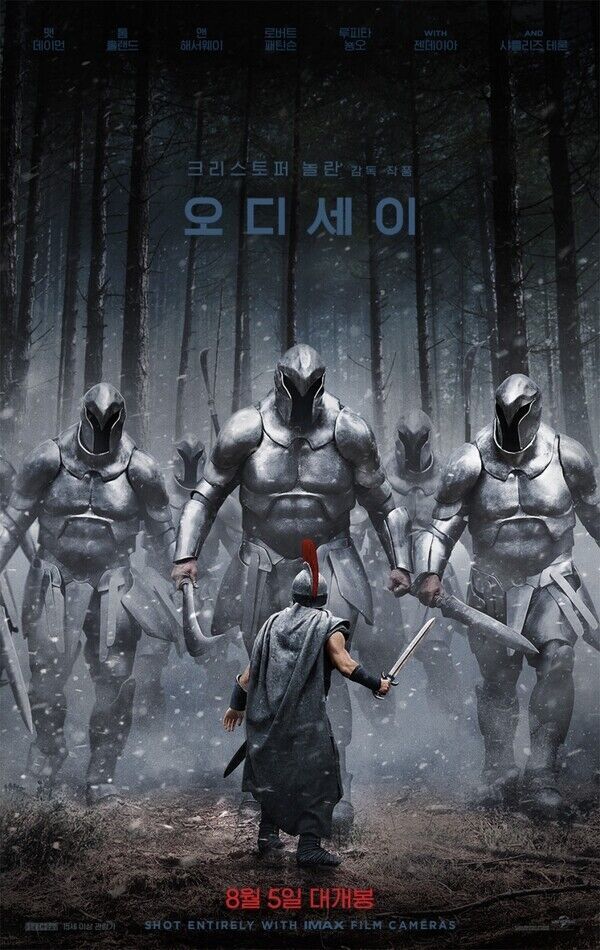
Heroic tales inherently follow a framework of leaving home and returning back. In the heroic narrative that progresses through departure, initiation, trials, return, awakening, and growth, there are inevitably trials and hardships accompanied by awakening and growth. This structure also forms the backbone of superhero movies that thrill film fans worldwide today.
The epic poem "The Odyssey," written by the ancient Greek poet Homer, serves as the archetype of the hero's narrative. Composed of 24 books in total, Odysseus does not appear until Book 5. The work opens with the story of his son Telemachus searching for his father (Books 1 to 4) before unfolding Odysseus's adventures (Books 5 to 12).
Nolan framed the film with a bookend structure, opening with a chaotic Ithaca in Odysseus's absence and concluding with Ithaca upon his return. What fills the space in between are Odysseus's flashbacks containing memories of war and his perilous journey home filled with adventures.
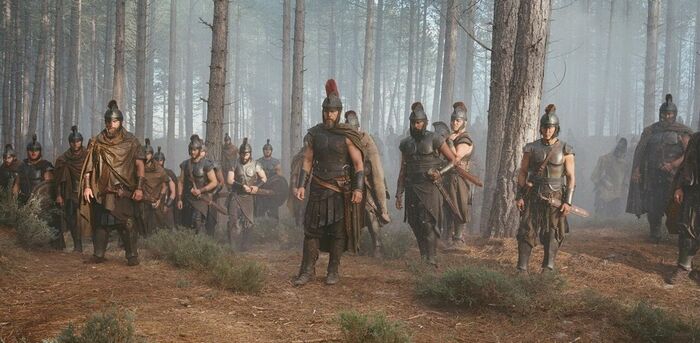
Time and memory are signature themes in Nolan's cinematic universe. In "The Odyssey" as well, he divides time through character perspectives and weaves memories together, intercutting Odysseus's grueling journey home with the arduous wait of Telemachus and Penelope across the screen. The narrative is structured so that Odysseus, unable to return home despite the war's end, Penelope, pushed to the brink while waiting for her husband, and Telemachus, setting out to find a father whose face he has never seen, ultimately converge in one space.
The timeless classic has been reinterpreted and reassembled in distinctly Christopher Nolan fashion. Odysseus's grueling homeward journey evokes "Interstellar" and "Dunkirk," while his struggle with the trauma of atonement brings "Oppenheimer" to mind.
Odysseus, King of Ithaca, devises the strategic Trojan Horse tactic, leading the Greek alliance to victory in the ten-year Trojan War. Dragging his exhausted body toward home, his arrogance and misjudgment incur the wrath of the gods, drifting him farther away from his homeland.
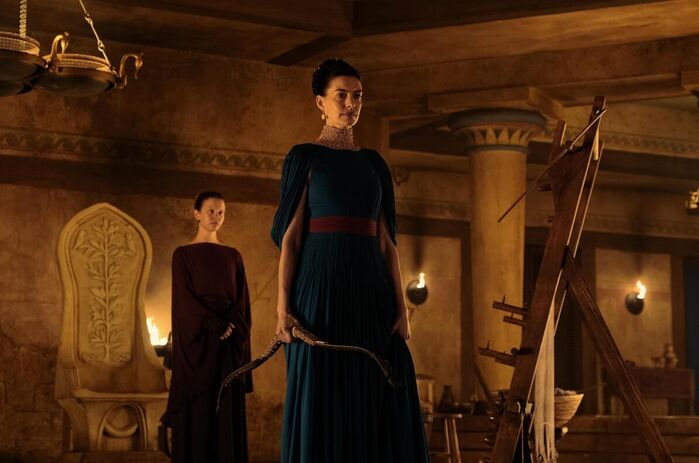
Meanwhile, Ithaca is teeming with men competing to win Queen Penelope. Using courtship as a pretext, they occupy Ithaca and squander its wealth, yet Penelope cannot drive them away due to the "Law of Zeus" (an ancient norm dictating warm respect and hospitality toward strangers). Unable to endure it any longer, Telemachus sets out to confirm the life or death of the father he was separated from as a child and whose face he does not even know.
It was considered somewhat surprising that Christopher Nolan, who won his long-awaited Academy Award with "Oppenheimer," chose "The Odyssey" as his next project. Why did he want to summon this age-old hero tale to the screen? Watching the grand 172-minute epic brought to life through IMAX film cameras, one comes to understand the reason behind his choice.
War, both past and present, is a product of political interests and a violent instrument for the gain of ruling classes. In the Trojan War, Queen Helen was merely a plausible pretext, while Greece's ambition toward rich city-states lay at the core of the conflict. For us living in an era of war, the immense sacrifices and deep wounds left by this clash of desires are not a distant story.
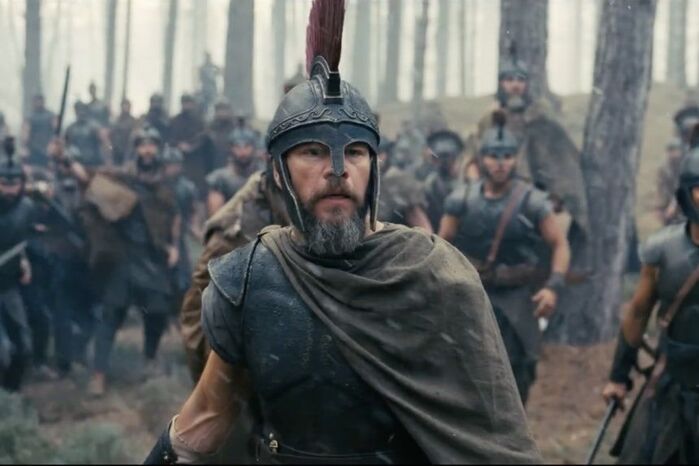
Nolan reinterpreted and dismantled the classic "The Odyssey" to write his own narrative. In Nolan's "The Odyssey," the focus centers on depicting humans rather than gods, and on expressing the scars of war rather than its glory. It shares a similar vein with his previous work "Oppenheimer," which dug into Oppenheimer's sense of guilt by portraying him not as a hero who ended a world war, but as the god of destruction.
Odysseus won the war, but lost many comrades. He suffers from nightmares every day and is tormented by guilt. Rather than portraying Odysseus as a peerless hero or strategist, Nolan depicts him like a defeated soldier suffering from PTSD. While staying on Calypso's island with lost memories, he pieces together fragmented memories while agonizing over "Who am I?" Odysseus wanders not because he cannot return home due to divine wrath, but because he cannot find answers to "Who am I?" and "Why did I fight?" In this way, Nolan shatters and deconstructs the hero of classical myth, depicting him as an incomplete and infinitely fragile human.
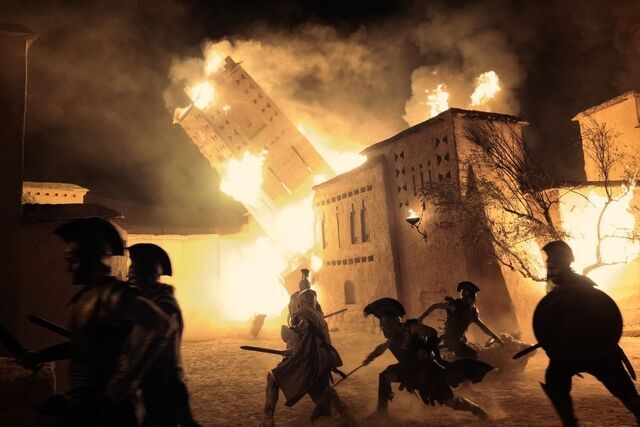
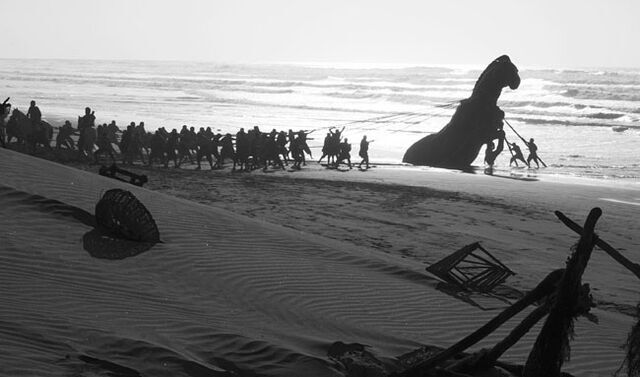
The depiction of monsters and gods is also approached from a different perspective. Adventures such as soldiers being devoured by the one-eyed monster Polyphemus and the witch Circe turning humans into pigs create a realistic sense of tension, building up the atmosphere of a horror film.
The film opens with the premise of "an era when magic existed." However, rather than realizing the presence and omnipotence of gods through visual spectacle, Nolan adopts a strategy of evoking them through energy and atmosphere. Poseidon's rage toward Odysseus for killing his son Polyphemus is expressed through violent sea storms, while the magic of Calypso, the sea goddess who strips Odysseus of his memories and detains him on her island for seven years, is represented through the Lotus fruit.
However, Athena, the goddess of wisdom, is visually embodied. Played by Zendaya, Athena lingers near Odysseus, watching and listening to his choices and the guilt he feels from the closest vantage point, offering comfort and counsel.
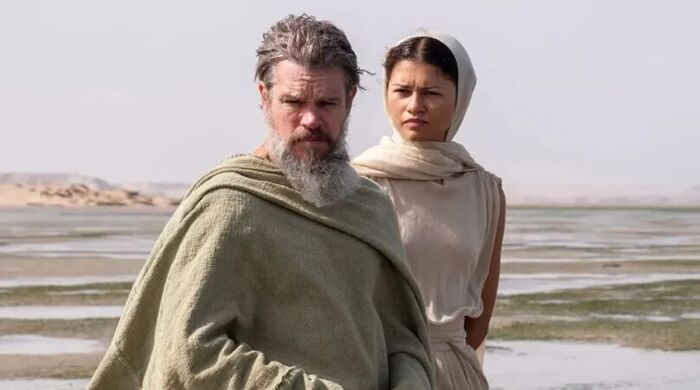
The "time of proof" that unfolds in the latter half after Odysseus returns to Ithaca is also riveting. Infiltrating Ithaca with his face concealed, Odysseus does not attempt to take the throne as a free rider; instead, he acknowledges the power vacuum and fallen authority, striving to gain recognition through proper means. Though Director Nolan has faced criticism in past works for underwhelming action sequences, the rough, unpolished action in this sequence highlights the desperation of Odysseus's ordeal. Furthermore, scenes during this process, such as his encounters with the swineherd Eumaeus and his loyal dog Argos, deliver moments of deep emotion.
Matt Damon as Odysseus and Anne Hathaway as Penelope serve as emotional anchors throughout the film with seasoned performances. Hathaway, in particular, virtually reinterprets Penelope, portraying her beyond a woman of patience and endurance as an independent, resolute, and steadfast character.
Tom Holland as Telemachus and Zendaya as Athena delivered irreplaceable performances in the "Spider-Man" series, but feel somewhat lightweight in this solemn period epic. Zendaya, in particular, maintaining a single facial expression throughout, feels as though she fails to properly convey the symbolic weight of the goddess of wisdom.
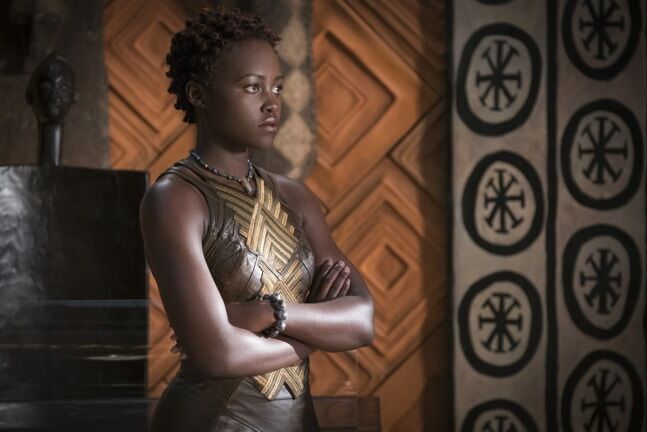
The casting controversies that sparked heated online debates prior to release fade away upon viewing the film. The "Black Helen," which drew outrage from many calling it a destruction of the original work, leaves little room for controversy due to her minor presence and role. Hence, the rationale for casting Lupita Nyong'o can hardly be interpreted as anything other than "diversity." Of course, many argue that discussing historical accuracy is inherently pointless given that the source material itself is rooted in mythology, a sentiment with which I partially agree.
Elliot Page, who faced "miscasting" controversy alongside Lupita Nyong'o, delivers the film's most impressive character and performance, contrary to concerns. Playing the Greek soldier Sinon, he plays a major role in the Trojan Horse strategy. Sinon serves as a symbol of Odysseus's guilt while functioning as proof of Antinous's meanness. In a majestic sequence that could be dubbed "the phantom of fallen comrades," Elliot Page maximizes the tragedy of war through a powerful performance.
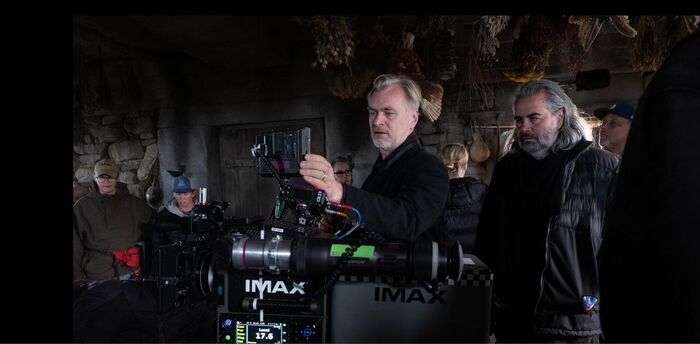
Exploits in myths and heroic tales in literature tend to be riddled with exaggeration. Rather than visualizing the epic through CG and special effects, Nolan brought it to life through analog methods, enhancing immersion. He sought to recreate the scenery of ancient Greece by traveling around the world to locations in Morocco, Greece, Italy, Iceland, and Scotland. For the one-eyed Polyphemus, rather than relying on CG technology, a 6-meter-tall practical giant puppet was built and operated. The Trojan Horse and Odysseus's ship were also constructed at actual scale and placed on beaches and open waters.
"The Odyssey" was shot entirely with IMAX 70mm film cameras for the first time in cinema history. However, as there are no theaters equipped with IMAX 70mm film projection facilities in South Korea, viewers can only experience it through digitally converted versions. Standard digital IMAX offers a 1.90:1 aspect ratio, but the CGV Yongsan IMAX theater supports a 1.43:1 aspect ratio that allows audiences to fully appreciate "The Odyssey." At present, it is the optimal theater to experience the film as Director Christopher Nolan intended.
(Reported by Kim Ji-hye | SBS Entertainment News)
※ Please note: This article was translated by AI and may contain errors.
Copyright Ⓒ SBS. All rights reserved. Unauthorized reproduction, redistribution, and use for AI training are prohibited.