SBS News
"Concerns Over Safety": Bill Abolishing Prosecutors' Supplementary Investigative Authority Passes Cabinet Meeting
Published : Aug 4, 2026 5:50 PM

An amendment to the Criminal Procedure Act that completely abolishes prosecutors' direct and supplementary investigative authority passed the Cabinet meeting today, following its passage through the National Assembly late last month. With legal procedures virtually finalized, "investigative prosecutors" will cease to exist in South Korea on October 2. Instead, criminal investigations will be handled by judicial police officers (the police and the Serious Crimes Investigation Agency) and the Corruption Investigation Office for High-ranking Officials (CIO). The bill has sparked significant controversy. Conservative opposition parties and some in the legal community demanded that the president exercise his veto, arguing that stripping prosecutors even of their supplementary investigative authority would leave public rights and interests vulnerable. However, President Lee Jae-myung remarked, "I cannot help but worry whether it is safe," while adding that it was not to the extent of exercising a veto. He indicated that the situation is hard to see as grave enough for the president to deny the legislative power of the National Assembly, presenting the grounds for his judgment as follows.
Amendment to Criminal Procedure Act, Including 'Abolition of Prosecutors' Supplementary Investigative Authority,' Passes Cabinet Meeting
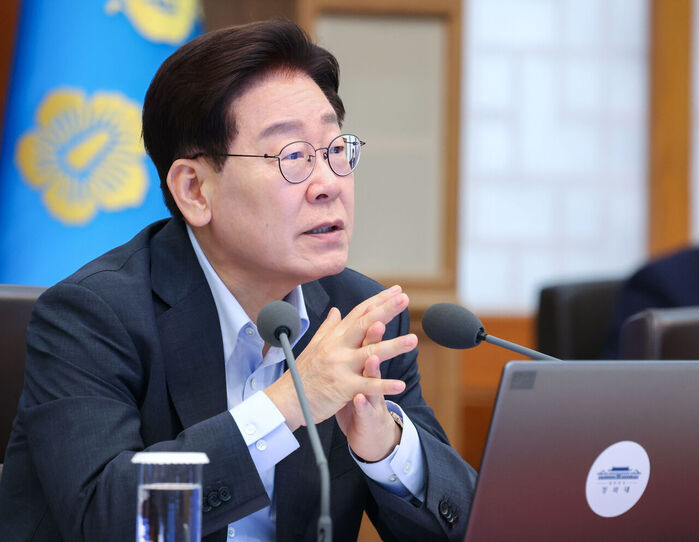
"Exercising a veto is not something that can be done simply because of a difference of opinion. According to constitutional scholars, under the principle of the separation of powers, one can only deny another's authority if that exercise of power itself violates the separation of powers or the constitutional order. Therefore, under the current circumstances, it is very difficult to view it as reaching the point of denying legislative power." (President Lee Jae-myung's remarks at the Cabinet meeting, today)
President Lee Expresses "Worry" and "Concern" Over Strengthening Police Authority
This means he made a constitutional judgment, while at the same time assessing the bill as a "starting point for normalizing the judicial system," a "first step toward normalizing an abnormal system," and an "inevitable measure of justice prevailing in the end." In essence, he framed it as a fundamentally positive bill. However, he also repeatedly expressed awareness of the problems arising from transferring prosecutors' investigative authority entirely to the police. He said he was worried and expressed concern. He spoke of his own experience during his time as a lawyer when it was difficult to trust not only prosecutorial investigations but also police investigations. He added that South Korea's constitutional history saw the power base of dictatorship shift from the police to the military and then to the prosecution, and that now a situation has arisen where there are concerns over power being concentrated in the police again.
"Aren't the entire public debating and worrying a lot about the separation of investigation and prosecution and the issue of supplementary investigations? There is ongoing debate over whether supplementary investigations should be allowed or not, and if not allowed, what complementary measures are needed. While it is difficult to assert what absolute truth is, it is a fact that concerns exist." (President Lee Jae-myung's remarks at the Cabinet meeting, today)
Minister Jung Sung-ho: "Revised at Speed of Light... Will Swiftly Fix Problems If They Arise"
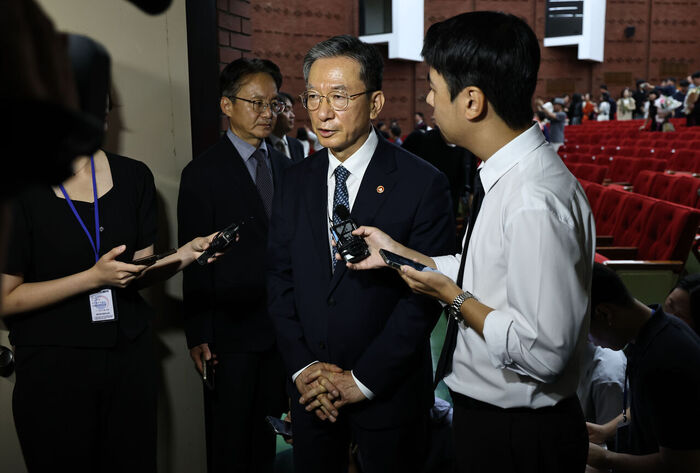
The president remarked, "Although there are many worries, this is a world where humans live, so human-made problems can all be solved by humans again." This sounds like the intention is that completely stripping prosecutors of all investigative authority is a matter of historic value, so elements of anxiety should be corrected as we move forward. Justice Minister Jung Sung-ho of the Ministry of Justice, the department in charge of the Criminal Procedure Act, also expressed a similar perception yesterday. After attending the final commissioning ceremony for prosecutors in the era of the Prosecutors' Office, Minister Jung met with reporters and voiced lingering concerns.
"This is probably the first time the Criminal Procedure Act has been amended at the speed of light. Because of that, even though we designed the new system with good intentions, no one can predict what side effects may arise or how properly it will operate in the field. So, if unexpected side effects or problems—or those that exceeded predictions—emerge while the criminal justice system operates on the ground, I expressed expectations that we swiftly supplement it and revise what needs to be revised. (Omitted) The criminal justice system is so crucial in protecting citizens' lives, property, and safety. If side effects occur here, a situation could arise where victims' harm worsens and they are not properly protected. Therefore, if many side effects occur and if it does not fit the reality on the ground, shouldn't we fix it quickly?" (Justice Minister Jung Sung-ho's remarks after the commissioning ceremony for prosecutors, yesterday)
Criminal Procedure Act Amendment... Legislation Accelerated Under Influence of Ruling Party's National Convention Schedule
Justice Minister Jung Sung-ho said this revision of the Criminal Procedure Act was carried out at "the speed of light." "Speed of light" is unlikely to be a positive assessment. It sounds like an assessment that thorough discussions through contemplation and deliberation were lacking, and that it was ultimately inadequate. Why the rush? Ultimately, it must be because of the ruling party. To be precise, it was likely due to the ruling party's national convention. Even former Prime Minister Kim Min-seok, who had shown similar views to the president and the justice minister, requested the party leadership on the day the preliminary party leadership primary results were announced last month, saying, "Please conclude prosecution reform before the national convention." Representative Song Young-gil, also a pro-Lee Jae-myung figure, said on the same day, "I hope this issue gets settled quickly so that there are no more dangerous attempts to politically exploit the supplementary investigation issue at the national convention or distort the president's concerns to attack him as if even the president were anti-reform." As Representative Jung Chung-rae claimed to be the flagbearer of prosecution reform and called for the complete abolition of supplementary investigative power, the two candidates seemed to hope that this issue would fade from the national convention agenda. Looking closely, because a weighty bill affecting citizens' lives, property, and safety was processed under the influence of the ruling party's political schedule, a situation unfolded where even the president and the minister in charge could not shake off their worries and concerns.
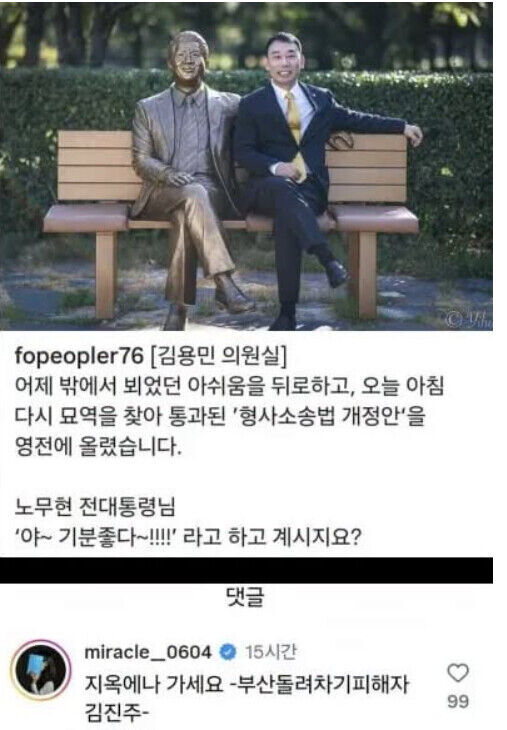
Naturally, the anxiety and dissatisfaction of those who view the abolition of prosecutors' supplementary investigative authority negatively are unlikely to dissipate. The victim of the Busan roundhouse kick case posted a passionate comment reading "Go to hell" on Democratic Party Representative Kim Yong-min's social media page. The Busan roundhouse kick case is considered a representative example where sex crime evidence ignored by the police was corrected through the prosecution's supplementary investigation. The victim strongly refuted Representative Kim Yong-min, who sponsored the Criminal Procedure Act amendment, after he posted a photo taken next to a bust of the late former President Roh Moo-hyun alongside a message to the effect that he had fulfilled Roh's dying wish. Democratic Party Representative Kwak Sang-eon, son-in-law of the late President Roh, also stated that the claims by Representative Kim and others are "completely different from President Roh Moo-hyun's intent or politics," explaining that "President Roh even reprimanded the police's demands to completely abolish prosecutors' investigative direction authority and grant police independent authority to conclude investigations," emphasizing that former President Roh attached great importance to mutual checks among power agencies. Although the revised law has been made, controversy is expected to persist, which is why the Democratic Party has also engaged in a public relations campaign.
With the revision of the Criminal Procedure Act, it is said that around 170 related laws and regulations will need to be revised. There is also the task of making thorough preparations so that the Serious Crimes Investigation Agency and the Indictment Agency can stably carry out their roles starting October 2. Today, Minister of the Interior and Safety Yoon Ho-jung reported measures on fairness resulting from the expanded police powers during the Cabinet meeting. These are measures that had been presented during past discussions, but they have failed to dispel counterarguments that such steps cannot properly monitor or check the police's concealment of investigations or misconduct during the investigative process. The contents of the Criminal Procedure Act revision are also expected to face judgment before the Constitutional Court soon. Constitutional petitions and other legal challenges are likely to be filed regarding potential violations of fundamental rights—such as whether citizens' rights can be properly protected—along with arguments that stripping prosecutors of their direct warrant request authority is unconstitutional based on the Constitution's stipulation regarding "warrant requests by prosecutors."
'Abolition of Supplementary Investigative Authority': If Problems Arise, Just Take Political Responsibility?
In about two months, a realm in the criminal justice system that South Korean society has never experienced before will open up. Initial confusion and side effects will be inevitable. The government and ruling party are telling the public that we should prepare as much as possible in advance and fix flaws or make supplements if problems still occur. However, there is no guarantee that an incident like the Jang Yoon-ki case will not happen again. Even if feared scenarios occur—such as the police performing a poor investigation whether intentionally or not, or criminals going unpunished because the statute of limitations on a case expires—it may be difficult to establish fundamental solutions due to the changed system. While unable to deny such possibilities, the thinking of the government and ruling party that enacted this law seems to be that if problems arise, they can simply "take political responsibility" at that time. A decision made by stepping on the gas pedal according to the ruling party's political schedule without alleviating citizens' anxiety and concerns... In what direction and to what extent they will bear that political responsibility will likely serve as a major factor determining the success or failure of the Lee Jae-myung administration.
※ Please note: This article was translated by AI and may contain errors.
Copyright Ⓒ SBS. All rights reserved. Unauthorized reproduction, redistribution, and use for AI training are prohibited.