SBS News
"10 Times Hotter on Hot Days"... Why the Same Heatwave Feels Different
Published : Aug 3, 2026 10:28 PM
 Video
Video
Even in the same city and under the same heatwave, how severely people feel the heat varies greatly depending on where they live. It was found that areas densely packed with older houses are much hotter than large apartment complexes with established green spaces.
Reporter Kim Minjun went to the scene.
[Reporter]
Gaemi Village in Hongje-dong, Seodaemun-gu, is considered Seoul's last hillside shantytown.
Old houses are packed closely together.
This is near the very top of the village.
I walked up here on foot from the entrance, and because the slope is so steep, just a little walking makes sweat pour down my entire body like rain.
However, as you can see, there are no proper shades or parks to take a short break.
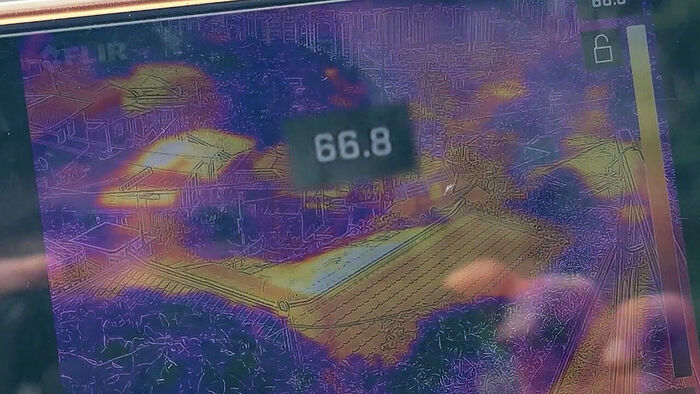
Measured with a thermal imaging camera, the roof temperature approaches 66 degrees Celsius (151 degrees Fahrenheit).
[Nearby Resident: Oh, it is hot. You cannot breathe. Because the ceilings are thin and flimsy like that. In the evening, the heat radiates downward.]
The heat vulnerability of detached houses is about 1.4 times that of multi-family housing like apartments.
This is because open spaces and roads around the houses are covered with asphalt or concrete, preventing heat from escaping easily.
Apartment complexes in Gangnam, Seoul, are a different story.
Green spaces created everywhere provide shade and absorb heat, making it much cooler than areas dense with old houses.
[Nearby Resident: It is naturally cooler (with green spaces). Just a little while ago, as I walked over here, I could see heat rising in waves from the asphalt. When I come here, it is at least a bit cooler.]
While the degree of heatwave felt varies greatly depending on the residential environment like this, during the past month of July, the number of days with an average sensible temperature of 35 degrees Celsius (95 degrees Fahrenheit) or higher averaged 8.4 days for the top 10 neighborhoods, compared to 0.8 days for the bottom 10 neighborhoods, showing more than a tenfold difference.
Areas with high sensible temperatures were mostly neighborhoods dense with old houses and downtown areas, while the bottom areas were mostly locations with large apartment complexes surrounded by green spaces.
Experts advise that heatwave responses, such as expanding green spaces on public land and improving living environments for vulnerable groups, must also be carried out in a comprehensive manner.
[Bae Woong-gyu / Professor, Department of Urban Systems Engineering, Chung-Ang University: If fences can be removed, we should remove them, and there must be trees so that as the trees sway, channels for wind movement are formed. We need to make improvements in a way that allows trapped heat to be released.]
Careful measures tailored to residential environments are needed so that the intense heat does not feel different depending on where one lives.
Reported by Lee Sang-hak and Kang Si-woo | Video by Kim Jun-hee | Graphics by Park Cheon-woong
※ Please note: This article was translated by AI and may contain errors.
Copyright Ⓒ SBS. All rights reserved. Unauthorized reproduction, redistribution, and use for AI training are prohibited.