SBS News
Runway Closures and Passenger Plane Diversions: Gimhae Airport's 'Unidentified Flying Object'
Published : Aug 2, 2026 10:05 AM
'Unanswered Questions' Explores 2026 UAP Mystery

SBS's "Unanswered Questions," broadcast on August 1, tracked down the unidentified flying object that appeared at Gimhae Airport last May.
On May 19, a flight departing from Nagoya, Japan, and scheduled to arrive at Gimhae Airport in Busan at around 9:30 p.m., suddenly headed for Incheon International Airport.
Following incomprehensible commotion—including a complete ban on aircraft takeoffs and landings and the closure of the runway at Gimhae Airport—the passenger plane was diverted to Incheon Airport.
Without a clear explanation for the sudden diversion, passengers ended up taking a staggering 10 hours to reach a destination that normally takes an hour and a half.
An informant who stated they were serving in a military unit within the airport at the time said they witnessed strange lights passing over the barracks. They stated that three green lights were moving in formation at about the height of a 10-story apartment building.
Gimhae Airport is a flight-restricted area for aviation security and a location where the Air Force is stationed, making it particularly sensitive to security.
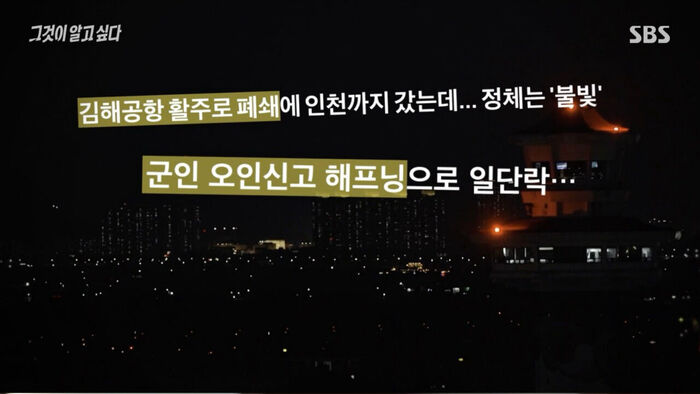
In response, the Air Force and police conducted a search for the flying object. However, they ultimately failed to identify the unknown object and closed the case, calling it a hap-ning caused by mistaking lights for a flying object.

Yet another informant revealed internal military radio comms from the time, stating that even the command leadership was mobilized to chase the flying object. However, the elusive object vanished for two hours, and its identity was never identified.
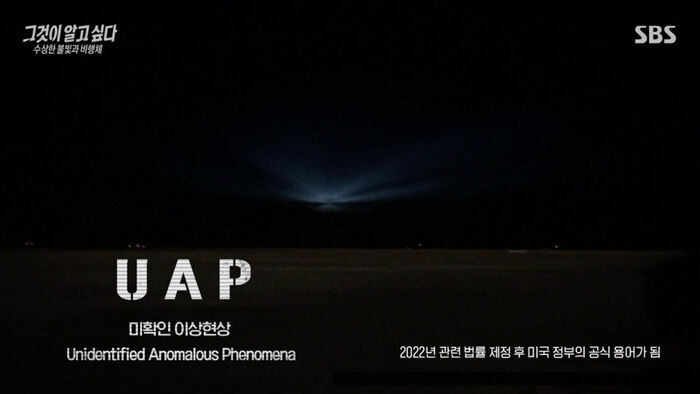
Last May, U.S. President Trump released footage regarding Unidentified Anomalous Phenomena (UAPs) collected by the U.S. across the globe over some 80 years. Amid rising interest in unidentified flying objects, what on earth is the identity of the object spotted at Gimhae Airport?

With various possibilities raised, an expert pointed out the need for attention toward various unmanned aerial vehicles, stating, "Because we tend to emphasize only the threat from North Korea, there is a lack of interest or will on our part to respond to unknown and unidentified threats. Countries around the world are already paying attention to non-military threats and broad security threats."

They also drew attention by voicing, "We need a shift in awareness that various unmanned aerial vehicles should not simply be dismissed as a matter of interest, but can pose a serious threat at the national security level."
(Kim Hyo-jung, Editor)
※ Please note: This article was translated by AI and may contain errors.
Copyright Ⓒ SBS. All rights reserved. Unauthorized reproduction, redistribution, and use for AI training are prohibited.