SBS News
Claims of 'No Favoritism' in 'Bakery Interview'... A Foredoomed Failure
Published : Jul 31, 2026 5:18 PM

An Army Under Abnormal Command Is Bound to...
When the northern Oirat tribe invaded, Wang Zhen, a eunuch who held power at the time, goaded the emperor—who had zero military experience—into personally leading the 500,000-strong army. However, actual command was exercised by non-experts, including Wang Zhen himself and eunuchs close to him. Tactical advice from military experts and generals was entirely ignored. Strategically absurd decisions were carried out. A prime example was Wang Zhen arbitrarily altering the army's march route so he could stop by his hometown to show off his power. This caused massive disruptions to supply lines, and the soldiers grew exhausted from forced marches. Ultimately, isolated in the disadvantageous terrain of Tumubao, they were ambushed by the Oirat forces. The Ming army was decimated, and Emperor Zhengtong was taken prisoner, suffering what is regarded as the greatest humiliation in Chinese history.
Appointing the Coach via a 'Bakery Interview'
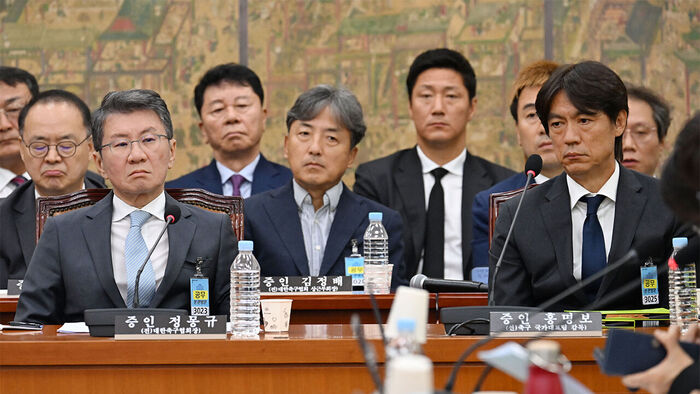
Lawmakers questioned whether it was lawful for former Technical Director Lee Lim-saeng to take over the authority to recommend and negotiate with coaching candidates after former National Team Committee Chairman Chung Hae-seong resigned, and ultimately make the final decision. Under KFA statutes, the recommendation of a national team head coach must go through official procedures and a vote by the National Team Committee. However, lawmakers poured criticism, pointing out that Lee arbitrarily taking over full authority violated association bylaws and constituted an illegal process. Criticisms were also raised that unlike other foreign manager candidates, Hong received special treatment through an unfair process. Lawmakers lashed out, noting that while other candidates were required to submit materials in advance, give PowerPoint presentations, and go through formal interview procedures, Hong was selected following a late-night visit by Lee for a so-called "bakery interview," asking whether he had received "tailored favoritism."
In response, former President Chung drew a line, stating, "There was no preferential treatment," and added that he had never given special favor to alumni of Korea University (which he attended). Former coach Hong also asserted, "The public might think meeting in front of my house [for an interview] was opaque," but insisted, "I never asked for any preferential treatment or benefit."
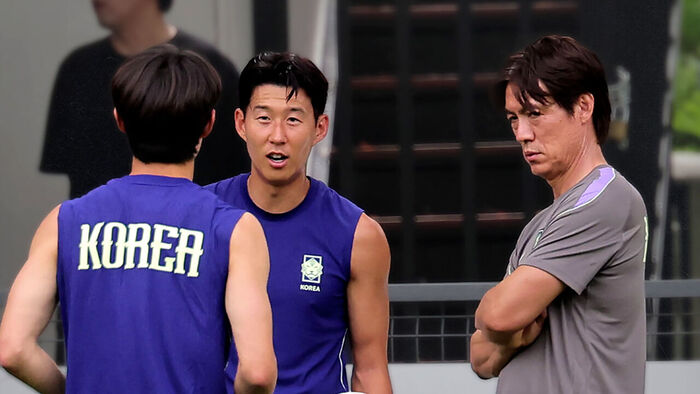
However, former President Chung failed to cite a clear clause supporting whether delegating full authority to former director Lee aligned with the association's statutes. Furthermore, while Hong denied asking for special treatment or benefits, he failed entirely to address how bypassing the verification system and evaluation process applied to other candidates was itself a form of special privilege. Having served as the KFA's executive director in 2017, Hong knew the coaching selection procedures better than anyone. Under such circumstances, stating after a late-night "bakery interview" that he "thought the KFA had carried out all proper procedures" is hard to accept at face value.
Failure Was Predetermined by Ignoring Due Process
① Weakened Cohesion Due to Lack of Legitimacy and Managerial Authority
A manager's leadership stems from fair procedures, internal approval, and the trust of fans and public opinion. However, taking office while losing procedural legitimacy due to the paralysis of the National Team Committee and controversy over special favors caused authority and trust to plunge to the ground. It was a structure where exercising strong leadership from the start was difficult. An appointment pushed through without internal consensus resulted in weakening the core pillar needed to unite the team in times of crisis.
② Psychological Pressure on the Squad from Ongoing External Controversy
Unable to focus on the core task of preparing for the tournament, the squad was exposed to intense conflict both inside and outside the football community. This led directly to a decline in concentration during matches. Endless controversies, including parliamentary hearings into the appointment process and fan protests, brought emotional uncertainty to the entire squad. In such a situation, a drop in morale was a natural consequence. The psychological burden of being an "unsupported national team" intensified, posing an obstacle to overcoming pressure on the main tournament stage.
③ Impairment of Tactical Receptivity and Completeness
Under a leadership structure lacking legitimacy, smooth communication and organic adjustments to enhance tactical completeness are difficult to achieve. Amid persistent doubts raised by fans and experts, efforts were rushed into managing public opinion rather than improving tactical completeness, ultimately failing to build a distinct team identity. This manifested as poor crisis management on the main tournament stage. The inflexible tactical responses and operational limitations shown against Mexico and South Africa following the victory against the Czech Republic in the first group match also have their roots in the improper managerial selection process.
④ Failure of Crisis Management and Absence of Accountability
A system built on unprincipled administration reveals vulnerabilities in high-intensity competitions like the tournament finals. It lacks the power to mediate internal conflicts and clashes of opinion or repair damage. Unfilled fine cracks cause irreversible ruptures under heavy pressure on the pitch. The moment performance faltered, there were no systemic assets to restore order or strong breakwaters to withstand criticism, leaving the team unable to reverse momentum once lost. The team's characteristic tenacity dissolved.
 Yesterday, a question raised by a lawmaker during the hearing drew media criticism and ridicule from football fans. "Why did you lose the match?" While it was certainly a foolish question, there is a wise answer. It is because the first button—the selection process for the national team head coach—was buttoned wrong. Even without a pointlessly shouting, responsibility-shirking hearing, we already know the answer. The key ultimately lies in whether collective intelligence can be exerted through lawful and fair procedures to achieve the best results going forward.
※ Please note: This article was translated by AI and may contain errors.
Copyright Ⓒ SBS. All rights reserved. Unauthorized reproduction, redistribution, and use for AI training are prohibited.