SBS News
BOK Says Seoul Metropolitan Area Saw Economic Recovery Driven by Semiconductor Boom, While Construction Slumped Across Most Regions
Published : Jul 29, 2026 1:28 PM

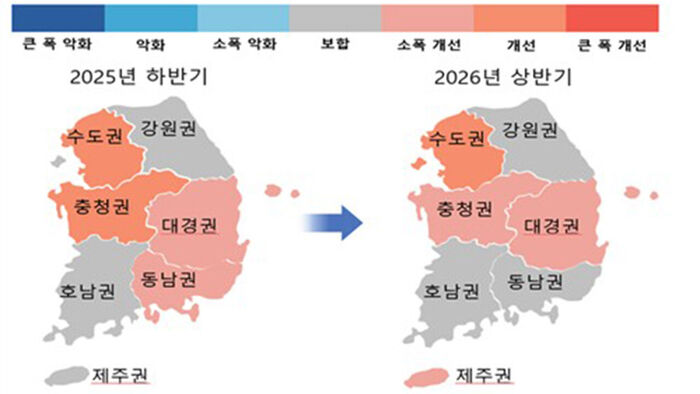
▲ Regional Economic Activity
Fueled by the semiconductor boom in the first half of this year, the regional economy showed signs of recovery, centering on the Seoul metropolitan area.
Meanwhile, the construction industry continued to slump across most regions due to burdens from construction costs and unstable supply and demand for materials.
In its regional economic report released today (the 29th), the Bank of Korea (BOK) stated, "In the first half of this year, the regional economy in the Seoul metropolitan area improved compared to the second half of last year, while the Chungcheong, Daegu-Gyeongbuk, and Jeju regions saw slight improvements. In contrast, the southeastern, Honam, and Gangwon regions remained flat."
The regional economic trends were influenced by differences in manufacturing sector conditions.
Manufacturing production increased, led by the Seoul metropolitan area, Chungcheong region, and Jeju region, driven by the semiconductor boom stemming from expanding demand for AI server memory.
The Daegu-Gyeongbuk region also saw a slight increase, centered on mobile phones, components, and steel.
On the other hand, production declined in the southeastern and Honam regions due to sluggishness in petro-chemicals and petroleum refining, while the Gangwon region saw drops in cement and auto parts production.
The BOK stated, "Looking ahead, manufacturing production is expected to improve, focusing on semiconductors in the Seoul metropolitan area, automobiles and shipbuilding in the southeastern region, steel and semiconductors in the Honam region, and medical devices and pharmaceuticals in the Gangwon region."
The service sector grew across all regions, backed by improved consumer sentiment and the government's consumption-stimulus policies.
The Seoul metropolitan area saw a modest increase as the finance and insurance sector expanded thanks to a buoyant stock market, while wholesale and retail, as well as accommodation and food services, showed solid growth.
Other regions also recorded slight increases, mainly in wholesale and retail and accommodation and food services, supported by improved consumer sentiment and an increase in domestic and foreign tourists.
In contrast, construction production continued to slump across most regions.
The BOK explained that rising construction costs caused by the Middle East crisis and unstable material supply and demand acted as downward pressures on the construction industry.
Production decreased in the southeastern, Chungcheong, Daegu-Gyeongbuk, and Gangwon regions, while the Seoul metropolitan area remained flat.
However, the Honam and Jeju regions showed slight improvements, mainly in the public sector, influenced by the expansion of social overhead capital (SOC) budget execution.
Jeong Min-su, head of the BOK's Regional Economy Investigation Team, stated, "Going forward, regional economies are expected to see slight improvements centered on the Seoul metropolitan area, Chungcheong region, and Gangwon region, driven by expectations of semiconductor plant expansions and public sector infrastructure commencements."
Private consumption edged up across all regions, supported by government policy measures such as high-oil-price relief funds and improved consumer sentiment.
Housing sales prices showed upward pressure during the first half of the year.
Housing sales prices (monthly average) in the Seoul metropolitan area during the first half rose 0.4 percent compared to the end of the previous period, maintaining an upward trend similar to the second half of last year (+0.4 percent).
While the upward momentum widened in the southeastern and Honam regions, the Gangwon region shifted to an upward trend, and the declines narrowed in the Chungcheong and Daegu-Gyeongbuk regions.
Conversely, the decline widened in the Jeju region.
Looking at inter-regional population migration between January and May (compared to the same period last year), net population inflow to the Seoul metropolitan area stood at 18,000 people, narrowing from the same period last year (+28,000 people).
The Chungcheong region saw a net influx of 99,000 people, an increase of 22,000.
Jeong explained, "Population migration does not change easily based on short-term movements. Job disparities stemming from the widening gap between regional economies, which has persisted for a considerable time, play the biggest role, and the movement of the younger generation is active."
The BOK stated, "The regional economy in the second half of the year is expected to see slight improvements across most regions or maintain the levels of the first half, as robust growth continues in major manufacturing industries such as semiconductors and automobiles."
(Photo provided by Bank of Korea, Yonhap News)
※ Please note: This article was translated by AI and may contain errors.
Copyright Ⓒ SBS. All rights reserved. Unauthorized reproduction, redistribution, and use for AI training are prohibited.