SBS News
'Real Estate' to Decide Lee's Fate... People Power Party Losing Momentum [Evening Briefing]
Published : Jul 24, 2026 5:27 PM

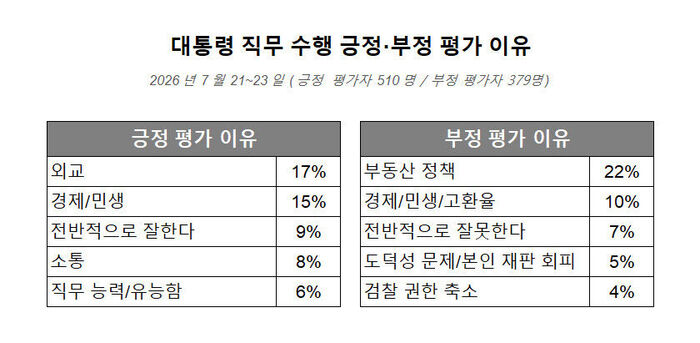
The reasons for positive evaluations are diplomacy (17%), economy and livelihood (15%), general competence (9%), communication (8%), and capability (6%), in that order. Real estate policy (22%) is overwhelmingly cited as the reason for negative evaluations. The number of respondents pointing to real estate increased by 11 percentage points from last week, exactly doubling. Economy and livelihood was the second most common reason for negative evaluations at 10%.
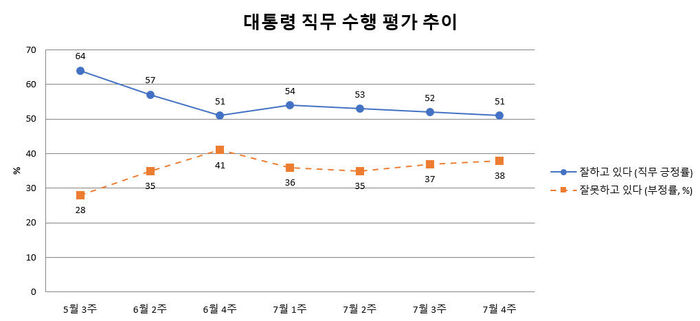
Real Estate Policy Tied to the Fate of the Lee Jae-myung Administration
However, the sector where positive and negative sentiments fluctuate most volatilely and where the negative rating itself is the highest is none other than real estate policy. Just four months ago in March, positive ratings rose to 51%, but in this survey, they halved to 26%. Negative evaluations dropped from 49% to 27% over a span of three to four months, only to bounce back to 46%.
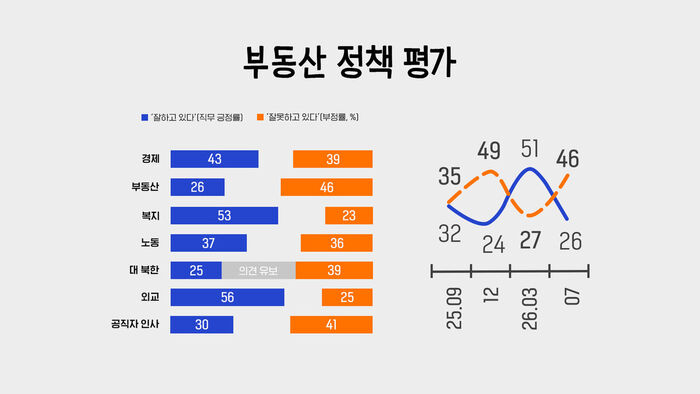 While real estate policy support previously rose due to a hardline stance on delaying heavy capital gains taxes for multiple homeowners, analysts suggest negative ratings have surged recently as the real estate market has become unstable and controversies surrounding the sale of the President's Bundang private residence have grown. (However, it is difficult to consider yesterday's National Public Debate on Real Estate held on the 23rd as having been fully reflected in this survey.)
Real estate issues have traditionally been sensitive to public opinion and difficult to manage successfully, and evaluations are fluctuating further amid recent market instability and scheduled tax system reforms, such as holding taxes. In particular, while public demand to overhaul loan regulations surged following the transaction of the President's Bundang home, the failure to provide sufficient answers regarding this during the real estate public debate may also work negatively. The numbers increasingly clarify that the success or failure of real estate policy is the core link determining the fate of the Lee Jae-myung administration in its second year in office.
Anxieties Growing in Seoul's Real Estate Public Sentiment
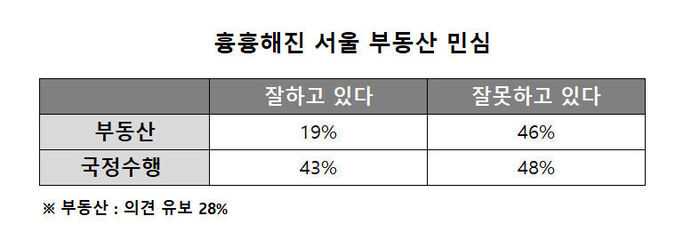
Let us compare two sets of figures. In the presidential job performance evaluation, Seoul showed 43% positive and 48% negative. Although negative sentiments are slightly higher, it is within the margin of error statistically. However, regarding real estate policy, positive evaluations stood at 19% and negative evaluations at 59%, showing an overwhelmingly high negative response. This is 11 percentage points higher than the overall negative rating of 46%. Higher even than Daegu and North Gyeongsang Province at 58%—which traditionally gives the harshest evaluations to the Lee Jae-myung administration—Seoul is currently the region with the most anxious real estate sentiment nationwide.
 The holding tax hike plans being prepared by the Lee Jae-myung administration are also highly likely to further worsen real estate sentiment in Seoul. While 97% of apartment complexes nationwide have a government-assessed value of 1.2 billion KRW or less (according to Ministry of Land, Infrastructure and Transport data), apartments valued between 1.5 billion KRW and 2.5 billion KRW account for 23.5% (approx. 350,000 units) of the total in Seoul, and those exceeding 2.5 billion KRW account for 16.8% (approx. 250,000 units) (according to Real Estate 114 data). This means hundreds of thousands of people will be directly hit by tightened holding tax measures.
Depending on how the criteria for ultra-luxury apartments and holding tax weighting standards are determined, Seoul's real estate sentiment is bound to fluctuate. Yet, the "negative" direction is unmistakably clear, varying only in intensity. President Lee Jae-myung has announced he will handle the holding tax issue regardless of political gains and losses, raising questions about how he will navigate the differing policy effects and public opinion trends between the nationwide scale and Seoul.
People Power Party Loses Momentum... Beginning of a 'Fall'?
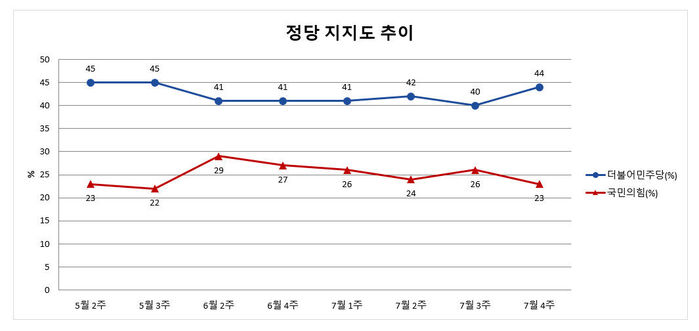 The Democratic Party's rising ratings may have been influenced by a convention effect, as its national convention is currently in full swing. Although internal conflicts are exploding—including provocative commentary by writer Yu Si-min—this can be interpreted as a rallying effect for its core supporters. Conversely, the People Power Party's ratings are stagnating and falling as it fails to properly respond to demands for conservative rebuilding and leadership renewal revealed in the local elections.
Various factions within the People Power Party are busy "calculating" regarding the future of leader Jang Dong-hyeok while hesitating in taking "action." Meanwhile, leader Jang Dong-hyeok is going "all-in" on the voting rights protest at Olympic Park. The conservative support base's demands to break away from the past and establish new leadership are receiving no response. Losing momentum is a natural consequence. Party approval ratings are like riding a bicycle; if you do not keep peddling, you lose momentum and stall. How much longer can they hold out by putting the mandate of public sentiment on the back burner under the pretext of factional interests and calculations?
※ Please note: This article was translated by AI and may contain errors.
Copyright Ⓒ SBS. All rights reserved. Unauthorized reproduction, redistribution, and use for AI training are prohibited.