SBS News
North Korea Revives 'Human Bomb Heroes' in Propaganda Echoing Glorification of Self-Detonation
Published : Jul 24, 2026 5:04 PM
"Blocked the Gun Port with His Chest": Highlighting 'Human Bomb Heroes' of the 1950s
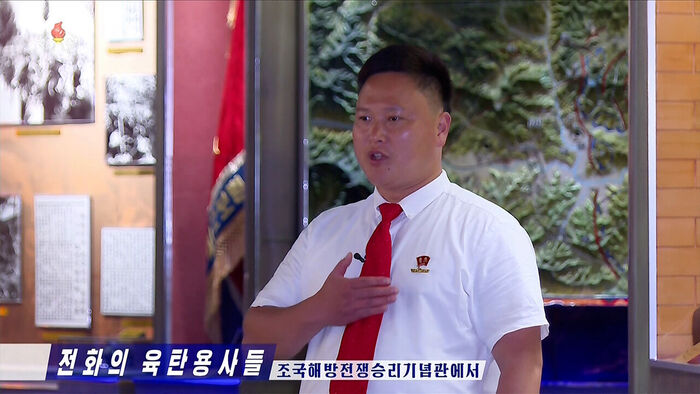
Korean Central Television (KCTV) reported on the evening of July 24 that a group of university students wearing uniforms with white shirts and red neckties or decorative ribbons recently visited the museum. This visit was part of an ideological education campaign held ahead of July 27, the anniversary of the signing of the Armistice Agreement, which North Korea calls "Victory Day." The museum houses around 30 exhibition halls and rooms, and the space highlighted in the broadcast was the "Heroes Hall," which displays records of over 620 individuals. Among those featured were the so-called "human bomb heroes," of whom 24 exist out of the 620 individuals.
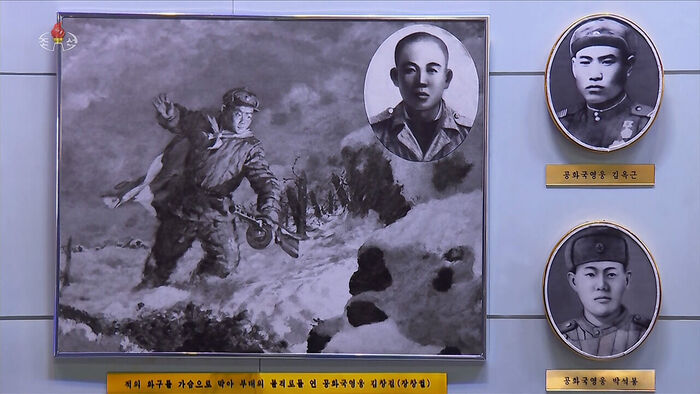 "Yuktan" (human bomb) refers to the act of using one's body as a projectile to attack enemy positions, or to a person who carries out such an act. A museum lecturer praised these figures, mentioning their names one by one and noting that there was even an instance where three "human bomb heroes" came from a single platoon. According to the description of "meritorious deeds" shown on screen, an individual named Kim Ok-geun "blocked an enemy gun port in the area of Chugok-ri, Yanggu County on December 25, 1950, opening an assault path for his unit."
The lecturer heightened the atmosphere with explanations such as, "Their bodies literally became human bombs," and "He blocked the enemy machine gun with his chest." A youth who underwent the training responded by saying, "The lives of the human bomb heroes remind us young university students that a life dedicated to the Party, the Leader, and the people lasts forever." Perhaps reflecting the totalitarian nature of prioritizing only the collective, the name of the university student who was interviewed was not even introduced.
"Stars of the Fatherland" for Troop Deployment to Russia: The Ongoing Hero-Making Process
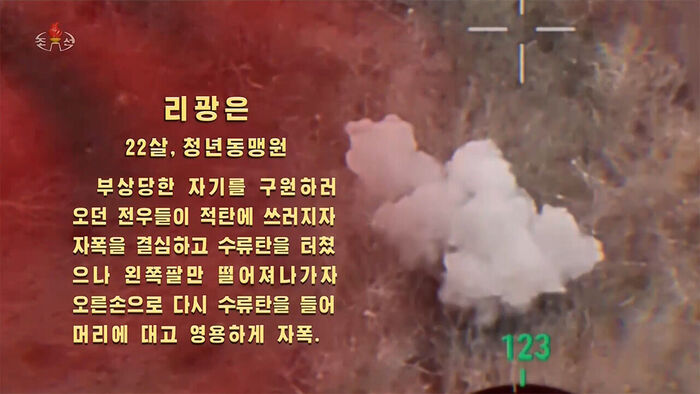
North Korea has repeatedly glorified those who committed self-detonation during their deployment to Russia, calling them "stars of the fatherland." Like the case of Kim Ok-geun, the details of how they died have also been introduced through videos. An individual named Ri Kwang-eun reportedly attempted self-detonation with a hand grenade after his comrades who came to rescue him were struck down; when his first attempt failed, he held a grenade to his head to detonate it again. Another individual named Ri Hong-nam is said to have broken through a minefield with his own body to clear a path when there was insufficient time for mine clearance.
 Shedding light again on deaths caused by human bomb attacks during the Korean War and introducing self-detonation cases of troops deployed to Russia as heroic tales—though the eras and locations differ, the values emphasized by North Korea appear largely unchanged. It is repeatedly exposing what could be considered an extreme form of action as the most ideal act of loyalty. Honoring those who gave their lives for their country is not unique to North Korea. However, North Korea clearly differs in that it does not stop at merely commemorating sacrifice. (However, the reality of the battlefield is understood to have differed from North Korean propaganda. According to a briefing by the National Intelligence Service to the National Assembly Intelligence Committee in January last year, notes left by fallen North Korean soldiers reportedly included content emphasizing self-detonation or suicide before being captured.)
Why Bring Back 'Human Bomb Heroes' Now?
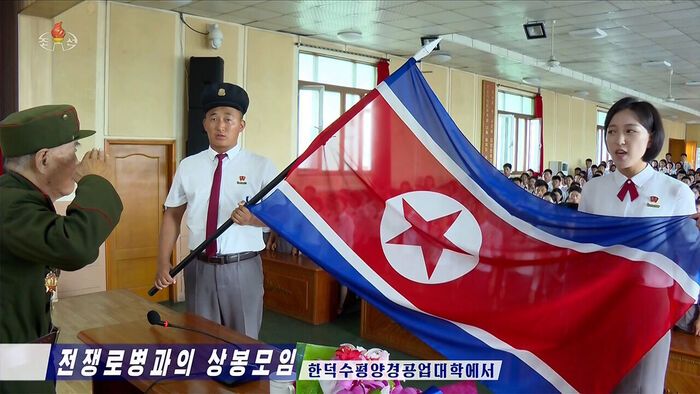
The first is a routine factor. It is because this period marks the annual season of intensive ideological education. North Korea operates the period from June 25, when the Korean War broke out, to July 27, the anniversary of the armistice signing, as the "Month of Joint Anti-US Struggle." Indeed, during this period, large-scale education is conducted targeting not only youth and students but also various strata of society. War veterans visit schools to share their combat experiences from that time and emphasize the need to defend the fatherland to the end. A staple part of these events involves a war veteran handing over the North Korean flag to young people, who receive it while shouting oaths of determination. On July 24, Korean Central Television also broadcast video footage showing war veterans in their 90s giving lectures at Han Tok Su Pyongyang University of Light Industry and Pyongyang University of Tourism. The veteran in his 90s urged students to "fly high the flag defended with blood," and the students responded that they would carry on that spirit. During this period, North Korea transforms into a massive arena for security education.
 Another presumed reason is the recent international security environment. Outside North Korea, multiple wars are unfolding simultaneously—between Russia and Ukraine, the U.S. and Iran, and Israel and Hamas. While some of these conflicts may resemble David versus Goliath struggles, the outcome of none of these wars is being decided solely by military power indicators. Despite significant disparities in military strength, there has been no overwhelming victory, and the wars are becoming prolonged. Although variables like drones and the Strait of Hormuz have been decisive, the endurance of the seemingly weaker side can also be viewed as an important factor. This does not mean North Korea intensified such education believing a war on the Korean Peninsula is imminent. Rather, as it watches these wars, North Korea likely realizes anew that to endure long in an emergency, it requires not only weapons and troop strength but also the ideological unity and militant mindset of its citizens. Following the extensive glorification of the sacrifices made by troops deployed to Russia, bringing back "human bomb heroes" from the Korean War can be understood in this context. It is interpreted as an effort to instill in advance an attitude of obeying orders completely, standing firm against the enemy, and enduring to the end.
How Much Appeal Does It Have? Even in North Korea, 'People These Days' Are Said to Be Different
Daily NK, a media outlet specializing in North Korea, cited a source in North Hamgyong Province as reporting in June—when class education programs were stepped up—that many participants felt fatigued, thinking "it's the same old story repeated over and over." Even Kim Jong-un was quoted as saying, "Among some officials, there are those who say people these days are different from people of past eras and are clinging to material aspects rather than ideological factors in Party work." This suggests that the atmosphere in North Korean society has also changed significantly. The fact that the importance of extreme sacrifice is being continuously reinforced may paradoxically suggest that North Korea is also transforming into a society where such readiness can no longer be taken for granted.
※ Please note: This article was translated by AI and may contain errors.
Copyright Ⓒ SBS. All rights reserved. Unauthorized reproduction, redistribution, and use for AI training are prohibited.