SBS News
"Chinese and Japanese Foreign Chiefs Had a Brief Conversation in Manila"… First Since Bilateral Relations Strained
Published : Jul 23, 2026 6:59 PM

▲ Chinese Foreign Minister Wang Yi
The foreign chiefs of China and Japan held talks for the first time since bilateral relations became strained following Japanese Prime Minister Sanae Takaichi's remarks in November of last year regarding intervention in a contingency involving Taiwan, Kyodo News reported on the 23rd.
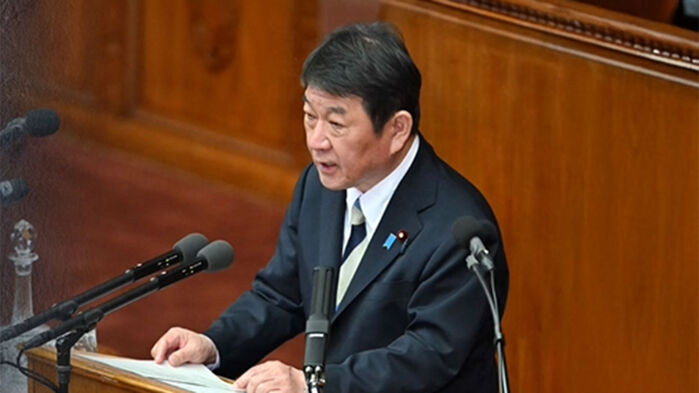
According to the report, Japanese Foreign Minister Toshimitsu Motegi met with reporters in Manila, the Philippines, where the Association of Southeast Asian Nations (ASEAN) Foreign Ministers' Meeting is being held, and stated that he had a brief conversation with Chinese Foreign Minister Wang Yi regarding bilateral relations.
Foreign Minister Motegi explained that he happened to run into Minister Wang while they were each carrying out their schedules at the venue where the ASEAN Foreign Ministers' Meeting is taking place, leading to the conversation.
While Foreign Minister Motegi said he spoke with Minister Wang about bilateral relations, the specific details of the conversation have not been made known.
He emphasized, "Japan is open to dialogue at all levels," adding, "Japan and China play major roles in regional peace. It is very important to continue dialogue moving forward."
The last official contact between the foreign ministers of China and Japan was a telephone conversation held on October 28 of last year to mark Foreign Minister Motegi taking office.
Chinese President Xi Jinping and Prime Minister Takaichi held an in-person summit in Gyeongju on October 31 of the same year, shortly after that phone call.
However, dialogue between the two countries was cut off after Prime Minister Takaichi attended parliament a week later on November 7 and remarked, "If [China] uses warships to carry out the use of force [against Taiwan], I think it could constitute a survival-threatening situation [allowing for Japan's military intervention]," prompting China to protest and designate it as an interference in internal affairs.
Since then, China has pressured Japan by issuing advisories to its citizens to refrain from traveling and studying in Japan, and by restricting the export of dual-use goods that can be utilized for both civilian and military purposes.
China has not confirmed the fact of the conversation between the two countries' foreign ministers.
During a regular briefing on that day, Chinese Foreign Ministry Spokesperson Lin Jian responded to a question about the meeting between Minister Wang and Foreign Minister Motegi without providing specific details, saying, "As far as I know, during this visit to Manila, Minister Wang Yi has no plans to meet with the Japanese side."
Kyodo News reported that the focal point is whether this contact between Minister Wang and Foreign Minister Motegi can serve as a stepping stone for arranging a summit between Prime Minister Takaichi and President Xi Jinping during the Asia-Pacific Economic Cooperation (APEC) summit in Shenzhen, China, in November of this year.
Minister Wang did not attend the ASEAN Plus Three (APT, ASEAN and South China-Japan) Foreign Ministers' Meeting or the ASEAN Regional Forum (ARF), a regional multilateral security consultative body, held in Manila that day.
The previous day at the ASEAN Foreign Ministers' Meeting, Minister Wang targeted Japan, stating, "We will absolutely not tolerate the resurgence of militarism."
In response, Japanese government spokesperson Chief Cabinet Secretary Minoru Kihara stated during a press conference, "Our country [Japan] has consistently walked the path of a peace nation since the post-war period and has defended freedom, democracy, and the rule of law," adding, "We have contributed to world peace and prosperity, and have received the trust and support of many countries, including Asia."
Having held bilateral meetings with ASEAN nations and major countries such as the United States in Manila the previous day, Minister Wang traveled to Kyrgyzstan on that day to attend the Shanghai Cooperation Organization (SCO) Foreign Ministers' Meeting.
Spokesperson Lin explained, "Due to scheduling reasons, Minister Wang Yi found it difficult to participate in the entire schedule of the East Asia cooperation foreign ministers' meetings," and added, "A high-ranking Chinese official will attend the APT and ARF as a representative."
(Photo: AP, Yonhap News)
※ Please note: This article was translated by AI and may contain errors.
Copyright Ⓒ SBS. All rights reserved. Unauthorized reproduction, redistribution, and use for AI training are prohibited.