SBS News
Over 1 Billion Won in Cash Found Packed in Travel Bag at Home of 6.4 Billion Won Tax Delinquent
Published : Jul 23, 2026 3:13 PM

▲ A total of 1.02 billion won is found inside a travel bag seized by the National Tax Service and Korea Customs Service last month from the residence of person A, who owes 6.4 billion won in national and customs taxes. (Photo: Yonhap News)
The National Tax Service (NTS) and the Korea Customs Service (KCS) announced today (July 23) that as a result of a joint raid conducted last month targeting 16 high-value and habitual tax delinquents, they seized a total of 1.3 billion won in hidden assets and secured promises of installment payments from some individuals.
Person A, a man in his 40s who operates an e-cigarette trading business, had his cash and check bundles totaling over 1 billion won seized after keeping them inside a travel bag.
He became a target of tax authorities after failing to pay a total of 6.4 billion won in individual consumption taxes, value-added taxes, and other levies through false declarations of raw materials and underreporting of sales.
The joint NTS-KCS search team raided A's home in Seoul, but after A's mother refused to open the door for two hours and even a police officer was dispatched, they ultimately forced their way inside.
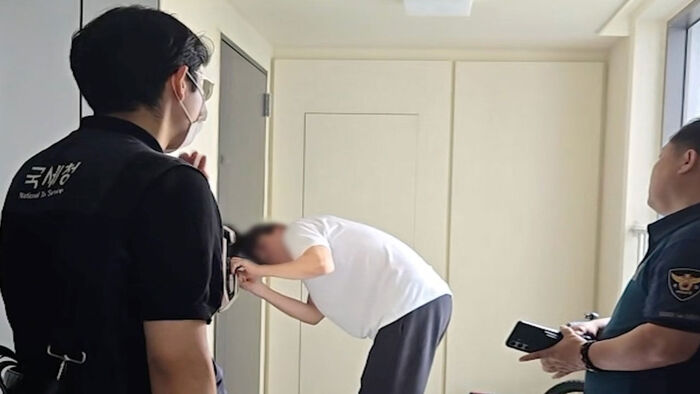
A's mother protested against the joint search team, calling it "unlawful trespassing," and refused to unlock the travel bag found in the master bedroom.
The joint search team seized the travel bag in its entirety, opened it, and discovered and seized a total of 1.02 billion won worth of hidden cash, including 540 million won in cash bundles and 480 million won in check bundles.
Targets of joint searches like person A are individuals who have defaulted on both national and customs taxes simultaneously, and are malicious delinquents who lead luxury lifestyles despite having the ability to pay their taxes.
The NTS exchanged data on hidden asset realities, luxury lifestyles, and actual residence analysis, while the KCS shared core asset-hiding information such as the registered address of customs clearance codes.
Regional tax offices and customs houses conducted precise data analysis, followed by stakeouts and inquiries to finalize the search targets and locations.
Ultimately, depending on the delinquent's jurisdiction, eight joint search teams consisting of around 10 members each were formed and deployed to initiate searches.
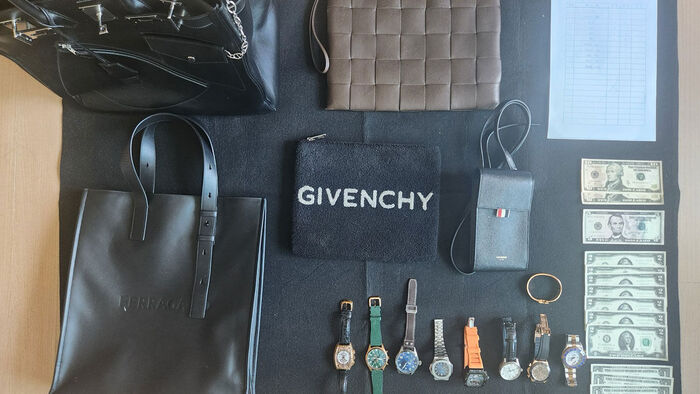
Person B, a person in their 50s who unpaid 120 million won in national and customs taxes—including failing to report capital gains tax from land transfers—was selected as a search target due to leading a luxury lifestyle, having departed the country 127 times over the past five years.
Following a search of B's home in Hwaseong, Gyeonggi Province, authorities seized five designer bags, one luxury bracelet, eight watches, and 15 promissory notes worth 500 million won from a carrier, and proceeded to collect on them sequentially.
Person C, a mold manufacturer in his 60s, had long failed to pay approximately 550 million won in value-added and corporate taxes.
The two agencies selected C as a joint search target, suspecting that he was evading compulsory collection through a sham divorce, given that he was actually residing in a large apartment in Daegu registered under his divorced former spouse.
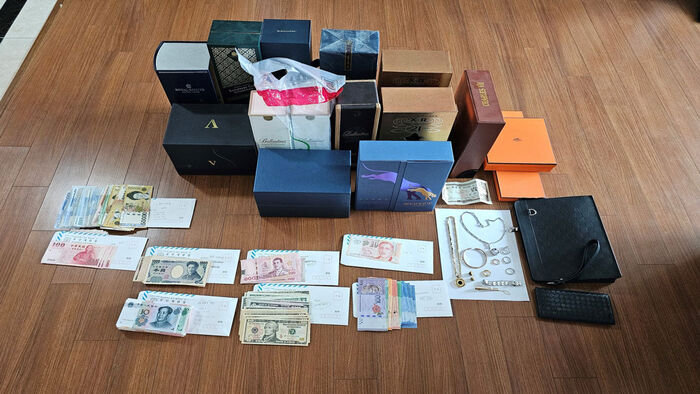
Just before authorities forced the door open, the former spouse opened it, and officials discovered a total of 26 million won worth of assets, including 9 million won in cash equivalents kept in a personal safe and gold rings.
The former spouse claimed, "These are my jewelry," but authorities explained the procedure for lifting seizures and seized all discovered assets.
Ha Yoo-jung, Director General of the Audit Bureau at the Korea Customs Service, explained, "If it is clearly demonstrated under the National Tax Collection Act that assets found at a location presumed to be a delinquent's living quarters belong to a third party, the seizure is lifted. Until then, however, they are treated as being related to the delinquent and are seized."
Building on this success, the NTS and KCS plan to regularize the exchange of information regarding hidden assets and living conditions of individuals delinquent on both national and customs taxes, maintaining continuous joint responses.
Kang Jong-hoon, Director General of the Collection and Legal Bureau at the National Tax Service, evaluated, "While the two agencies have previously cooperated in areas such as tax refunds, this instance was significant in that each agency shared its superior information to conduct more precise searches. The success rate of this search was around 80%, yielding vastly superior results compared to independent searches."
(Photo provided by the National Tax Service, Yonhap News)
※ Please note: This article was translated by AI and may contain errors.
Copyright Ⓒ SBS. All rights reserved. Unauthorized reproduction, redistribution, and use for AI training are prohibited.