SBS News
Why Are Pregnancy Badges Appearing on Secondhand Markets? "Non-Pregnant Users Could Face Fraud Charges"
Published : Jul 20, 2026 5:58 AM
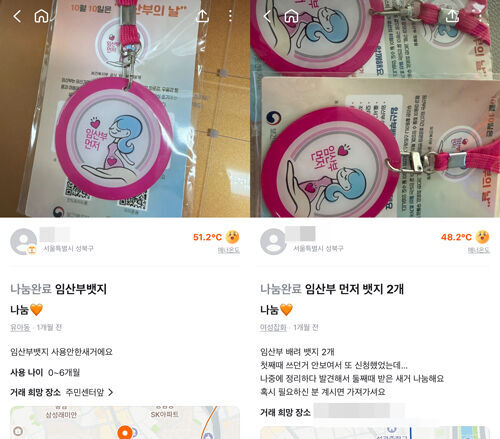
▲ A pregnancy badge given away for free on the secondhand platform Danggeun
The trading of pregnancy badges, which serve as proof of pregnancy and provide access to various benefits, on secondhand transaction platforms has sparked controversy.
On June 26, a screenshot of a pregnancy badge being traded on a secondhand platform was posted on Threads, garnering approximately 410,000 views.
The sales post in the image included a description stating that it is "useful for using priority seats for pregnant women."
Currently, the sale of pregnancy badges for money is prohibited.
An official from the Ministry of Health and Welfare's Childbirth Policy Division stated on July 15, "We are aware of some cases of misuse, but physical collection is difficult because the cost of retrieving the badges exceeds the production cost." The official added, "As the pregnancy badge system is designed to improve public awareness, voluntary consideration and mature civic consciousness among citizens are essential."
The pregnancy badge was designed to protect expectant mothers, especially in the early stages of pregnancy when it is not physically visible, and to encourage the yielding of priority seats on public transportation.
The badges are issued to pregnant women who have received a medical diagnosis and hold a pregnancy confirmation certificate.
They are typically available at local public health centers, and some regions also distribute them at subway station offices.
Since any pregnant woman can receive one, it is an item that, in principle, should have no reason to be traded on the secondhand market.
However, until recently, allegations were raised that pregnancy badges were being traded on secondhand platforms for prices ranging from several thousand won to 10,000 won.
This is because the badges allow holders to receive various benefits.
In addition to using priority seats on public transportation, pregnant women can receive preferential services at airports and airlines, as well as discounts at popular restaurants.
For example, major airlines and Incheon International Airport offer dedicated counters and priority boarding and processing, while some hotel buffets provide discounts of 20 to 50 percent.
While most places require additional proof such as a maternity handbook, some establishments accept the badge itself as sufficient evidence.
Previously, in 2024, the famous Daejeon bakery Seongsimdang offered discounts and priority entry to pregnant women, but after controversy over misuse grew, the bakery changed its policy to require additional verification documents such as a maternity handbook.
In April, a company that manufactures and supplies pregnancy badges posted a notice on its website stating, "We have received news that pregnancy badges are being traded at high prices on secondhand platforms or misused as a 'free pass' at famous restaurants or on public transportation." The company added, "Inquiries about individual purchases are increasing, but we do not sell to individuals."
As of July 17, while instances of pregnancy badges being 'sold' on secondhand platforms like Danggeun are not readily visible, posts offering them for free, saying "Take it if you need it," continue to appear.
Pregnant women argue that 'sharing' these badges is necessary due to the risk of loss or for daily convenience.
A woman surnamed Lee (34) said, "I lost my badge a few days ago," adding, "Public health centers close at 6 p.m. on weekdays, so as a working mom, I don't have time to get a replacement unless I take a half-day off. I received a lot of help thanks to someone who gave one away for free on Danggeun."
She argued, "There may be unavoidable situations, and while there is a risk of misuse, blocking even free sharing seems like an excessive measure."
Meanwhile, a woman surnamed Kim (29) said, "It is quite cumbersome to switch the pregnancy badge between bags," adding, "I obtained an extra one through a local parenting community or secondhand sharing to keep one on each of my bags."
She added, "If even well-intentioned sharing is blocked, it seems it will only increase the inconvenience for pregnant women."
However, there is also strong opposition arguing that even free sharing should be strictly regulated to prevent 'misuse.'
A woman surnamed Park (32), who is three months pregnant, asked, "Even if it is a free giveaway, how can you verify it if the person coming to pick it up lies and says they are picking it up for someone else?"
She pointed out, "The pregnancy badge is like a form of identification," adding, "It is right for public health centers or community service centers to thoroughly check maternity handbooks for reissuance or additional issuance, even if it is a bit inconvenient."
A woman surnamed Jung (33), who gave birth three months ago, said, "I thought about sharing my badge after giving birth, but I just put it away in case someone misused it," adding, "It would be good to create a retrieval system, such as making the badge unusable after the expected due date or exchanging it for a small gift if returned to the public health center."
While secondhand platforms prohibit the sale of pregnancy badges, they do not restrict sharing.
An official from the Danggeun public relations team stated, "We manage public support items, including pregnancy badges, as prohibited items for trade," but added, "As there are cases where users in need cannot receive them in time due to shortages, we do not restrict public-interest sharing that delivers items to those who actually need them."
An official from the Joonggonara public relations team said, "Considering the purpose of the pregnancy badge, we restrict the registration of such items for sale," adding, "If we receive a separate request for cooperation from relevant agencies regarding the trading of pregnancy badges in the future, we will actively review and discuss it."
However, the legal criteria for punishing the sale of pregnancy badges for money remain ambiguous.
Choi Gwang-hyun, a lawyer at the law firm Daeryun, explained, "There are no explicit regulations in current law that directly punish the act of selling or purchasing pregnancy badges themselves." He added, "However, if the issuing authority clearly stated conditions such as 'for use by the pregnant woman only' or 'transfer and sale prohibited,' civil liability could arise for violating those conditions."
He further pointed out, "Presenting a badge as if one is pregnant when they are not constitutes a legal 'act of deception,'" and warned, "Depending on the nature of the benefits obtained through this, there is a possibility of legal punishment under other laws, such as fraud, obstruction of business, or the illegal use of official marks."
Jung Jae-hoon, a professor of social welfare at Seoul Women's University (CEO of Gyeongbuk Happiness Foundation), noted, "A return system must be established to ensure the badges can be reliably collected after childbirth." He pointed out, "Currently, there is no management of expiration dates, leaving the badges neglected and highly likely to lead to secondhand trading or unauthorized use."
Professor Jung advised, "In welfare states like Germany, citizens deeply understand the purpose of welfare systems, so a culture has formed where people voluntarily report cases of abuse when they discover them," adding, "Rather than just shouting 'illegal use prohibited,' we should create a virtuous cycle where citizens monitor and show consideration for each other by actively promoting why pregnancy badges are necessary."
(Photo: Screenshot of Danggeun app, Yonhap News)
※ Please note: This article was translated by AI and may contain errors.
Copyright Ⓒ SBS. All rights reserved. Unauthorized reproduction, redistribution, and use for AI training are prohibited.