SBS News
China Throws Cold Water on Japan's "Innovation" Celebration with Mocking Confidence
Published : Jul 10, 2026 3:16 PM
China Downplays Japan's 'Rare Earth Recycling' Project
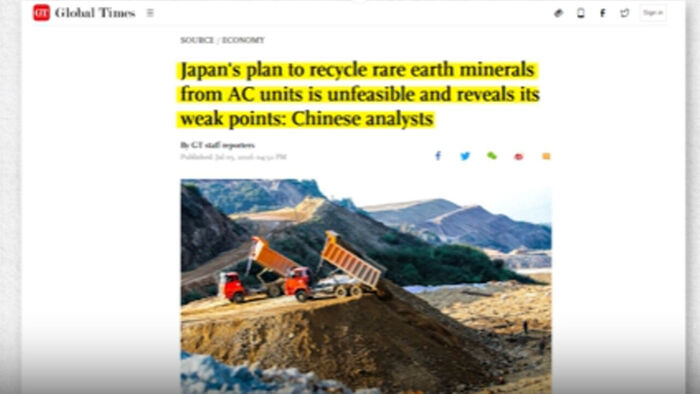 The claim is that Japan has established a so-called "fully circular system" for the first time, extracting rare earths from discarded home appliances and feeding them back into its own products. As China tightens export controls on rare earth-related technologies and items, citing potential military diversion, a red alert has been triggered for Japan's high-performance permanent magnet supply chain. Stepping in as a relief pitcher is Mitsubishi Electric, a major Japanese home appliance and defense company. Mitsubishi Electric has partnered with materials and refining specialists such as Shin-Etsu Chemical and Eco Advance to establish a "closed-loop recycling" system completed entirely within Japan. The specific process is as follows: First, a partner company of Mitsubishi Electric separates the "compressor," a core component, from discarded air conditioner outdoor units collected in accordance with the Home Appliance Recycling Act. In the next step, a company called Eco Advance safely extracts high-performance magnets from the motors inside the separated compressors. In the third step, Shin-Etsu Chemical, a leading Japanese chemical company, melts these magnets to cleanly separate and refine four key rare earth elements, including neodymium, contained within them. The core of the plan is for Mitsubishi Electric to then use these recovered rare earths to manufacture new air conditioners.
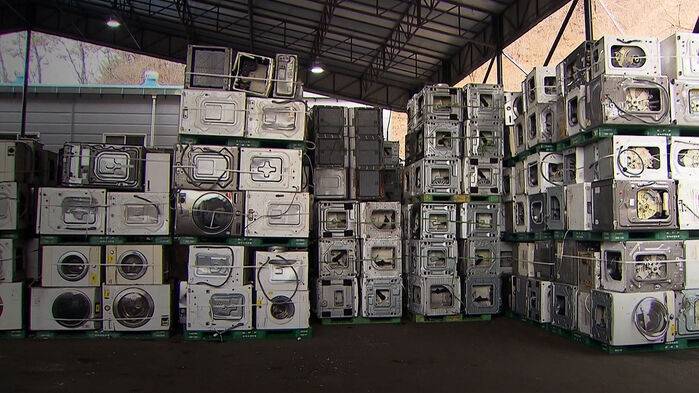 According to the press release, Mitsubishi Electric projects that this technology will allow it to self-supply up to 35% of the specific rare earth demand required for manufacturing air conditioners. If successful, it comes close to an ideal model of "urban mining," extracting critical resources from discarded home appliances without digging up any ground. Consequently, Japanese media celebrated this, calling it "an innovative breakthrough to counter China's weaponization of resources."
Why Is China Criticizing It?
[Dr. Han Yo-sep / Resource Utilization Research Division, Korea Institute of Geoscience and Mineral Resources (KIGAM): (Then how should we obtain heavy rare earths?) We are also researching heavy rare earths at our institute, and it is extremely difficult. Even obtaining samples is very hard. They don't trade them. And when dealing with foreign entities, there are quite a few cases of getting scammed. Often, we buy what is claimed to be raw ore in quantities of 1 ton or 500 kg, but when we analyze it, there is almost nothing in it. Rather than getting them from such sources, what we currently focus on most... heavy rare earths are used in wind power, electric vehicles, or three-stage motors used in physical AI. It is true that Japan and China have a tight grip on heavy rare earths.]

What About South Korea?
[Dr. Han Yo-sep / Resource Utilization Research Division, Korea Institute of Geoscience and Mineral Resources (KIGAM): Non-Chinese countries are doing this to secure resources. They are doing this for stockpiling purposes in case China, for example, plays games. It is not actually a business aimed at beating China in the industry. From China's perspective, it makes sense to say that, because their unit costs are so cheap and ore is abundant. They can say that, but smaller countries have no choice but to do it. They have to have it.]
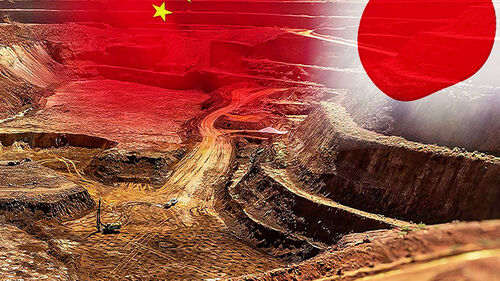
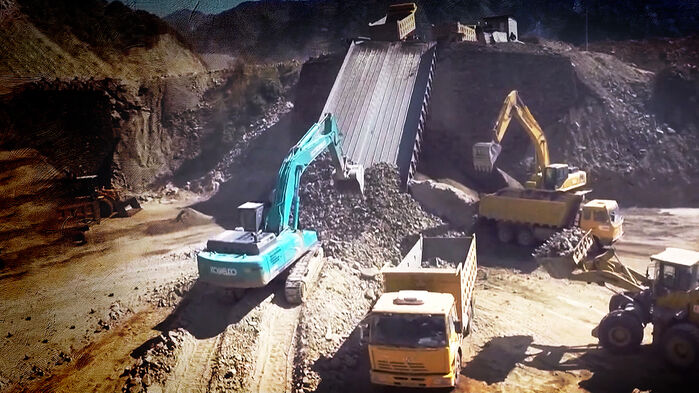 Just as important as importing minerals is the proprietary technology that allows them to be distributed and used across various industrial sectors. The reason Japan can hold its ground despite Chinese pressure is that global materials companies like Shin-Etsu Chemical possess world-class refining technologies. Of course, South Korean state-run research institutes, such as KIGAM, have also already developed proprietary technologies to separate and refine high-purity rare earths from waste magnets or minerals. We have caught up significantly, even when compared to Japan, a leading nation. However, the problem is that we have not "scaled up" these technologies to a factory level. Building a large-scale refining plant requires massive capital, as well as bearing the costs of treating the enormous amount of wastewater and environmental pollutants generated during the refining process. Because companies have been reluctant to invest due to low economic feasibility, there are virtually no large-scale commercial refining facilities in South Korea. While there are companies that ultimately manufacture permanent magnets, the middle stage of the supply chain is missing. Consequently, even with the technology, we currently suffer from a structural vulnerability where we have no choice but to import raw materials from China or semi-finished raw materials processed in Japan. This is why experts point out that we must make bold investments in core materials technologies, such as battery recycling and waste motor refining technologies. We cannot afford to just stand by and watch the rare earth war between China and Japan. If we have no resources to mine, making technology our mine is our path to survival.
 Video
Video※ Please note: This article was translated by AI and may contain errors.
Copyright Ⓒ SBS. All rights reserved. Unauthorized reproduction, redistribution, and use for AI training are prohibited.