SBS News
Land Transaction Permit Zones Designated Near Gwangju Military Airport; Effective from the 14th
Published : Jul 9, 2026 5:09 PM

▲ A passenger plane takes off from Gwangju Military Airport in Gwangsan-gu, Gwangju, Jeonnam, on the 7th.
The site of the Gwangju Military Airport and its surrounding areas, designated as the location for the Honam Semiconductor Cluster, have been designated as land transaction permit zones.
The Ministry of Land, Infrastructure and Transport announced on the 9th that, following a review by the Central Urban Planning Committee, a total of 364.19 square kilometers in the vicinity of the planned Honam High-Tech Semiconductor National Industrial Complex will be designated as land transaction permit zones for two years.
The affected areas include Dong-gu, Seo-gu, Nam-gu, Buk-gu, and Gwangsan-gu in the Jeonnam-Gwangju Integrated Special City, as well as Naju, Jangseong-gun, and Hwasun-gun.
The designation will take effect on the 14th and will remain in place until July 13, 2028.
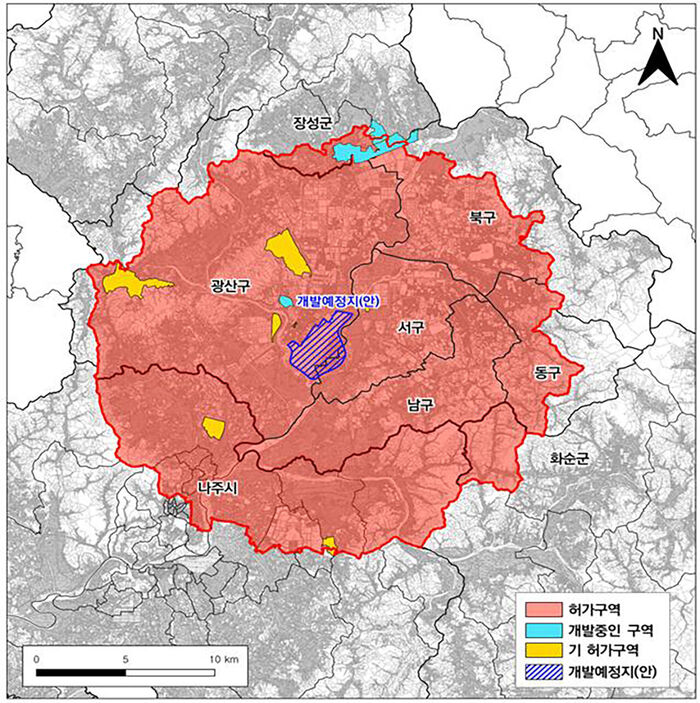
▲ Designated land transaction permit zone areas
These land transaction permit zones have been finalized based on the boundaries of legal dongs and ris, covering the planned site for the Honam High-Tech Semiconductor National Industrial Complex and its surrounding areas.
All land transactions exceeding a certain area based on the zoning category must receive prior approval.
In urban areas, approval is required for residential land exceeding 60 square meters, commercial and industrial land exceeding 150 square meters, and greenbelt land exceeding 200 square meters.
For areas without specific zoning designations, transactions exceeding 60 square meters require approval.
In areas outside of urban zones, approval is required for farmland exceeding 500 square meters, forests exceeding 1,000 square meters, and other types of land exceeding 250 square meters.
Since Gwangju Military Airport was selected on the 6th as the site for the Honam Semiconductor Cluster project—one of the government's three major mega-projects—concerns have been raised regarding the potential influx of speculative demand driven by expectations of development.
The Ministry of Land, Infrastructure and Transport initiated the process of designating these land transaction permit zones to preemptively curb rising land prices and speculative transactions.
To trade land within these zones, prior approval is mandatory, and buyers are subject to an obligation to use the land for its intended purpose for up to five years.
Violations of these regulations will result in enforcement orders and the imposition of administrative fines.
The Ministry of Land, Infrastructure and Transport and the Jeonnam-Gwangju Integrated Special City stated, "We plan to intensively monitor the newly designated land transaction permit zones and will respond strictly in cooperation with relevant agencies if any suspicious transactions or illegal activities, such as speculation, are identified."
(Photo: Yonhap News)
※ Please note: This article was translated by AI and may contain errors.
Copyright Ⓒ SBS. All rights reserved. Unauthorized reproduction, redistribution, and use for AI training are prohibited.