SBS News
Microplastics Found in 92% of Deep-Sea Organisms at 2,000 Meters
Published : Jul 9, 2026 9:37 AM
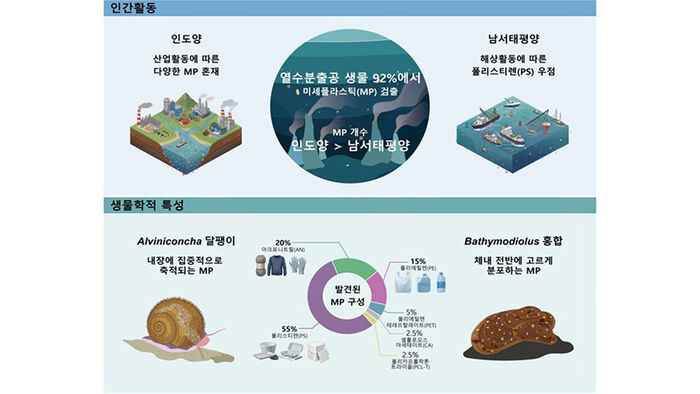
▲ Research findings image
Even organisms living 2,000 meters deep in the ocean have not been able to escape the impact of microplastics.
The Korea Research Institute of Bioscience and Biotechnology (KRIBB) announced on July 9 that a joint research team led by Dr. Kim Se-joo and Dr. Jeong Jin-young, along with researchers from the Korea Institute of Ocean Science and Technology (KIOST), has identified the characteristics and causes of microplastic accumulation by analyzing organisms from deep-sea hydrothermal vents in the Southwest Pacific and the Indian Ocean.
Hydrothermal vents are deep-sea locations where hot water erupts from the ocean floor. They are unique ecosystems where various life forms thrive despite the absence of sunlight.
However, little has been known about the extent to which organisms in these areas are exposed to microplastics or where these particles accumulate within their bodies.
The KRIBB research team analyzed deep-sea snails and mussels collected by KIOST from the North Fiji Basin in the Southwest Pacific and the Central Indian Ridge at depths of over 2,000 meters. Through precise analysis of microplastics and interpretation of the marine ecosystem, they were able to determine the characteristics of microplastic accumulation.
The results showed that microplastics were detected in 92% of the organisms examined.
An average of 3.42 microplastic particles were found per individual.
The research team explained that the most frequently detected plastics were those widely used in household goods and packaging materials, demonstrating that plastics generated by human activity have already spread to deep-sea ecosystems.
The study also confirmed that even among organisms living in the same deep-sea environment, the way microplastics accumulate in their bodies varies depending on what they eat and how they feed.
In snails, which graze on microorganisms on the seafloor, microplastics were mainly found in the digestive tract. In contrast, in mussels, which filter feed from seawater, the particles were distributed relatively evenly throughout their body tissues.
The research team added that these results show that the pathways and accumulation sites of microplastics can differ based on feeding methods.
A comparison between the different oceans also revealed differences in the degree of microplastic accumulation.
Organisms collected from the Indian Ocean showed a microplastic concentration per body weight up to 14.7 times higher than those from the Southwest Pacific.
The research team believes that the scale of human activity in surrounding regions and the characteristics of ocean currents are likely factors contributing to this difference.
Dr. Kim Se-joo stated, "Plastic pollution is now spreading to the deep sea, which is beyond the reach of human hands. This study confirms that deep-sea hydrothermal vents are no exception, and it will serve as important foundational data for future deep-sea environmental monitoring and the development of conservation policies."
(Photo courtesy of Korea Research Institute of Bioscience and Biotechnology, Yonhap News)
※ Please note: This article was translated by AI and may contain errors.
Copyright Ⓒ SBS. All rights reserved. Unauthorized reproduction, redistribution, and use for AI training are prohibited.