SBS News
Retail Investors Dump, We Buy: Those Quietly Buying the Dip as Gold Plunges 30%
Published : Jul 9, 2026 9:05 AM
TokSori Economy

⚡ SBS Premium Key Summary
Shift to Discounted Physical Gold Trading in China and India: As investment sentiment in China and India—the world's largest gold consumers—weakens, a short-term wait-and-see attitude has intensified. As of late June, physical gold bars in China traded below international prices for the first time in six months.
Capital Rotation into AI Stocks and Plunging Gold Prices: Following the war in Iran, massive capital flowed out of gold and Bitcoin ETFs into AI tech stocks like memory semiconductors and the SpaceX private offering. Consequently, international gold prices plummeted nearly 30% from their intraday highs.
Central Bank Buying Amid Rate Hike Fears: While short-term downward pressure persists due to a strong dollar and fears of Fed rate hikes, global central banks continue to aggressively accumulate gold to reduce their reliance on the dollar. Thus, the long-term upward trend and year-end rebound forecasts remain intact.
※ This article is based on a video released on July 2, 2026.
Even the Chinese gold market has finally started a bargain sale. As of late June, physical gold bars in the Chinese market are selling for an average of about $6 cheaper per ounce than international prices. This is the first time such a discount has been seen in six months, since the end of last year.
The "Kimchi Premium" or "Kimchi Discount" is not unique to the Korean asset market. Chinese consumers, who along with Indians are the world's biggest gold investors, traded gold bars at a premium—even if only a small one—over international prices until mid-June, despite falling gold prices in May. This indicated that gold demand was still resilient. However, even these Chinese investors have now shifted toward a wait-and-see attitude.
Recently, the discount on gold bars in India was already much larger. As of late June, Indian consumers only bought gold bars when they were discounted by at least 2,700 won (approximately $1.95 USD) per gram compared to the international spot price.
How far and how long will gold prices fall? Recently, international gold prices have been hovering around the $4,000 per ounce mark, having dropped 12% in June alone. This marks the largest monthly decline in 18 years, since October 2008 when the Lehman Brothers bankruptcy triggered the global financial crisis and led to panic-selling of gold to secure US dollars. Compared to this year's intraday high, prices have plunged nearly 30%, returning to levels seen in the fourth quarter of last year.
It is not just gold. Silver is experiencing the same, and even copper is stalling. This is a stark contrast to the asset market at the beginning of this year when commodities were heating up. Furthermore, Bitcoin, which started the year with an ominous decline amid a so-called "crypto winter," has seen its situation worsen. Unlike the hot stock market, alternative assets are cooling down rapidly.
In a market where even Chinese and Indian consumers—the world's biggest gold lovers—are demanding discounts on gold, what do we really need to know right now?
"The outlook that gold prices will rise in the long term remains unchanged. However, in the short term, we have not hit bottom. The $4,000 per ounce mark could also be broken." Prices have ultimately fallen to the very range mentioned three months ago.
But as gold prices fell to this level, who was selling and who was buying? Simply put, individual and institutional investors have largely dumped gold since March. However, central banks in several countries, including China, have quietly begun to increase their purchases again.
Suki Cooper | Managing Director of Commodities Research, Standard Chartered
"What's different this year is that central banks are still buying. But we are seeing money flow out of physical gold ETFs."
*Source: Bloomberg Podcasts YouTube channel
"What's different this year is that central banks are still buying. But we are seeing money flow out of physical gold ETFs."
*Source: Bloomberg Podcasts YouTube channel
In fact, even in the first quarter of this year, the volume of capital buying physical gold bars or coins globally was much larger than in early last year when gold prices began their historic rally. Nevertheless, the total investment in gold simultaneously decreased by 5% compared to a year ago.
Why? Because money flowed out of physical gold ETFs like an ebb tide in March when the war in Iran broke out. Physical gold ETFs, which allow ordinary people to easily invest in gold through the stock market, are a key indicator of gold investment sentiment. However, massive amounts of money began to leave these ETFs starting in March. Although Asian investors continued to buy through March, it was incomparable to the massive scale of gold ETFs being sold off in the New York stock market.
In April, some money returned to gold ETFs, helping gold prices rebound. However, large sums of money continuously flowed out again in May and June. This time, gold investors in Asian stock markets also dumped their holdings on a large scale. During this period, the pace of capital outflow from spot Bitcoin ETFs was actually much faster than that of physical gold ETFs.
Where did global investors go after pulling their money out of alternative assets like gold and Bitcoin in the stock market? The largest volume of capital since early 2024 flooded into AI-related stocks, including memory semiconductors. A prime example is the "DRAM" ETF listed on the New York stock market on April 2, which focuses on the top three memory makers—Samsung Electronics, SK Hynix, and Micron. It became the most successful launch in ETF history, attracting $25 billion (approximately 39 trillion won) in just two months, easily surpassing the initial popularity of the Bitcoin ETFs launched in early 2024.
Such a massive concentration of capital inevitably required money to be pulled from elsewhere. This is why analysts estimate that a significant portion of the funds leaving gold and Bitcoin ETFs flowed into these sectors. It is also believed that substantial capital moved into SpaceX's private offering, which took place on June 12 as one of the largest offerings in history.
Ven Ram | Cross-Asset Strategist
"Looking back at late 2025 and early this year, both of these assets (gold and Bitcoin) were incredibly hot. They surged 30% to 40% in a short period. Then, that money rotated into memory semiconductor stocks in pursuit of faster returns. It is an incredibly rapid rotation. Gold prices are down 30% from their January peak, making those highs feel like a distant memory, while Bitcoin has lost half its value."
*Source: Bloomberg Television YouTube channel
"Looking back at late 2025 and early this year, both of these assets (gold and Bitcoin) were incredibly hot. They surged 30% to 40% in a short period. Then, that money rotated into memory semiconductor stocks in pursuit of faster returns. It is an incredibly rapid rotation. Gold prices are down 30% from their January peak, making those highs feel like a distant memory, while Bitcoin has lost half its value."
*Source: Bloomberg Television YouTube channel
Investors who realized profits from gold investments early in the year looked for their next opportunity and saw memory semiconductors with stellar earnings outlooks, AI tech stocks, and opportunities to participate in SpaceX's private offering as it began turning space-based concepts into profitable realities.
Gold Prices in Free Fall? 'Super Whales' Quietly Build a Floor
However, central banks quietly increased their gold purchases in the second quarter as gold prices slid. Although the volume was far smaller than the private sector's selling pressure, it clearly put a floor under gold prices. Because of this central bank support, even Goldman Sachs, which significantly lowered its gold price forecast this week, still expects gold to recover to $4,900 per ounce by the end of next year. That is a price that requires a rally of more than 22% from current levels.
Even OCBC, one of Singapore's leading banks and among the most pessimistic institutions to revise its gold outlook this week, projected gold to reach $4,360 per ounce by the end of this year—about 7.5% higher than current prices. For decades leading up to the early 2000s, central banks were generally net sellers of gold.
In modern financial circles, the dominant sentiment was, "Why do central banks need gold? There is nowhere to use it. It is cumbersome, so let's sell what we have." However, after the global financial crisis, the realization grew that "after experiencing the unimaginable, we shouldn't accumulate assets solely in US dollars." Consequently, central banks began turning into net buyers, purchasing around 500 tons annually.
Then, following the Russia-Ukraine war in 2022, seeing the United States freeze Russia's US dollar assets heightened a sense of crisis among emerging economies, including China: "If we only hold dollars, we cannot know what will happen in an emergency." Since then, central bank gold purchases have exceeded 1,000 tons annually for four consecutive years, an unprecedented phenomenon.
This year, central banks have already net purchased 244 tons of gold in the first quarter alone. Furthermore, a survey by the World Gold Council revealed that 45% of central banks plan to increase their gold reserves further this year—a figure that has grown compared to last year. Under these conditions, it seems highly likely that central bank net gold purchases will exceed 1,000 tons for the fifth consecutive year.
Over the past decade, Poland has been one of the largest buyers of gold among global central banks, alongside China and Turkey. In March, at the height of the war in Iran, rumors circulated that Poland was considering selling its accumulated gold to secure urgent dollar liquidity, but they ultimately did not sell. Instead, they purchased an additional 14 tons in April.
And whether buying in small or large quantities, China has steadily accumulated gold for 18 consecutive months. Now, even as gold buying among ordinary Chinese citizens has cooled, the central bank has significantly increased its purchases. In April alone, it bought 8 tons, its largest monthly purchase since January 2024.
The temporary shift to net selling by central banks in March was primarily due to Turkey selling a large volume of gold all at once to secure urgent dollar liquidity amid the war in Iran. This was an isolated issue for Turkey, and other central banks did not follow suit. Since 2022, gold has remained an asset that central banks continuously accumulate, regardless of how difficult it is to store or how little it contributes to cash flow. The war in Iran was a crisis that paradoxically confirmed this trend.
So, When Will Gold Prices Rise?
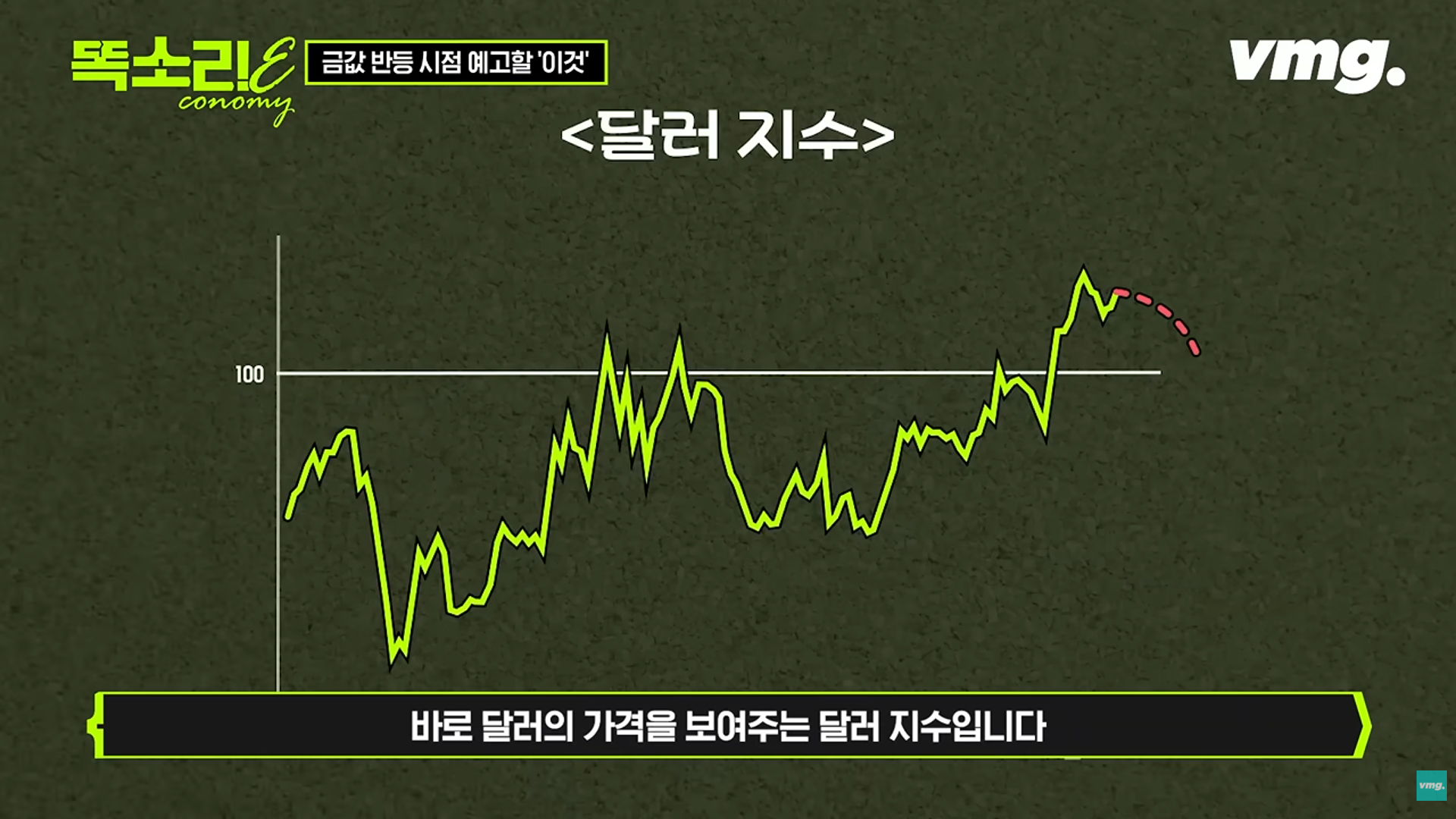
So when can gold prices return to an upward trajectory? To point to a single indicator for reference, a rebound in gold prices could begin when the end of this graph starts to trend downward. This is the US Dollar Index, which shows the value of the dollar.
The US Dollar Index measures the value of the US dollar relative to a basket of six major currencies, including the euro and the yen. When this index exceeds 100, the dollar is considered expensive and strong. Except for late March, when fear over the prolonged war in Iran peaked, the US Dollar Index had not crossed 100 this year. However, on June 18, it surged well past 100 and has shown no signs of dropping below that level since.
June 18 (Korean time) was the day the results of the US Federal Reserve's June FOMC meeting were announced. It was the day the world clearly realized that the policymakers who determine the US benchmark interest rate—the cost of borrowing money—were considering raising it. When the dollar becomes expensive, gold prices inevitably face downward pressure. Since gold is priced in dollars, a stronger dollar naturally depresses the nominal price of gold.
Furthermore, when interest rates rise, the opportunity cost of holding physical gold bars, which are difficult to store, increases. With the world full of attractive yield-bearing or dividend-paying assets, holding gold—which pays no interest and actually incurs storage costs—becomes much harder to justify. Because this is a phase where the value of money, rather than physical assets, is rising, the idea of using gold as a store of value fades. Interest rates are the beginning and end of the market. When the interest rate regime changes, everything else must change with it.
The gold price outlook, which was highly bullish at the beginning of this year, shifted in just six months due to the war in Iran. The logic went: "Look at oil prices; inflation is bound to rise. We thought the US would cut rates, but now they might have to raise them." The anxiety over a potential rate hike, rather than a cut, was amplified more than the market expected on June 18 by the new Fed Chair, Kevin Warsh. This triggered the dollar's rally and accelerated the decline in gold prices.
Currently, the interest rate futures market (where future rate expectations are traded) is largely pricing in a scenario where the US benchmark interest rate is hiked twice—once in September of this year and again in March of next year.
"We Don't Buy the Rate Hike Threats": Is Gold Nearing Its Bottom?
Why, then, do leading investment institutions remain confident that gold prices will return to higher levels by the end of this year or next year? While the market currently prices in two rate hikes by March of next year, many question whether that will actually happen. Even if a single hike occurs, the prevailing view is that it will not mark the start of a prolonged tightening cycle, and that the Fed will ultimately pivot back to rate cuts next year.
Kevin Warsh | Chair of the US Federal Reserve
"Over the past four weeks, concerns about inflation have eased somewhat. The risk of inflation has lowered. However, we are not jumping to conclusions and will continue to monitor the situation."
*July 1 (local time), Sintra Forum
"Over the past four weeks, concerns about inflation have eased somewhat. The risk of inflation has lowered. However, we are not jumping to conclusions and will continue to monitor the situation."
*July 1 (local time), Sintra Forum
Now that the war has wound down, many believe that inflation fears were somewhat overblown. The thinking is: "Unless something like the war in Iran happens again, this inflation is a matter of a few months, not something that will stretch into next year."
Moreover, prices for silver and other raw materials, not just gold, have cooled down. While there are several reasons, one major factor is China. Although China's economy seemed to be reviving at the start of the year, it has remained sluggish. Consumers lack spare cash and businesses are tight on investment funds, as evidenced by a clear slowdown in May's fixed-asset investment, which fell by more than 4% compared to a year ago.
Consequently, while the People's Bank of China (the central bank) is buying gold, gold investment among ordinary citizens watching the price decline has cooled even further. Because businesses are holding back on investment, demand for raw materials like silver and copper has also hit a roadblock. China acts as a vacuum cleaner for global commodities; when Chinese demand is lackluster, it is difficult for commodity prices to rise significantly.
Although demand for raw materials for AI data centers is surging due to the AI development race among US tech giants, bottlenecks continue to delay actual data center construction. The cooling demand for raw materials that would otherwise be immediately utilized in China is bound to impact global prices.
As commodity prices cool, concerns over soaring inflation should ease. While inflation remains a concern for this year, the five-year inflation expectation has already fallen below levels seen before the outbreak of the war in Iran. Given this, the market is increasingly believing that "even if a rate hike occurs once, a sustained tightening trend is unlikely," a sentiment bolstered by the downward trajectory of inflation expectations.
Park Sang-hyun | Senior Economist at iM Securities
"I believe there is room for gold and Bitcoin prices, which have been heavily suppressed, to rebound. If inflation indicators stabilize downward in July and August, that could be the buying window. However, if the AI cycle remains robust, the rebound sentiment might not be as strong due to continued capital concentration in AI."
"I believe there is room for gold and Bitcoin prices, which have been heavily suppressed, to rebound. If inflation indicators stabilize downward in July and August, that could be the buying window. However, if the AI cycle remains robust, the rebound sentiment might not be as strong due to continued capital concentration in AI."
※ Please note: This article was translated by AI and may contain errors.
Copyright Ⓒ SBS. All rights reserved. Unauthorized reproduction, redistribution, and use for AI training are prohibited.