SBS News
As Promised by Trump, U.S. Strikes Iran for Second Consecutive Day
Published : Jul 9, 2026 7:09 AM

▲ U.S. President Donald Trump
The U.S. Central Command (CENTCOM) conducted additional airstrikes against Iran on July 8 (local time) in response to Iranian attacks on merchant vessels.
The scope of the strikes was reportedly expanded compared to the previous day.
With Iran also expected to retaliate for the second day in a row, concerns are rising that the level of military confrontation between the U.S. and Iran is nearing a critical point where the momentum for negotiations could be lost entirely.
CENTCOM stated on the social media platform X that day, "Under the direction of the Commander-in-Chief, U.S. Central Command has initiated additional strikes targeting Iran."
CENTCOM added, "This is to further degrade their (Iran's) capability to threaten freedom of navigation in the Strait of Hormuz," and "The United States is holding Iran accountable for unjustified attacks on merchant vessels and civilian crews freely navigating key international waters."
The U.S. airstrikes against Iran have now continued for two consecutive days.
This is a response to Iran's persistent attacks on merchant ships in the Strait of Hormuz.
In this announcement, the U.S. military made it clear that the strikes were carried out under the direction of the Commander-in-Chief, President Donald Trump.
The U.S. online media outlet Axios, citing U.S. officials, reported that the scope of these strikes was broader than the previous day, including Iranian coastal radar, anti-ship missile sites, and air defense systems.
The previous day, the U.S. military announced that it had used precision-guided munitions to strike over 80 targets, including Iranian air defense systems, command and control networks, coastal radar sites, anti-ship missile assets, and approximately 60 small boats belonging to the Iranian Islamic Revolutionary Guard Corps (IRGC) deployed in and around the Strait of Hormuz.
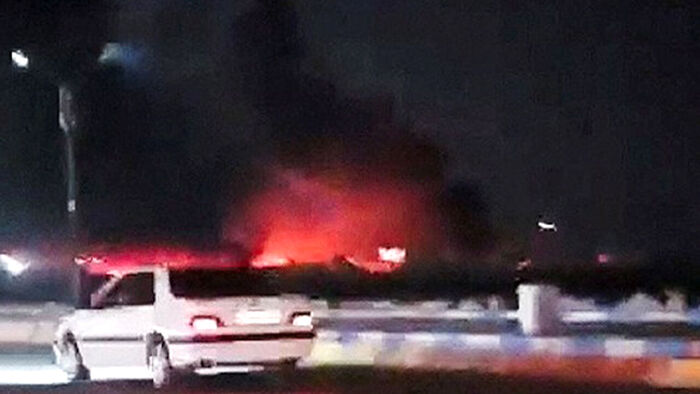
Just before the CENTCOM announcement, Iranian media reported that several powerful explosions were heard in the key southern Iranian cities of Bandar Abbas and Sirik.
Strong explosions were also reported in Chabahar, a strategic port on the coast of the Gulf of Oman in southeastern Iran.
The additional U.S. strikes were anticipated.
President Trump, who is visiting Ankara, Turkey, to attend the NATO summit, had signaled the possibility of further strikes earlier that day, stating, "We might hit them hard again tonight."
The high-intensity strikes over two consecutive days appear intended to maximize pressure on Iran, which has been threatening the Strait of Hormuz through attacks on merchant ships.
President Trump had previously secured the opening of the Strait of Hormuz through the signing of a Memorandum of Understanding (MOU) to end the conflict, despite domestic criticism that he had conceded too much to Iran.
With it appearing almost certain that Iran will retaliate for the second day in a row, there are concerns that the momentum for follow-up negotiations has effectively dissipated.
The U.S. and Iran engaged in armed clashes for two consecutive days late last month, and talks held in Doha, Qatar, early this month were limited to indirect discussions through mediators.
As President Trump declares the previous MOU "over" and launches fierce attacks on Iran using terms like "garbage," prospects for the two countries to find common ground appear increasingly dim.
While President Trump's remarks, which suggest he is losing patience, may be a deliberate performance to pressure Iran, the situation is moving further away from the original goal of the MOU, which was to resolve denuclearization issues through 60 days of follow-up negotiations.
However, President Trump has attempted to soothe markets and public opinion for now, stating that the armed conflict with Iran would not lead to a resumption of full-scale war.
The situation is a dilemma: while the burden of resuming war is heavy, the U.S. cannot simply stand by and watch Iran's attacks on merchant vessels.
(Photo: AP, Yonhap News)
※ Please note: This article was translated by AI and may contain errors.
Copyright Ⓒ SBS. All rights reserved. Unauthorized reproduction, redistribution, and use for AI training are prohibited.