SBS News
800-Trillion-Won Semiconductor Belt Will Grind to a Halt Without 'This': The Real Battleground for South Korea's Fate-Defining Mega Project
Published : Jul 8, 2026 2:31 PM
Cho Hong-jong, Professor of Economics at Dankook University

Growth requires power. The power to remain unshaken, the power to reach higher. "Please Look After Gyoyang-i," the knowledge news that makes you smarter the more you listen, empowers you to grow into a well-rounded intellectual alongside top SBS Premium contributors.
Cho Hong-jong, Contributor
Professor of Economics, Dankook University
President, Korean Resource Economics Association
Professor of Economics, Dankook University
President, Korean Resource Economics Association
When the United States launched powerful airstrikes and revoked oil sanction waivers in response to Iran's attacks on commercial vessels in the Strait of Hormuz, Iran immediately retaliated by targeting Bahrain and Kuwait, where U.S. military bases are located. Tensions between Iran and the U.S. have escalated once again.
But was this tension surrounding the Strait of Hormuz simply Iran's problem alone?
In fact, U.S. pressure and military intervention against Iran heightened instability along maritime energy routes, prompting Iran to use the Strait of Hormuz as a bargaining chip. The issue is that this instability ultimately provided a new justification for the U.S. as well. As the Middle Eastern crude oil supply chain faltered, the U.S. was able to push its own oil and energy more aggressively, leveraging the logic of being a "stable energy supplier."
Donald Trump | U.S. President (This past March)
"You could say the U.S. doesn't even need to be in Hormuz. We have plenty of oil."
"You could say the U.S. doesn't even need to be in Hormuz. We have plenty of oil."
Indeed, U.S. crude oil exports have easily hovered above 5 million barrels per day on a weekly basis this year. At the end of April, they soared to a record high of 6.438 million barrels per day. In terms of total petroleum exports, combining crude and refined products, the U.S. has effectively risen to the position of the world's largest energy exporter. Ultimately, this conflict was an event that demonstrated just how much the center of gravity for oil has shifted from the Middle East to the United States.
The past U.S. strategy in the Middle East was clear: sell weapons to the Middle East, protect them militarily, and secure a stable oil supply chain in return. However, the calculus has changed now. The U.S. no longer relies on Middle Eastern crude oil as much as it used to. Since the shale revolution, the U.S. has become a country that produces massive amounts of oil and natural gas on its own soil and can sell surplus energy to the rest of the world. In particular, it is already the world's largest exporter of liquefied natural gas (LNG).
President Trump's energy strategy boils down to this: "If Middle Eastern crude oil is unstable, buy American energy." This conflict was a demonstration of how that idea plays out in the actual market. Paradoxically, the greater the instability in the Middle East, the stronger the U.S. energy hegemony becomes. However, it is difficult to call this a complete victory for the United States. While leadership over fossil fuels has shifted more strongly toward the U.S., the costs paid by its allies in the process have been substantial. The energy price shock shook European society and placed a heavy burden on manufacturing nations like South Korea, Japan, and Taiwan. Although they are U.S. allies, these countries, which are also the most vulnerable to energy price shocks, were the first to feel the pressure.
As a result, every country will now begin efforts to diversify its energy sources, and all nations will prepare to transition from the era of the "petro-state" (oil state)—which has become even more critical recently due to AI—to the era of the "electro-state"* (electricity state).
*Electro-state: A country where the entire energy axis has completely shifted from fossil fuels to electricity.
There is something even more important. Ultimately, China and the U.S. are beginning to compete in an electrification race. China's plan is to extract a large amount of shale gas from its own land, use it for power generation, and run AI with that generated electricity. Will the U.S. be able to win this electrification war against China? This will likely be the key point to watch going forward.
Why Big Tech Is Joining the Electricity War: Ultimately a Battle of Capital Liquidity
Why is AI so important in this process? Do you use AI every day? I am spending in the range of 10 million won on subscription fees alone. Surprised? I think I will spend even more in the future. Once you are hooked on AI, you can feel the productivity boost firsthand.
We are perfectly familiar with LLM models*.
*LLM Model: Large Language Model pre-trained on vast amounts of data
However, they consume an enormous amount of electricity. The deciding factor in AI hegemony is "how much electricity can be fed into semiconductors, and how much sufficient electricity can be supplied to data centers." That is how crucial electricity is. How much electricity needs to be produced to power AI data centers or utilize AI? If AI data centers in the U.S. continue to expand until 2030, they will consume 500 TWh/y* of electricity by 2030.
*TWh/y: An energy unit representing annual electricity consumption on a national or large city scale
How big is this number? To put it in perspective, South Korea consumes about 550 TWh/y. This means AI data centers alone will consume as much electricity as South Korea does in an entire year. Data centers alone will account for about 20% of total electricity consumption in the U.S. With the rise in electricity usage and computational power, the increase in the volume of semiconductor chips required is only in its infancy.
Jensen Huang | NVIDIA CEO (June 2026)
"Building AI factories is highly important. If it's profitable, anyone would want more AI factories."
"Building AI factories is highly important. If it's profitable, anyone would want more AI factories."
About half of the world's data centers are in the United States. If the U.S. converts all of them into AI data centers and Big Tech companies continuously build their own data centers, electricity usage and semiconductor supply will run into bottlenecks. The electricity bottleneck is even more severe than the semiconductor bottleneck because it requires laying down massive infrastructure like power grids and power plants.
When the U.S. tried to build data centers, it found there was no electricity. The U.S. has rarely expanded its power facilities since the 2000s. Because it lacked a manufacturing base, it did not need electricity to run massive factories. As an economy enters the advanced stage, it relocates energy-intensive, dirty, or low-skilled factories overseas, meaning it has little need for production facilities that consume excessive energy. Thus, the U.S. did not install them.
But then AI emerged. An immense amount of electricity became necessary, and the country faced a shortage of power facilities. No power plants? No power grids? Consequently, data centers began building power plants, moving next to existing ones, or drawing in whatever electricity was available. Electricity bills for local residents started to rise, turning electricity into a social issue. This led to a "consumer protection pledge"* to avoid raising rates for regular consumers.
*Principle of Self-Funding Power Costs: Companies bear the full cost of operating AI data centers to protect general taxpayers.
Since electricity bills rose because of Big Tech building data centers and citizen opposition grew, one might think they would stop building them if told, "Build them with your own money." But that was not the case. Seven companies participated in this pledge: Google, Microsoft, Meta, Amazon, Oracle, OpenAI, and xAI. They entered into energy self-sufficiency agreements, saying, "We will invest in everything—money for power plants, transmission and distribution costs to supply power, and backup infrastructure. Since we have overflowing liquidity, we will spend the money to take whatever power generation facilities we need."
Ultimately, AI data centers and electricity are supplied by money, so the core issue is whether companies can keep pouring money into them. Can this money be supplied endlessly? How long will liquidity hold up? In other words, the issue of power generation facilities is a race against time. By securing electricity, the competition among Big Tech companies will be over by 2030. They are trying to end the game by spending whatever it takes to leave latecomers behind, monopolize AI subscribers, and offer enterprise-rate services. The investment direction for data centers and power facilities will be shaped by the expectation that the hierarchy will be sorted out, with the top one to four players winning and ending the game, while the rest disappear.
In the semiconductor industry ten years ago, there were about 20 memory manufacturers. Today, only three remain. The rest are gone. Because they must pursue AI through such fierce survival competition, they need electricity immediately. Since they are dumping all their money into this, the U.S. is sweeping up global supplies of power generation equipment, wiring materials, transformers, substations, and circuit breakers. The South Korean semiconductor, power equipment, and cable companies whose stock prices are soaring are all selling to this market.
Lee Joo-soo | CEO of the Korea Energy Information Culture Foundation
"If semiconductors are the brain of AI, power is its heart. No matter how outstanding our technology is, the growth of future industries cannot be sustained without a stable energy supply. Energy will become the core foundation that determines national competitiveness in the future."
"If semiconductors are the brain of AI, power is its heart. No matter how outstanding our technology is, the growth of future industries cannot be sustained without a stable energy supply. Energy will become the core foundation that determines national competitiveness in the future."
The Key Bottleneck to Electrification: Why Power Grid Infrastructure Is Urgent
Electricity has an important characteristic that sets it apart from other energy sources: supply and demand must always match perfectly. If you produce 100, you must consume 100; if you produce 80, you must consume only 80. If consumption suddenly spikes to 100, production must be adjusted to 100. Any slight mismatch inevitably leads to a blackout. What happens if generation is high but consumption is low? A blackout. What if generation is low and consumption is high? A blackout. The frequency must be maintained at exactly 60Hz*.
*60Hz: The alternating current of a power system oscillating 60 times per second.
In the past, in a society centered on 24-hour generators, nuclear power, coal, or natural gas, it was easy to match fluctuations in demand by turning generators on and off. However, as renewable energy increases, control becomes difficult. Whether the wind blows or not, whether the sun shines or not, or if there is a sudden heavy downpour, the supply side fluctuates. This increases the likelihood of blackouts. Maintaining the frequency is crucial in the process of supplying electricity and expanding renewable energy. The frequency must be synchronized on a nationwide scale.
Q. How do you assess the 60Hz standard in a situation where domestic power demand is surging?
This is the power mix during the Lunar New Year holiday. Since factories are closed during Lunar New Year, electricity consumption drops, bringing total demand down to about 50 GW. Since demand reaches about 100 GW during the hot summer, only half of that is consumed during Lunar New Year. Because we cannot afford to run out of electricity, we maintain power generation facilities to prepare for peak times, but only half of them are used during the holiday. Yet, supply and demand must always match.
We use solar power, adjust the frequency with coal and gas, and rely on nuclear power for baseload. Nuclear power plants cannot easily adjust their output. They generate a fixed output, and as renewable energy increases, we reduce gas; when renewable energy is insufficient, we increase gas. We use gas resources to match the frequency. However, if renewable energy generation increases too much, and we cannot suddenly turn off nuclear plants despite the surge in supply, the supply will exceed 100, leading to a blackout. This is a critical issue.
Just as you shouldn't put all your eggs in one basket when investing in stocks, we must have many flexible power sources to prepare for situations where electricity is either in surplus or in deficit. Otherwise, it is difficult to maintain the system. Although we use electricity conveniently, generating it, connecting it to consumption areas, adjusting the frequency, and maintaining voltage stability regionally is a difficult task.
The best approach is to supply it directly to the demand areas. As long as there is a transmission grid, electricity can be delivered to where it is needed. Without a transmission grid, even if power is generated, it cannot be delivered, causing a mismatch between supply and demand. The transmission grid is the core bottleneck to electrification. It takes a long time to build, and because it only passes through areas without providing direct benefits to them, there is often strong local opposition. Consequently, the entire world is suffering from transmission grid issues. I believe a national consensus or a political resolution is needed to solve this.
Can South Korea Withstand the Surge in Power Demand?
South Korea's power system has several unique characteristics that set it apart from other countries. The most important is that it is an isolated grid. It is not connected to the transmission grids of other nations. It is essentially an island, unconnected to North Korea, Japan, or China. If grids are connected, countries can trade electricity when they have shortages or surpluses. Europe is fully interconnected. Germany is connected to 11 countries, so if it runs short, it buys power from French nuclear plants or Dutch gas power plants. If it has a surplus, it sells to other countries. But we are an isolated island. We have to balance everything on our own here.
Our power density is also high. Because our land area is small, whether we build nuclear power plants or solar farms, the density is high. We have no choice but to build many of them in a single region. Power generation complexes are distributed around favorable areas, mainly along the coastlines. The Seoul metropolitan area consumes the most electricity, but it lacks generators, so the system relies on drawing power from distant regions. As a result, it is a system that requires building a lot of transmission lines.
In South Korea, renewable energy penetration is less than 10%, placing us at around stage 2 of renewable energy development, yet we are already exhibiting the problems of stages 3 and 4. This is because we are unable to lay down transmission lines while power generation facilities are being built rapidly. A mismatch is occurring.
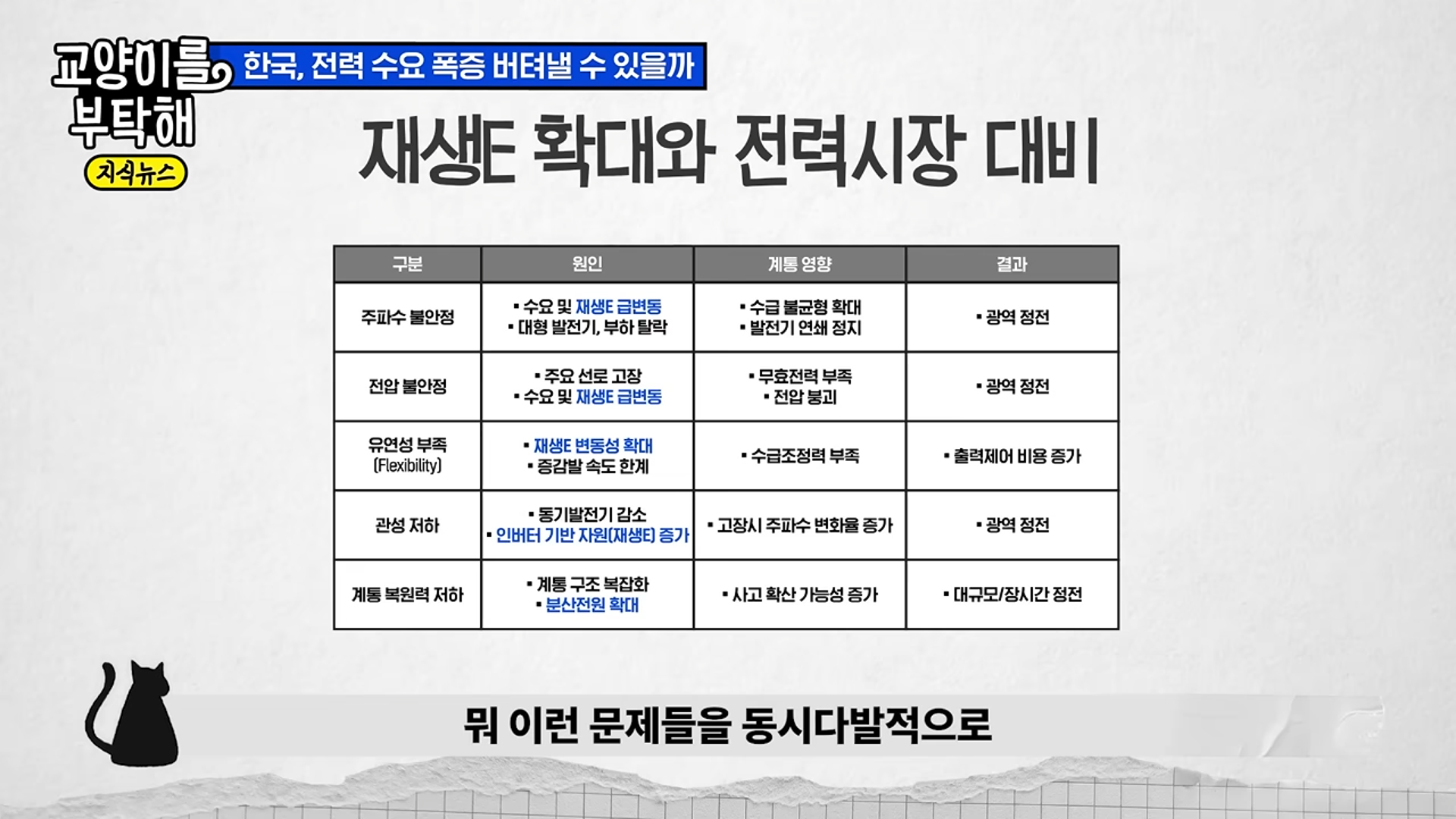
As renewable energy expands, we must simultaneously solve issues such as frequency instability, voltage instability, lack of flexibility, reduced inertia, and decreased grid resilience. However, semiconductors are entangled in this. Semiconductor factories consume massive amounts of electricity. TSMC used to consume 5% of Taiwan's electricity, but that figure rose to 10% in just five years.
Samsung Electronics and SK Hynix likely consume about 7% of South Korea's electricity now. Samsung Electronics alone pays nearly 5 trillion won annually just for electricity bills. They are currently expanding their semiconductor fab factories. The power facilities required for this expansion alone amount to about 15 GW. Looking at the supply plans for national and general industrial complexes, the method is to connect them via transmission grids. However, the construction of these transmission grids is continuously being delayed.
If the transmission grid is the problem, we must work on building it, and in preparation for delays, we could consider on-site power generation or relocating to other regions. However, we must carefully weigh which method is superior in terms of total cost and the competitiveness of the semiconductor industry. Otherwise, there are concerns that we might miss the window of opportunity while engaged in fierce competition with China, Taiwan, and Micron of the U.S.
Data centers want to enter South Korea. They think, "Since we can't find electricity in the U.S., we should build elsewhere." Originally, they considered the energy-rich Middle East, but the Middle East has ended up in that state. They want to find a stable location, but they cannot enter China. In Northeast Asia, the only reliable regions are Japan and South Korea. However, Japan's electricity rates are about 2.5 times more expensive than ours. It is hard to find a country that is stable, cheap, and has an uninterrupted power supply. Big Tech companies want to come to South Korea, even if they have to pay a bit more. Such companies keep knocking on our door.
In South Korea, which offers such a favorable environment for building data centers, electricity must not hold us back. However, the first order is to go to the provinces. But foreign personnel need to reside there. To solve these issues, there must be incentives, or power generation in the metropolitan area must be opened up. Under the principle of "local production, local consumption," if electricity produced in a region is consumed heavily within that same region, fewer transmission grids need to be built. Therefore, moving closer to generators in the provinces is indeed one way for data centers to receive a stable power supply. But does that mean we should completely block the metropolitan area? If so, data centers will not be able to freely decide their locations. It is a difficult problem. If we keep clustering power plants in one place, transmission grid issues are bound to erupt.
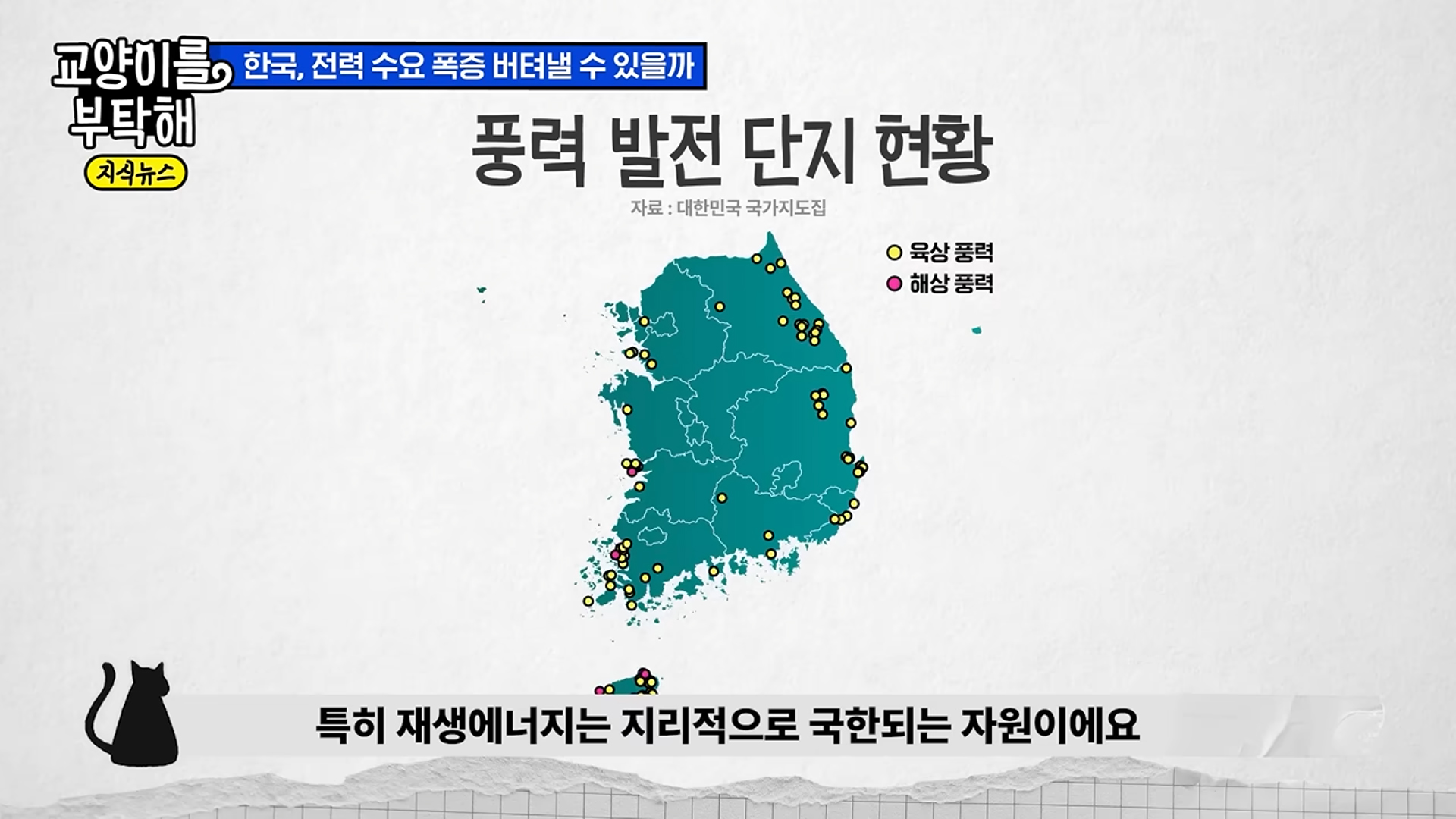
In particular, renewable energy is a geographically limited resource. It is installed only in areas with good sunlight or wind. Often, there are no industrial complexes in those areas. In that case, we have to lay down more transmission grids. We must carefully consider what the optimal location is.
Electricity Is National Competitiveness: The Real Battleground for AI Hegemony
Q. Could you specifically point out the link showing how power competitiveness connects to the industrial ecosystem and national competitiveness?
In the past, the most important energy source was oil, which defined the "petro-state." Nowadays, it is the "electro-state," a country that supplies energy through electricity. We must generate enough electricity. It is even better if we can produce it cheaply. In the future, energy hegemony will shift to electricity. We must become a nation that can supply stable electricity. Moving away from the past era of drilling and searching for buried reserves, the core of the future battle for energy hegemony will be how to build power plants, how to lay down transmission grids, how to connect batteries, and where and how to place facilities like circuit breakers and substations to run them stably.
South Korea is a massive energy-consuming nation, with manufacturing accounting for 30% of our GDP. Some might argue we should block energy imports because we consume so much and import a lot of energy sources. But we do not consume it all ourselves. We use energy as an intermediate good, engage in processing trade, and sell products abroad. This means that if we block energy imports, our exports will also decrease. The first priority is how much electricity we can generate by utilizing imported energy effectively.
Second, we must foster our domestic energy industry. For domestic energy, we can produce power with renewable energy and just a small amount of uranium. This would serve as another method of energy security. The way to become an electro-state is to increase the stability of power facilities while establishing a stable foundation for energy sources. Therefore, if we view carbon-free energy—namely renewable energy and nuclear energy—as domestic energy, it is indeed beneficial to expand them significantly.
A major shift in energy hegemony is on the horizon. Unless a country possesses a complete supply chain, spanning from existing materials to raw materials, it will have to depend on China. Although South Korea is doing well now, we must support it so it can continue to do well in the future. To transition into an electro-state, we must anticipate the increase in electricity consumption and ensure a sufficient supply to both data centers and semiconductor facilities to facilitate electrification. The process of converting sectors that currently use fossil fuels in other industries to electricity will require astronomical costs. We must invest heavily to ensure these industries remain in South Korea.
Q. Is South Korea a country that can do this well?
South Korea is the only country capable of competing with China across all its value chains, including renewable energy, batteries, electric vehicles, and power equipment. Globally, the only countries that engage in semiconductors, automobiles, defense, steel, and petrochemicals simultaneously are China and us. We excel even more in semiconductors, and while small modular reactor (SMR) projects related to data centers are underway worldwide, our nuclear power technology is the best in the world.
In the Western world, the only countries with experience building nuclear power plants are France and South Korea. However, France takes too long and is too expensive. South Korea builds them in the shortest time and at the lowest cost. Therefore, our nuclear power and related technologies can be considered unrivaled. Since the U.S. has not built a nuclear power plant in 30 years, if it decides to build one now, South Korea is the only place it can turn to for help.
The power equipment industry is an overwhelmingly advantageous sector for South Korea. Our top three power equipment companies are number one in supplying equipment to data centers. Of course, this is possible because the U.S. is blocking China. As free trade declines, the WTO system crumbles, and we move toward protectionism and bloc economies, our equipment exports to the U.S. are bound to grow continuously as long as the U.S. blocks China. It is not that the U.S. lacks facilities, but we are the only ones with the potential to expand capacity to that extent.
To build future growth industries, we must construct many data centers, supply them with sufficient electricity, and expand semiconductor factories. Given that humanoids will be working in manufacturing in the future, manufacturing will also collapse without data centers. We must transition our energy to electricity. Therefore, we must quickly shift to an economic system led by the power equipment and semiconductor industries.
Lee Joo-soo | CEO of the Korea Energy Information Culture Foundation
"Ultimately, South Korea's future competitiveness begins with the choice of stable energy. I believe a balanced energy mix is a crucial choice that will allow our industries to grow steadily and ensure that future generations have more opportunities."
"Ultimately, South Korea's future competitiveness begins with the choice of stable energy. I believe a balanced energy mix is a crucial choice that will allow our industries to grow steadily and ensure that future generations have more opportunities."
https://youtu.be/_es2GIlzVmc
You can watch more content by subscribing to the <Please Look After Gyoyang-i> YouTube channel.
※ Please note: This article was translated by AI and may contain errors.
Copyright Ⓒ SBS. All rights reserved. Unauthorized reproduction, redistribution, and use for AI training are prohibited.