SBS News
Calls Grow for Reform of KFA Presidential Election System Following World Cup Failure
Published : Jun 30, 2026 9:34 AM

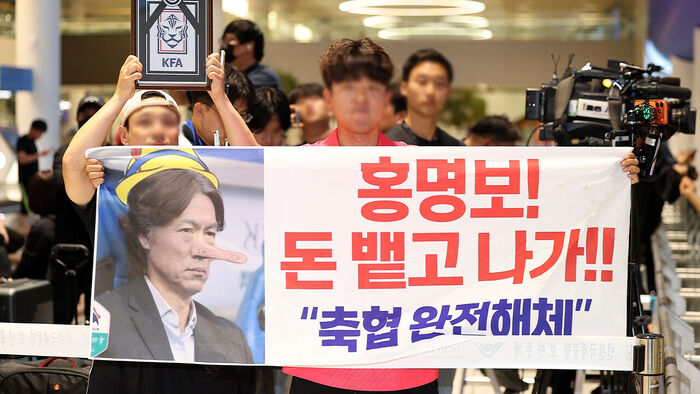
▲ Fans protest as former national football team head coach Hong Myung-bo arrives at Incheon International Airport Terminal 2 on June 30, following his resignation after the team failed to advance to the Round of 32 at the 2026 North and Central America World Cup.
"To save South Korean football, we must start by changing the election system."
Following the South Korean national football team's worst-ever performance and group stage elimination at the 2026 North and Central America World Cup, there is a growing consensus that fundamental reform of the Korea Football Association (KFA) presidential election system is essential for true innovation.
Critics point out that under the "Chung Mong-gyu regime," which has lasted for over a decade, the KFA has lost its momentum for change and innovation, and that it is difficult to expect new leadership under the current electoral structure.
The South Korean national team, led by head coach Hong Myung-bo, finished third in Group A of the North and Central America World Cup with one win and two losses.
The team ranked 10th among the 12 third-place teams, failing to secure a spot in the Round of 32, which is awarded to the top eight third-place teams, and ended its tournament run.
Although expectations were high following a comeback victory in the opening match against the Czech Republic, the team's performance declined in subsequent matches, resulting in 0-1 losses to both Mexico and South Africa.
In particular, the final match drew harsh criticism from fans, who were disappointed by both the players' lack of fighting spirit and the team's tactical execution.
Compounded by the controversy surrounding the appointment of Hong Myung-bo and the resignation of President Chung Mong-gyu just before the tournament began, South Korean football has faced its lowest point in both performance and administration.
Experts agree that moving beyond simply replacing the head coach, changing the KFA's governance structure itself is the starting point for reform.
Shin Moon-sun, a visiting professor at Myongji University, argued, "The most urgent task is to break the cartel structure formed while the Hyundai family has led the KFA for such a long time. We must reform the election system to reduce the influence of tainted football figures."
He cited the 55th KFA presidential election held last year as a prime example.
In that election, 183 out of 192 electors cast their votes, and President Chung Mong-gyu was elected with overwhelming support, receiving 156 out of 182 valid votes.
"Even if President Chung steps down, there is a high possibility that another figure supported by the existing establishment will become president under the current structure," Professor Shin emphasized. "We must significantly expand the size of the electoral college to create a structure where specific connections or vested interests cannot dominate the election."
Football commentator Park Moon-sung added, "With an electoral college of only around 190 people as it is now, the pool of presidential candidates is inevitably limited. We need to broaden the base of the electoral college to create an environment where diverse talent can challenge for the position."
President Chung Mong-gyu, who has led South Korean football for 13 years since taking office as the 52nd KFA president in 2013, has announced his intention to submit his resignation after the North and Central America World Cup, which concludes on July 19 (local time). According to the KFA statutes, an election for the next president must be held within approximately 60 days of his resignation.
However, if the current system remains in place, the next president will be decided by the same electoral college of about 190 people.
There is significant concern within and outside the football community that under this structure, the influence of existing vested interests will remain dominant, potentially causing fundamental reform to fail once again.
However, expanding the electoral college also presents its own challenges.
Beyond the social consensus on how much to increase the number of electors, the method of voting is also a practical concern.
If the electoral college is significantly expanded, it will not be easy to maintain the current method of gathering in one place for in-person voting.
However, FIFA and the Asian Football Confederation (AFC) prioritize the principles of "secret ballot" and "direct election" in association presidential elections, and they do not recognize online voting due to concerns that these principles could be compromised.
Most importantly, changing the presidential election system, which is considered the starting point of reform, is not as easy as it seems.
As the KFA is a member organization under the Korean Sport & Olympic Committee, its election system must also follow the committee's articles of association.
Ultimately, experts point out that for South Korean football to expand its electoral college, it must simultaneously solve the task of devising a new election management plan that satisfies both fairness and practicality.
There is a growing consensus in the football community that the failure at this World Cup should serve as a catalyst for structural reform that goes beyond merely changing the national team coach or the technical committee, and includes the KFA's operating system and election rules, in order for South Korean football to regain its competitiveness.
A football industry official stated, "Creating a new election system that satisfies fairness, representativeness, and practicality is the most important thing. However, due to the realistic issues of having to change existing systems and regulations, there are bound to be questions about its effectiveness."
(Photo: Yonhap News)
※ Please note: This article was translated by AI and may contain errors.
Copyright Ⓒ SBS. All rights reserved. Unauthorized reproduction, redistribution, and use for AI training are prohibited.