SBS News
From the Pitch to Entertainment: Where Have Star Footballers Gone?
Published : Jun 30, 2026 9:33 AM

▲ The logo of the Korea Football Association at the Korea Football Park in Cheonan, South Chungcheong Province, on June 29.
Head coach Hong Myung-bo has fallen once again after suffering a devastating failure: elimination in the group stage of the 2026 North and Central America World Cup.
The shock felt by fans is even greater than during the 2014 Brazil tournament, Hong's first World Cup as head coach, because the team was packed with elite players such as Son Heung-min (LAFC), Lee Kang-in (Paris Saint-Germain), and Kim Min-jae (Bayern Munich). Furthermore, the conditions, including travel distances and the strength of opponents, were considered so favorable that some even described them as a stroke of luck.
When Hong was appointed as the national team head coach two years ago, there was controversy over the fairness of the selection process.
There were strong voices calling for the appointment of a foreign coach who had been proven on a bigger stage.
When explaining their decision, Korea Football Association officials cited practical reasons, such as salary constraints, that made hiring a foreign coach difficult, and argued that among domestic coaches, Hong was the best choice in terms of experience and achievements.
At the very least, it is hard to deny that Hong was a strong candidate among domestic coaches, having led Ulsan HD to its first K League title in 17 years and securing a second consecutive championship.
With Hong having failed so miserably as head coach, it is not easy to find another domestic candidate to take the helm of the national team.
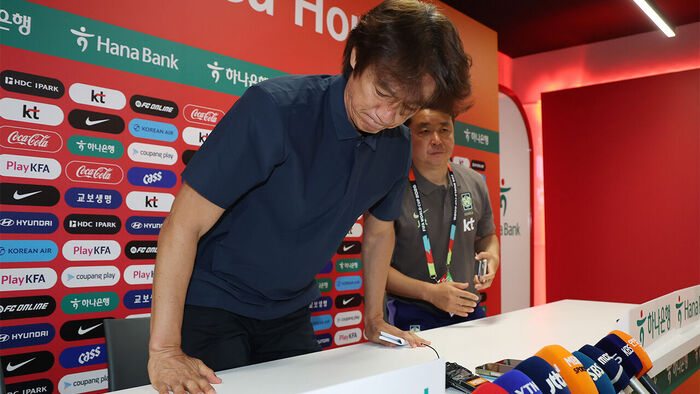
While names like FC Seoul manager Kim Gi-dong and Suwon Samsung manager Lee Jung-hyo are being mentioned, there are assessments that they still need to be further tested in terms of performance and their ability to manage star players.
The problem is the next generation.
It is difficult to find star football figures born in the late 1970s or later who have consistently remained on the field and steadily built their careers as coaches.
It is a common trend for star players to follow a steady path into coaching after retirement.
However, this formula has long been broken in the South Korean football scene.
Instead of working as field coaches, who face stress and job insecurity, the majority turn to TV entertainment programs or new media platforms like YouTube, where they can maintain public popularity with less risk.
Those who have stopped dedicating themselves to football on the training ground often seek public attention by offering harsh criticism whenever the true face of South Korean football is revealed.
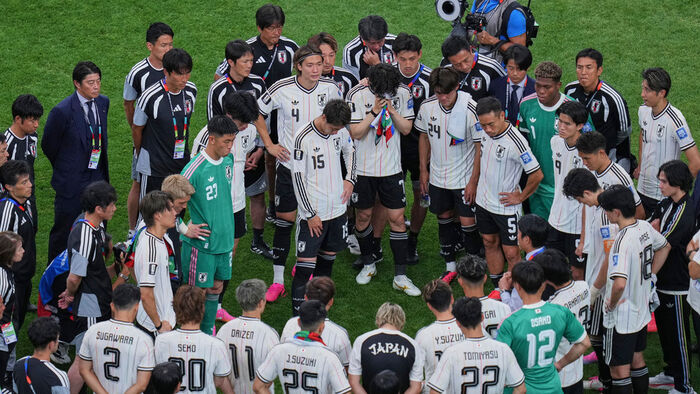
Japanese football, which now shows such a large gap in performance compared to South Korea that the term rival feels meaningless, is the exact opposite.
Older stars do not hesitate to dedicate themselves to football.
Makoto Hasebe, who wore the captain's armband in the 2010 South Africa, 2014 Brazil, and 2018 Russia tournaments, announced his retirement from active duty in May 2024 and began building his coaching career as a coach for the Eintracht Frankfurt U-21 team.
He subsequently answered the call of Japan national team head coach Hajime Moriyasu and is contributing to the team in a part-time capacity, working with the national team only during international match periods.
Shunsuke Nakamura, a first-generation pioneer of Japanese players in Europe, is also assisting head coach Moriyasu as a coach.
Well-known to domestic fans for his fantastic free-kick ability while playing for Reggina (Italy), Celtic (Scotland), and Espanyol (Spain), he joined the national team this year.
In the context of South Korea, this would be equivalent to Park Ji-sung and Lee Young-pyo both joining the national team as coaches.
There are also stars who help their juniors in positions even lower than that of a coach.
Maya Yoshida, who played for Southampton in the English Premier League and retired from the national team last month, joined the team as a training partner to support his juniors.
Attacking midfielder Takumi Minamino (Monaco), who was sidelined by injury just before the World Cup, also helped his teammates as a mentor.
If there are more football figures who voice opinions that ride the wave of public outrage from the perspective of a third party, rather than those who face reality on the field, propose alternatives, and share responsibility, the development of South Korean football will inevitably slow down.
(Photo: Yonhap News)
※ Please note: This article was translated by AI and may contain errors.
Copyright Ⓒ SBS. All rights reserved. Unauthorized reproduction, redistribution, and use for AI training are prohibited.