 Video
Video
[Anchor]
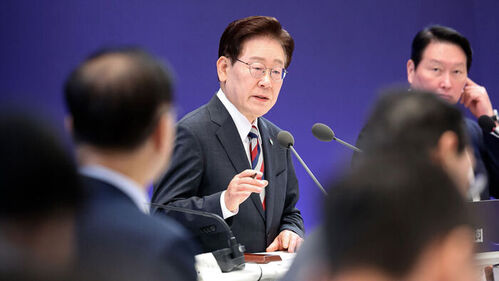
President Lee Jae-myung and the Blue House have directly refuted claims from the conservative opposition party regarding "preferential treatment for the Honam region" and "coercion of businesses." President Lee emphasized that the long-term lack of development in the Honam region has, in some respects, become an opportunity, and stressed that the government is not forcing losses or risks upon companies. The Blue House also questioned the opposition, asking why the previous Yoon Suk-yeol administration did not pursue such investments if they could be achieved simply by government mandate.
Reporter Kang Cheong-wan has the story.
[Reporter Kang Cheong-wan]
President Lee Jae-myung emphasized the necessity of regional development, stating that while the success of global artificial intelligence competition depends solely on speed, the capacity of the capital region, where semiconductor complexes are currently being built, has reached its limit.
[President Lee Jae-myung: As inefficiencies due to concentration intensify, the capital region is on the verge of exploding, while local regions are facing the crisis of extinction.]
In particular, he noted that the long-term exclusion of Honam from development has, in some ways, become a factor of opportunity.
[President Lee Jae-myung: The southwest coastal area is rich in water resources and, in particular, renewable energy.]
President Lee refuted the conservative opposition's claim that the government is "twisting the arms of businesses," stating that this is the reason companies chose Honam.
[President Lee Jae-myung: It is not about forcing national needs upon companies at the cost of their losses and risks, as some fear, but rather enabling them to invest with a better outlook.]
Kang Hoon-sik, Chief of Staff to the President, explained that the conservative opposition's claim that the government is twisting the arms of businesses shows a complete lack of understanding of corporate circumstances. He added that the Republic of Korea is in a situation where it must act with desperation, as failing to secure such investments could diminish the nation's future growth engines.
He further remarked, "Honam land is the cheapest," adding, "If it were possible to make companies invest just because the government told them to, I wonder why the Yoon Suk-yeol administration didn't work hard to do so."
(Reported by: Jung Sang-bo, Yoon Hyung | Video Editing: Jeon Min-gyu | Design: Kang Yoon-jung)
---
[Anchor]
Despite these explanations from the government, the People Power Party has sharpened its criticism, calling it a "dumping of projects into Honam" and a forced decision driven by state-controlled economic intervention, while demanding a parliamentary investigation. In response, the Democratic Party countered by calling for an end to malicious smear campaigns and outdated regionalism.
Reporter Kim Bo-mi reports.
[Reporter Kim Bo-mi]
Regarding the government's announcement of the "Three Mega Projects," the People Power Party dismissed it, claiming that the core is ultimately the "Honam Semiconductor Cluster" and that the other projects were merely window dressing to dilute the focus on Honam.
They argued that although the government gathered heads of major conglomerates to make it appear as if the investments were voluntary, it was actually "twisting the arms of businesses," and declared it a declaration of war by a state-controlled economy where power seeks to take over the market.
[Jung Kwang-sik/People Power Party Floor Leader: The very fact that two competing major conglomerates are announcing large-scale investment plans at the same location simultaneously is a forced decision resulting from government intervention rather than the autonomous judgment of the companies.]
In particular, they raised concerns about the lack of infrastructure such as electricity and water in the Honam region and launched an offensive, demanding that the site selection process be fully disclosed through a parliamentary investigation.
Governors and lawmakers from the People Power Party in the Chungcheong and Daegu-Gyeongbuk regions also held a series of "protest press conferences."
[Choo Kyung-ho/Governor-elect of Daegu: This is closer to 'national fracture' than balanced development. It will be difficult to avoid criticism that this announcement was a political decision to divide the Yeongnam and Honam regions once again.]
In response to the People Power Party's intense offensive, the Democratic Party launched a counterattack, stating, "This is a result of ignorance that fails to understand the survival strategies of global companies, and a malicious attempt to block national growth."
[Han Byung-do/Acting Party Leader and Floor Leader of the Democratic Party: They are bringing up outdated regionalism to stir up trouble. The Democratic Party will respond legally without leniency to these malicious smear campaigns.]
They urged the opposition to "stop the old-fashioned politics of turning national industrial strategies into regional sentiment," claiming that during the Yoon Suk-yeol administration in 2023, the Jeonnam-Gwangju region was excluded from the "National High-Tech Strategic Industry Specialized Complex" open call despite receiving the highest scores.
(Reported by: Lee Seung-hwan, Shin Dong-hwan | Video Editing: Oh Young-taek)
---
[Anchor]
Now, let's look into this in more detail with reporter Kang Min-woo, who covers the Blue House.
Q. What is the background behind today's announcement?
[Reporter Kang Min-woo: First, it is being interpreted as a bold move by President Lee Jae-myung as he enters his second year in office. A Blue House official mentioned that this project is not just about revitalizing the AI industry. The explanation is that if large-scale investments can drive balanced regional development, it could lay the foundation to resolve issues related to real estate, education, and population all at once. It is also read as a strategic move to build a legacy by focusing on constructing new national infrastructure, similar to the Gyeongbu Expressway that led industrialization under past administrations or the high-speed communication networks during the IT revolution at the turn of the century. Within the ruling party, there is also an expectation that this will be an opportunity to reverse the presidential approval rating, which had fallen to the 40% range after the local elections. As for the timing of this announcement, it is interpreted that the period after the June 3 local elections was chosen to avoid controversy and potential election issues that could have arisen if regional differences in investment amounts were highlighted.]
Q. When is the semiconductor complex expected to be completed?
[Reporter Kang Min-woo: As you mentioned, looking at the case of the Yongin Semiconductor Cluster, it took over nine years to build. A Blue House official told me that just as the investment amount is unprecedentedly large, the implementation will be unprecedentedly fast. Chief of Staff Kang Hoon-sik stated regarding the Honam semiconductor base that foundation work will be completed within two years before factory construction begins, aiming for completion within the current administration's term. This means they intend to complete the second semiconductor base within four years, which shows that the government is pouring all its efforts into it.]
Q. What are the remaining tasks?
[Reporter Kang Min-woo: First, overcoming the claims of neglect in other regions, raised mainly by the conservative opposition, is the first political task to be addressed. President Lee is expected to focus on dispelling these concerns by visiting the Chungcheong and Yeongnam regions, as well as Honam, this week to announce regional investment plans. Since astronomical investment amounts have been announced, the potential for disappointment if they are not realized or the backlash from other regions are also sensitive issues. Even today, there was some confusion regarding investment amounts by region; the Blue House provided additional clarification that the 81 trillion won initially reported for the Chungcheong region was limited to the semiconductor sector, and the total amount is 390 trillion won.]
(Reported by: Jung Sang-bo, Yoon Hyung | Video Editing: Lee Seung-hee | Design: Kang Yoon-jung)
 Video
Video