SBS News
Decreased Lovebugs: Did Pest Control Win? The Answer Will Come in Late July
Published : Jun 27, 2026 5:24 PM
Park Sun-jae, a researcher at the National Institute of Biological Resources, compares the same tree with last week's records.
"Compared to last week, it has clearly decreased."
The words of residents hiking up and down the mountain were no different. Lee Geon-sik, who visits here once a week, shook his head.
"They have decreased a lot. There are none. If you walk around, you might see one or two? You don't see them. I guess it's because of the pest control."
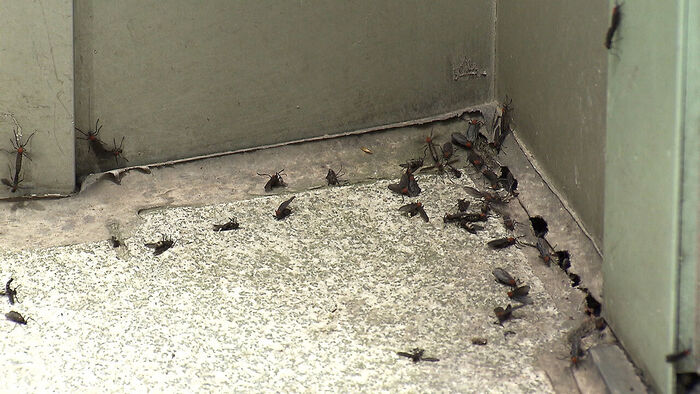
Remembering last year, he added, "Compared to last year, they have decreased significantly. In any case, there are none. Not even a single one." The swarms of lovebugs that covered the hiking trail in black just a few days ago were rarely seen this year.
It was not just Baengnyeonsan Mountain. Yongwangsan and Suraksan mountains, where complaints were concentrated this year, were also visited in turn. Both are urban neighborhood parks, but the result was the same. In all three locations, lovebugs had noticeably decreased compared to last week.
Public interest is higher than ever. On the 'Lovebug Map' website, where people directly upload sighting locations, thousands of reports are piling up daily. However, the actual scenery in the mountains was different from the reporting situation.
This year, a massive outbreak of lovebugs was predicted for this week. The National Institute of Forest Science projected the peak of activity to be June 24. However, the mountains close to the city center were quiet. What happened?
End for Urban Areas, Just Beginning for Mountains
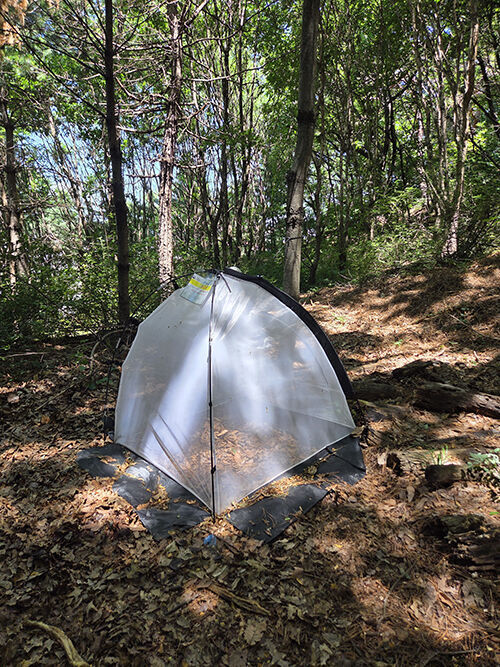
Researchers at the National Institute of Biological Resources have installed lovebug traps in 180 mountainous areas where they majorly occur, and observe daily the emergence rate of larvae in the soil turning into adults. "We are monitoring the occurrence of adults in five locations a day across the Seoul area, including Gyeyangsan Mountain in Incheon."
Daily records show conflicting timetables between urban areas and forests. "In areas where the outbreak began in early June, the numbers increased significantly last week, but we were able to confirm that the population has decreased a lot this week."
On the other hand, forest areas have only started to see a full-scale increase in population this week.
"Urban areas tend to see population increases about a week earlier than forest areas," explained researcher Park. "Some urban areas have passed their peak and are now entering a stabilization phase. In forest areas, the population tends to increase from mid-to-late June through the end of the month."
Urban areas first, mountains later. Because temperatures are higher in urban areas than in forests, emergence is faster, while the relatively cooler forests are delayed accordingly. Therefore, areas close to the city center, such as Baengnyeonsan, Yongwangsan, and Suraksan mountains, have passed their peak and entered a stable phase, but the peak in deeper forests is pushed back to next week.
This is why the "lull" in urban areas should not be interpreted as the end of the massive outbreak. On top of that, this year has been hit by heat. As temperatures rise, lovebugs become adults earlier. The early heatwave has brought forward the timing of the outbreak compared to previous years.
A Name Entered into the Statute Books
Until last year, lovebugs were ambiguous insects. They are beneficial insects that do not bite humans or transmit diseases. Pesticides could not be sprayed recklessly, nor could authorities just stand by. Because there was no proper legal basis for pest control at the national level, responses varied by local government.
The situation changed this year with the amendment of the Wildlife Protection and Management Act. Insects like lovebugs and stick insects, whose appearances have become more frequent due to climate change, were newly defined as "outbreak insects," and the Ministry of Climate, Energy and Environment and local governments were mandated to investigate their occurrence and establish pest control and management plans. It means this nuisance insect has had its name entered into the statute books as an official target of national management for the first time.
Based on this legal ground, pest control at the larval stage began in earnest this spring. In April and May, the National Institute of Biological Resources divided the area around the summit of Gyeyangsan Mountain in Incheon into nine zones of 900 square meters each and sprayed BTI sequentially. This is the first empirical experiment to directly target lovebug larvae outdoors. BTI is a microbial insecticidal component that has been used for nearly 50 years to control mosquito larvae; it destroys the digestive tracts of Diptera larvae but has almost no effect on other organisms.
"In laboratory settings, it showed a mortality rate in the 90% range after three weeks. This is to verify how effective it is under natural conditions."
The verification is conducted by dividing treated and untreated areas. "How many larvae emerge in the treated areas versus the untreated areas. Looking at both larvae and adults together is what that means."
This involves comparing the number of larvae in the soil side-by-side with the rate at which those larvae emerge as adults. This is also why emergence traps were installed. However, researcher Park did not rush the results. "We expect the results to come out around late July by comprehensively comparing the two."
Once adults emerge, physical control methods such as light traps and water-spraying drones are added. Larvae are targeted with BTI, and adults are captured. In other words, the process is divided into stages.
According to statistics from the Ministry of Climate, lovebug-related complaints in the metropolitan area increased from 4,448 in 2022 to 13,127 in 2024. Last year, the number was 11,429, a slight decrease from the previous year. Whether this year's pest control has changed this trend has not yet been proven by numbers.

What About Florida, Which Experienced It First?
The American lovebug, Plecia nearctica, grew exponentially around the Gulf of Mexico in the 1960s and 1970s. Their splattered body fluids turned highly acidic within a day, damaging car paint, but they were not eradicated because they are beneficial insects. The United States has lived with this insect for decades, classifying it as a "nuisance pest."
However, in Florida, lovebugs have actually been decreasing in recent years. The academic community views this as a phenomenon linked to the overall decline in insect populations, but the exact cause has not yet been identified.
The lovebugs in Korea are a different species: Plecia longiforceps. This invasive species, which used to live in southern China, Taiwan, and Okinawa, was first discovered in Bupyeong-gu, Incheon, in 2015, and saw a massive outbreak in Seoul in 2022. This is the northernmost occurrence record of this species known to academia. Genetic analysis shows the path of this insect migrating northward from China across the West Sea. The driving force is pointed to as the warming climate.
The outlook is bleak. A study published in 2022 predicted that under all six climate change scenarios, the entirety of South Korea and East China would become suitable habitats for lovebugs by 2070.
The difference lies in the response. While the United States watched for a natural decline after the species became naturalized, Korea chose "management" through larval control and legislation in the early stages of settlement. Same insect, different choices.
Not Eradication?
The answer will be revealed in late July, when the numbers from the treated and untreated areas are released. Until then, the swarms that have subsided in urban areas will climb the mountains, and the peak in the forests has not yet arrived. Relief over the decrease is, therefore, premature.
One thing is clear: the force pushing this insect up to the Korean Peninsula is not a single year of pest control, but decades of climate change. While the United States watches a natural decline after 60 years, Korea is just beginning to wait for the results of its first pest control efforts.
※ Please note: This article was translated by AI and may contain errors.
Copyright Ⓒ SBS. All rights reserved. Unauthorized reproduction, redistribution, and use for AI training are prohibited.