SBS 뉴스
Only One in Six Industrial Complexes Meets 'Biotope Area Ratio' Requirement for Rainwater Absorption
입력 : 2026.06.22 16:16수정 : 2026.06.22 16:16
Audit Board's Inspection Results on the Implementation of Biotope Area Ratio in Industrial Complexes

One of the main reasons urban spaces are vulnerable to the climate crisis is that the ground surface is covered with concrete and asphalt, blocking the water cycle. This refers to a high proportion of so-called impermeable surfaces. According to the Seoul Institute, the ratio of impermeable surfaces in Seoul was 7.8% in 1960, but it surged to 50.1% in 2020. This means that half of Seoul's total area is made of hard, artificial surfaces, preventing rainwater from seeping into the ground.
With the growing threat of climate disasters such as typhoons and localized heavy downpours, the ground's inability to absorb rainwater inevitably exacerbates flood damage to an extreme degree. It was this awareness that led to the introduction of the 'Biotope Area Ratio' (BAR) system under the Natural Environment Conservation Act. When implementing various urban development projects, such as industrial complexes or tourist complexes, a certain portion of the total project site must be maintained as soil area with ecological or natural circulation functions. This refers to natural soil composed of dirt and sand that allows rainwater to be absorbed. (If maintaining natural soil is difficult, alternatives such as permeable blocks that allow drainage are also available.) For example, the required ratios are 30% to 40% for urban development projects, 20% for industrial complexes, 60% for tourist complexes, 50% to 80% for sports facilities, and 40% to 50% for waste facilities.
The Reality of the Biotope Area Ratio System in Industrial Complexes on the Ground
What is the reality? In November 2024, I obtained internal documents from the Ministry of Environment (the predecessor of the current Ministry of Climate, Energy and Environment), which revealed the implementation status of the Biotope Area Ratio system.
("Promised '22% Ecological Space'... But Drones Show 'Nothing but Asphalt'" (Jang Se-man) [Nov. 30, 2024, 8 News])
One of the locations pointed out in the documents at the time was the Gimhae Techno Valley General Industrial Complex in Gimhae, South Gyeongsang Province. When I actually visited the site, the entire complex was covered in concrete and asphalt, and it was difficult to find any soil-state ground surface where rainwater could seep in.
Board of Audit and Inspection Results: Only One Out of Six Met the Requirement
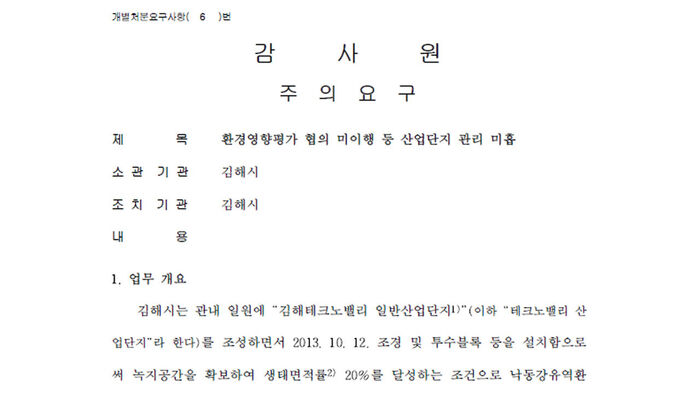
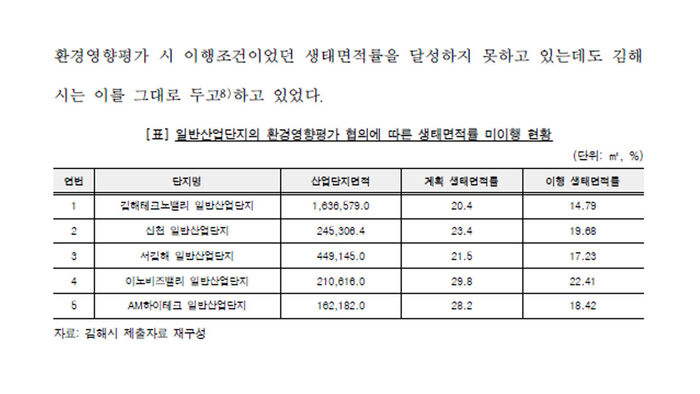
Following the report, the Board of Audit and Inspection (BAI) conducted a regular audit of Gimhae City, including this issue in its scope, and the results were released last month (May 2026). The BAI stated, "In the process of developing the Techno Valley Industrial Complex, Gimhae City was required to achieve a Biotope Area Ratio of 20% to prevent damage to the natural environment, in accordance with its agreement with the Nakdong River Basin Environmental Office, thereby implementing the agreements of the environmental impact assessment." However, it pointed out, "Gimhae City failed to properly manage the implementation of the 20% Biotope Area Ratio agreement. During the building permit process following the sale of plots to individual tenant companies after the complex's completion, the city granted building permits without imposing conditions or opinions regarding the installation of green spaces, thereby failing to obligate individual companies to secure green spaces." According to the BAI's findings, the actual Biotope Area Ratio of Gimhae Techno Valley was only 14.79%. During this process, the BAI investigated the Biotope Area Ratio of not only Techno Valley but also six other industrial complexes within Gimhae City's jurisdiction, revealing that only one of the six had met its originally planned Biotope Area Ratio.
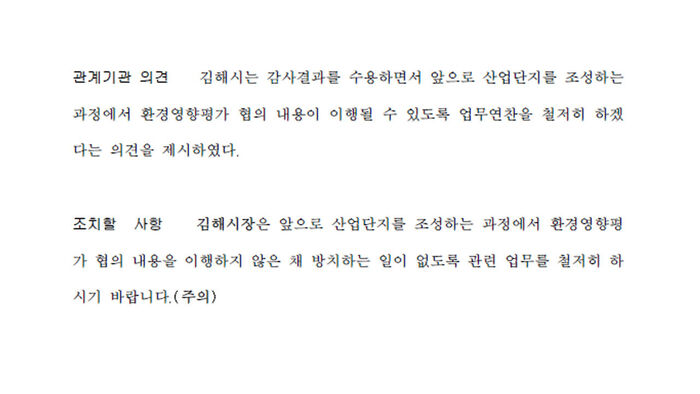
 Why did Gimhae City stand by despite this non-compliance? The BAI pointed out, "Because industrial complex development projects take a long time from approval to completion, personnel changes during the process led to a failure in properly handing over duties regarding the Biotope Area Ratio, which is part of the environmental impact assessment agreement." Furthermore, regarding why building permits were issued without conditions or opinions on green space installation, the BAI revealed that during consultations among relevant departments within Gimhae City, the building permit department requested opinions from the department in charge of the environmental impact assessment, but the responsible department failed to provide any. In conclusion, the BAI requested a cautionary warning, stating, "Gimhae City accepted the audit results and expressed its intention to thoroughly review and study its duties to ensure that environmental impact assessment agreements are implemented during the development of industrial complexes." The BAI demanded: "The Mayor of Gimhae should thoroughly manage related duties in the future to prevent environmental impact assessment agreements from being left unfulfilled during the development of industrial complexes."
Audit Conclusion Limited to a 'Cautionary Warning'... Is This Acceptable?
Is the BAI's audit conclusion, which ended with a mere cautionary warning to Gimhae City, appropriate? Not quite. This is because the issue is not confined to Gimhae City alone. According to the Ministry of Environment documents I obtained back in 2024, this problem is analyzed to be widespread nationwide. First of all, a major flaw is that although the Biotope Area Ratio system was established under the Natural Environment Conservation Act, there are no penal provisions for violating it. Even if the required ecological area is not met, alternatives like permeable blocks (paving blocks that absorb water through microscopic pores and discharge it into the soil below) exist, but these also incur costs. The system has been implemented with a lack of research on what incentives could encourage developers to participate, which appears to be a fundamental issue. Therefore, a proper audit should have identified the structural reasons why the Biotope Area Ratio system is failing to function effectively and included institutional improvements, which is a point of regret. As the climate crisis accelerates, the need to promote the urban water cycle to reduce urban flood damage grows. It is time to discuss fundamental improvements based on an inspection of how the Biotope Area Ratio system is being operated not only in Gimhae City but also in other regions, including Seoul.
※ Please note: This article was translated by AI and may contain errors.
Copyright Ⓒ SBS. All rights reserved. 무단 전재, 재배포 및 AI학습 이용 금지