SBS 뉴스
107 Power Bank Fires in Seoul Over 3 Years, Leaving Couple Dead and Newborn Seriously Injured
입력 : 2026.06.19 21:21수정 : 2026.06.19 21:21

▲ A notice regarding the restriction of portable power banks posted inside a subway station
Over 100 fires involving portable power banks have occurred in Seoul over the past three years, showing a sharp increase with more than half of them taking place last year alone.
According to the Seoul Metropolitan Fire and Disaster Headquarters, a total of 107 power bank fires occurred in Seoul over the three-year period from 2023 to last year.
On November 1 last year, a fire started from a power bank charging at the bedside of an apartment in Gwanak-gu, killing a couple in their 30s and leaving a newborn baby seriously injured.
Including this incident, there were seven casualties over the three years, with two deaths and five injuries, along with approximately 277 million won in property damage.
The annual number of fires has steadily increased, rising from 15 cases in 2023 to 37 in 2024, and 55 in 2025.
In terms of proportion, last year alone accounted for 51.4% of the total.
The headquarters added that the number of safety hazard cases involving power banks reported to the Consumer Injury Surveillance System of the Korea Consumer Agency also surged more than sixfold in three years, from 22 cases in 2021 to 136 in 2024.
Power banks are often charged or stored in places with many combustible materials, such as beds and sofas, making it easy for fires to spread rapidly.
During the summer, exposure to high temperatures can cause the internal temperature of a power bank to rise, leading to "thermal runaway" and making it difficult to extinguish, which requires caution.
Furthermore, if a power bank fire occurs in confined spaces such as airplanes or subways, smoke can spread quickly and evacuation routes can be restricted.
In such environments, power banks are mostly stored in bags or pouches, but the headquarters explained that there are currently no performance standards, such as flame resistance, established for these pouches.
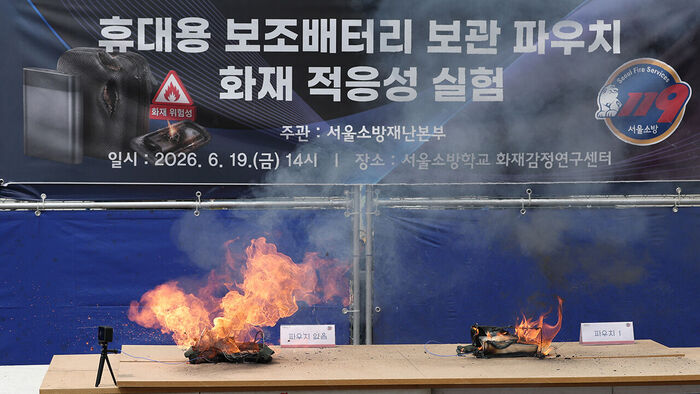
▲ On June 19, a fire adaptability test on various commercially available power bank storage pouches is being conducted at the Seoul Fire Academy in Eunpyeong-gu, Seoul.
In response, the headquarters, along with eight related organizations including the Korea Airports Corporation, Seoul Metro, and Korail, conducted an experiment on June 19 using four types of commercially available pouches to examine how they affect the spread of smoke and flames during a battery fire.
Based on the results, the headquarters plans to suggest to relevant authorities the necessity of establishing performance standards for pouches and improving related regulations.
The headquarters will also strengthen education to prevent power bank fires.
For citizens, fire patterns related to the use of battery storage pouches will be incorporated into educational materials, and the dangers of power bank fires will be promoted in connection with citizen safety experience centers and fire station safety training.
Station staff, including those from Seoul Metro and Airport Railroad, will be trained on the characteristics of power bank fires and initial response procedures.
Practical training using equipment such as fire-resistant gloves, pouches, and water tanks will also be conducted.
Anticipating an increase in power bank usage during the summer vacation season, the headquarters plans to provide safety guidelines for charging, storing, and carrying them on its official website (fire.seoul.go.kr) and social media channels.
"Power banks have become essential in citizens' daily lives, but they require extreme caution as smoke and flames can spread in a short time if a fire occurs," said Hong Young-geun, head of the Seoul Metropolitan Fire and Disaster Headquarters. "We will recommend that relevant authorities establish standards so that pouches meeting certain performance criteria can be distributed in the market, and we will also strengthen safety guidelines that citizens can easily relate to."
(Photos: Courtesy of Seoul Metro, Yonhap News)
※ Please note: This article was translated by AI and may contain errors.
Copyright Ⓒ SBS. All rights reserved. 무단 전재, 재배포 및 AI학습 이용 금지
SBS 뉴스