SBS 뉴스
Draft Agreement Comprises 14 Points: Nuclear, Sanctions Relief Talks to Follow Reopening of Strait of Hormuz
입력 : 2026.06.15 10:19수정 : 2026.06.15 10:19

▲ Tehran
Iran has released an explanation of the draft agreement, which is reportedly scheduled to be signed with the United States in the form of a memorandum of understanding (MOU) on June 19.
However, as this explanation was released several hours before the announcement of the signing plan, it is based on a pre-finalized draft and may differ from the actual finalized agreement.
Furthermore, because it entirely reflects Iran's interpretation, it has the potential to conflict with the U.S. interpretation in the future.
Iran's semi-official Mehr News Agency's English edition released an explanation of the draft MOU's contents at 4:44 p.m. on June 14, Tehran time (10:14 p.m. KST), as conveyed by Mohammadi, the "strategic advisor to the head of the Iranian negotiating team."
Although the article only identifies the source as "Mohammadi," circumstantial evidence suggests the individual is likely Mehdi Mohammadi.
He serves as the strategic advisor to Mohammad Bagher Ghalibaf, the speaker of the Iranian parliament and Iran's chief negotiator.
According to Mehr News Agency, Mohammadi detailed the 14-point draft agreement in an audio file.
He emphasized that the Islamic Republic of Iran currently provides various services, including safety, navigation, and security, in the Strait of Hormuz and collects fees for them, stating, "The right to collect these fees belongs entirely to Iran and Oman, and no other party has the authority to make decisions regarding this."
He added that this system is already in place and will remain unchanged regardless of any future agreements.
According to Mohammadi, the first point of the draft stipulates that the current war must stop on all fronts, including in Iran and Lebanon.
Following that, the opposing side must promise not to initiate any new wars or military operations.
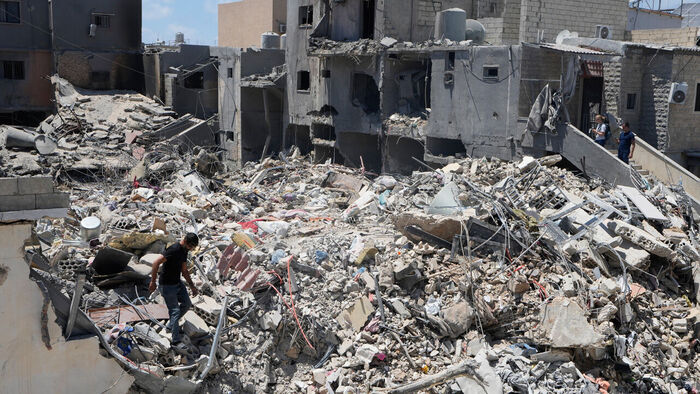
Mohammadi added that the U.S. has agreed to provide these commitments on behalf of itself as well as Israel, and once the agreement is signed, the opposing side will be obligated to immediately end the war.
He claimed that this is an incredibly significant achievement and a sign of the opposing side's failure in the war, arguing that the other side did not enter the conflict with the intention of ending it in the first place.
He emphasized that this is the first time in history that the Islamic Republic of Iran has forced the U.S. to provide guarantees on behalf of Israel.
Mohammadi stressed, "Until now, the Americans have never accepted this kind of agreement. The long-standing joint strategy of the U.S. and Israel was for the U.S. government to sign agreements while Israel remained outside that framework to maintain freedom of action. In this document, we did not tolerate that."
He also emphasized that Iran's commitments would be reciprocal.
He said, "If they (the U.S. side) do not fulfill their obligations, we will not either. The strait will remain blocked, we will not proceed to the next stage of negotiations, and if necessary, we will go to war. They are fully aware of this."
Regarding the U.S. maritime blockade of Iran, Mohammadi said that upon the signing of the agreement, measures to lift maritime restrictions and prevent any interference with Iranian shipping must begin immediately.
He explained that through this process, shipping activities must be restored to pre-blockade levels within 30 days.
He also mentioned the proposed development and reconstruction fund, valued at $300 billion (455 trillion won).
He explained that the term "reconstruction" was used in the document, which refers to repairing damage caused by the war.
He argued, "Although the word 'compensation' is not explicitly mentioned, it is clear that when the other side talks about reconstruction, it means compensation for the damage Iran suffered during the war."
He further stated that this is the first time the U.S. has promised to lift primary sanctions as well as secondary sanctions in a final agreement, saying, "Such a promise has never existed before."
Mohammadi noted that comprehensive sanctions relief will not occur until the second stage of negotiations is reached.
He also emphasized that the other side's demands regarding Iran's nuclear program are currently limited to highly enriched nuclear material, and no discussions are underway regarding other aspects of Iran's nuclear activities.
Although not mentioned in Mohammadi's explanation, the draft agreement previously claimed by Iran included the exclusion of Iran's missiles and proxy forces—issues Israel has long considered critical—from the negotiation agenda.
Mohammadi said, "There is a sentence in the document that allows for discussions on other nuclear issues, but they can only be discussed if both parties agree."
Mohammadi said, "If the other side wants to raise new issues, they must obtain our consent before any discussion. Naturally, the Islamic Republic will not accept every topic. Without mutual consent, there are no negotiations."
He added that even if both sides reach a final agreement, Iran's obligations will be limited to promising not to build nuclear weapons and resolving the issue of its 60% enriched uranium stockpile through a formula proposed by Tehran.
Mohammadi added that the "dilution" of nuclear material is being discussed in this context, saying, "Even if the material is diluted, it will remain in the country, and if necessary, it can be restored to a higher enrichment level in a short period of time."
He explained that there are no immediate nuclear-related measures that Iran must take under this MOU.
He said, "Everything has been postponed to the future. First, we must see if the other side lifts the blockade, releases frozen assets, suspends oil sanctions, and ends the war in Lebanon. If these things happen, only then can we consider the next steps."
Mohammadi also stated that under this agreement, the U.S. must withdraw its troops from the region surrounding Iran within 30 days, saying, "Imagine the significance of the United States writing and signing a commitment to withdraw its troops from near Iran. That achievement is priceless."
Regarding sanctions relief, Mohammadi reiterated that the draft MOU includes a commitment that the U.S. will lift primary sanctions as well as secondary sanctions once a final agreement is reached.
He explained that in contrast to previous agreements, including the 2015 nuclear deal, where many types of sanctions were not addressed in negotiations, this draft MOU includes the lifting of all sanctions as a subject of discussion.
However, Mohammadi pointed out that the implementation of these measures depends on whether a final agreement on the nuclear issue is reached.
Mohammadi's explanation also included some details that were uncertain to be included in the final MOU at the time of his explanation.
He said that a demand to release half of Iran's frozen assets in the early stages of the agreement's implementation is being discussed, and that the Iranian side is working hard to secure such a commitment from the U.S.
This statement shows that at the time the explanation was given, it was not finalized whether this content would be included in the final MOU to be agreed upon and signed by both sides.
The draft agreement also included a plan to support implementation through a UN Security Council resolution once a final agreement, including on the nuclear issue, is signed.
(Photo: AP, Yonhap News)
※ Please note: This article was translated by AI and may contain errors.
Copyright Ⓒ SBS. All rights reserved. 무단 전재, 재배포 및 AI학습 이용 금지
SBS 뉴스